
Holidays and traditions

Where the holidays we celebrate come from, told with sources: Halloween, the Day of the Dead and the traditions that got added along the way.

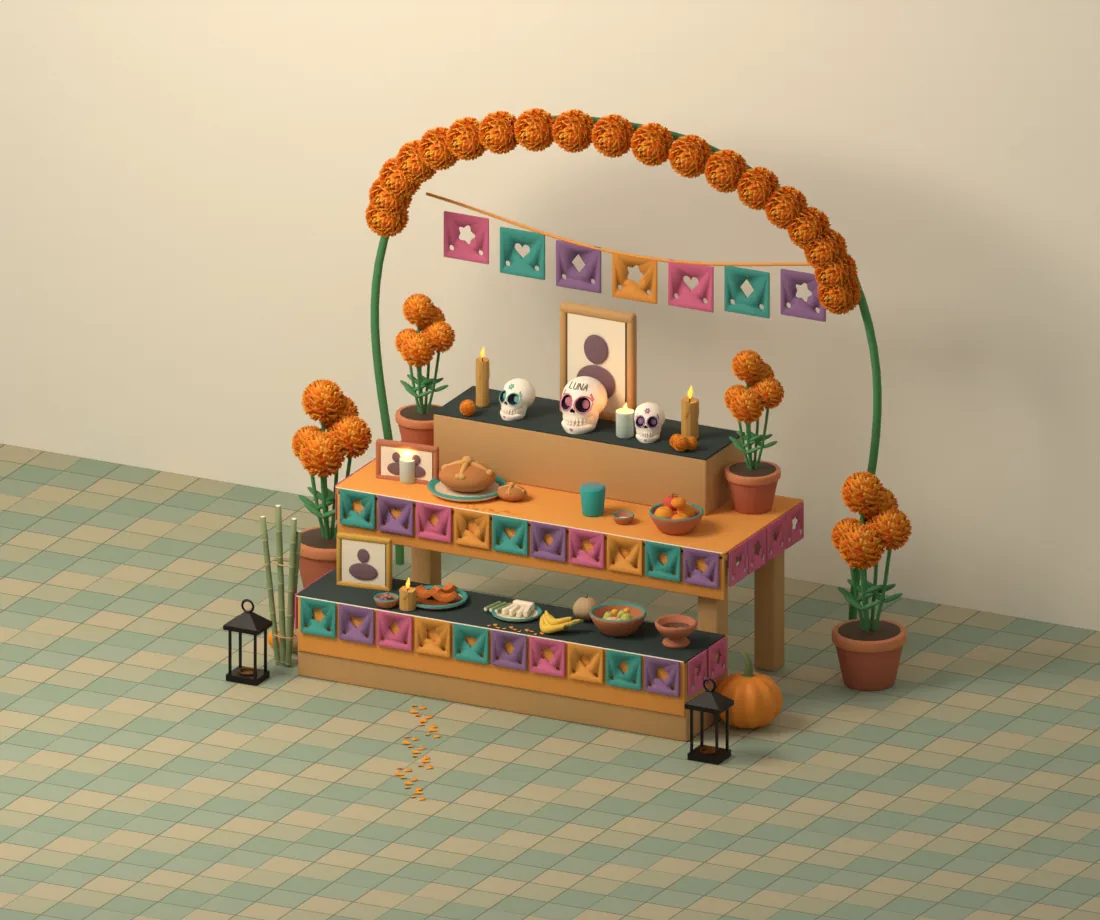
  • A three-tier Day of the Dead offering with a marigold arch, papel picado, portraits, candles, sugar skulls, pan de muerto, fruit, sugarcane and a pumpkin

    Why is the Day of the Dead on November 1 and 2?

    In Mexico, on the night of November 1, candles are lit on home altars and a path of marigold petals is laid so the dead can find their way home. That same night in Poland, cemeteries fill with thousands of candles glowing on the graves. In Guatemala, giant kites of colored tissue paper rise over a cemetery. In Bolivia, families set tables with breads and offerings to welcome their dead. And the evening before, across half the world, kids in costume are ringing doorbells for candy.

    How do so many places, so far apart, remember their dead on nearly the same day?

    Because of a calendar. November 1, All Saints’ Day, was set by the popes in Rome in the eighth century, and November 2, All Souls’ Day, was added by the monks of Cluny, in France, around the year 1000. The Church carried that calendar everywhere it went, and everywhere it mixed with local customs. That’s why these holidays are cousins: they share a grandmother. There are others, in Asia and in ancient Rome, that look a lot alike and fall on other dates, because they were born on their own. Those are lookalikes. This is the story of both families.


    Who put the dead in November?

    Popes and monks, over four centuries. According to the Catholic Encyclopedia of 1907:

    • In 609 or 610, Pope Boniface IV dedicated the Pantheon in Rome to all the martyrs, on May 13.
    • Between 731 and 741, Pope Gregory III consecrated a chapel to all the saints and set their feast on November 1.
    • Between 827 and 844, Pope Gregory IV extended that date to the whole Church.
    • Around the year 1000, Saint Odilo, abbot of the monastery of Cluny, ordered that every year, the day after, all the faithful departed be remembered: November 2. From Cluny the custom spread to other monasteries and then to the whole Church.

    That’s how the pair was set: the 1st for the saints, the 2nd for all the dead. And the night before the 1st, the eve, is the one English called All Hallows’ Even: Halloween.


    How did that calendar reach Mexico?

    With the Spanish conquest, in the sixteenth century. The Mexica (Aztecs) already honored their dead, but at a different time of year: two festivals in their calendar, the “little feast of the dead” and the “great feast of the dead,” fell toward the summer, between August and September, according to the magazine Arqueología Mexicana.
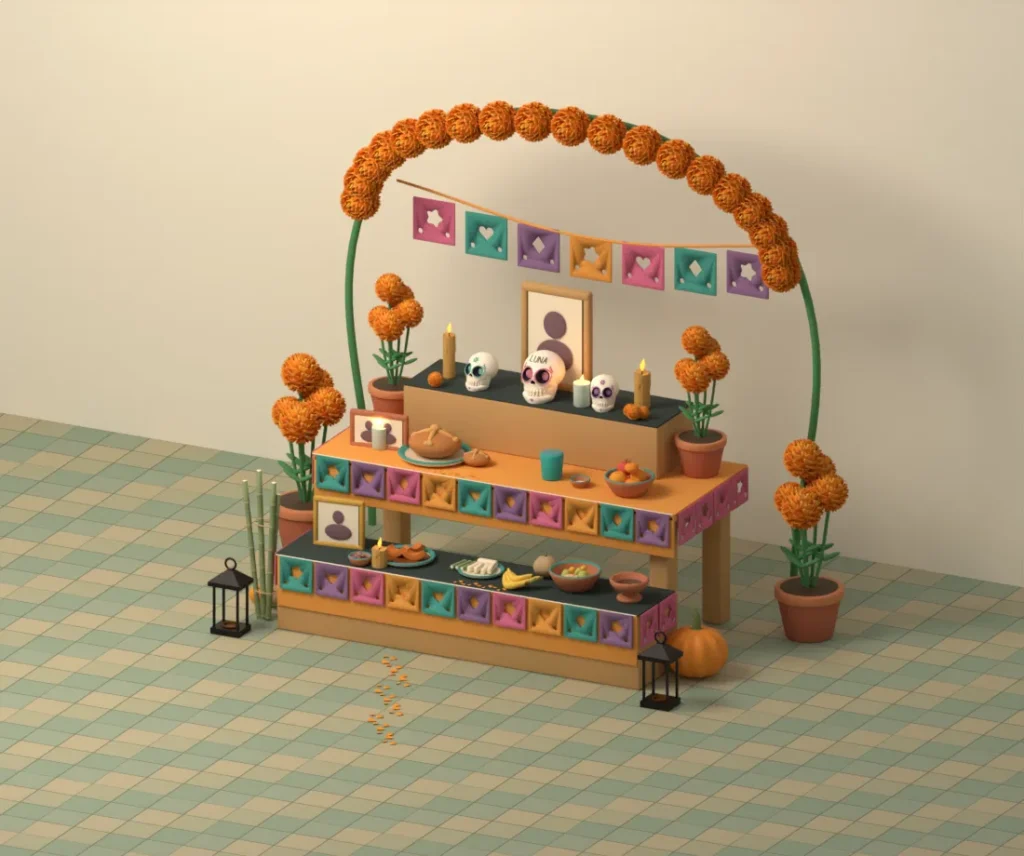
    A three-tier Day of the Dead offering with a marigold arch, papel picado, portraits, candles, sugar skulls, pan de muerto, fruit, sugarcane and a pumpkin

    When the Catholic days of All Saints and All Souls arrived in November, the two traditions met. Out of that meeting, over the colonial period, came the Day of the Dead: a holiday that took shape on the Catholic calendar and, region by region, took in Indigenous practices. By the 1760s a friar in Mexico City saw an entire market of sugar figures made for those days, and people were already calling it the “Day of the Dead.”

    UNESCO recognized it in 2008 as intangible cultural heritage, under a name worth saying in full: the Indigenous festivity dedicated to the dead.

    And from Mexico it kept traveling: since the 1970s it has had a public life in the United States, starting with Chicano artists in Los Angeles and San Francisco. That chapter is in how Halloween came to North America.


    Where else are the dead remembered on those days?

    In almost every place the Catholic calendar reached. Each one dressed it in its own way:

    WhereWhenHow
    MexicoOctober 31 to November 2Ofrendas (home altars), marigolds, candles, visits to the graves
    Guatemala (Sumpango and Santiago Sacatepéquez)November 1Giant kites of tissue paper, months in the making, raised in the cemetery. UNESCO dates the tradition to the late nineteenth and early twentieth centuries
    Bolivia and PeruNovember 1 and 2Andean Todos Santos: tables of offerings to welcome the souls
    La Paz, BoliviaNovember 8The Fiesta de las Ñatitas: skulls cared for by families, carried to the cemetery with flowers and candles. It closes the season of the dead
    PolandNovember 1 and 2Mass visits to cemeteries, with thousands of candles on the graves
    PhilippinesNovember 1 and 2Undas: families visit and keep vigil over their dead in the cemeteries
    BrazilNovember 2Finados: visiting the graves
    Ireland, Scotland, the United States, Canada and half the worldOctober 31Halloween, the eve, with customs of its own

    They’re all cousins: different on the outside, the same date on the inside.


    And the ones on other dates?

    Some peoples remember their dead with great tenderness, in festivals that look remarkably similar, at other times of the year. They never had anything to do with Rome or Cluny.

    FestivalWhereWhenHow
    ObonJapanSummer (July or August)Ancestors are welcomed home, people dance bon-odori and light lanterns
    Ghost FestivalChina and Chinese communities worldwideSeventh month of the lunar calendar (August or September)Offerings for ancestors and for wandering spirits with no family
    ChuseokKoreaEighth lunar month (September or October)A table of offerings for the ancestors
    Pchum BenCambodiaFifteen days in a lunar month of September or OctoberOfferings to monks, to help the dead
    Parentalia and LemuriaAncient RomeFebruary and MayOfferings at the tombs; and, in May, rites to drive spirits out of the house

    These are lookalikes: they resemble each other because nearly everywhere, people want to remember those who have gone, and each people found its own way. Although within this family there are cousins too: Japan’s Obon and China’s Ghost Festival share the same Buddhist root.


    Does every culture honor the dead at the end of the harvest?

    It’s often said. The idea of one great, universal festival of the dead at harvest’s end became very popular in the late nineteenth century, above all through the Scottish anthropologist James Frazer, who was looking for a single agricultural myth behind many customs.

    What people who study it say today: it’s too easy a model. The folklorist Juliette Wood writes that Frazer and his speculations about a universal agrarian myth produced “an emotionally appealing, but far too glib a model” for explaining these customs. And the historian Ronald Hutton traces back to Frazer and John Rhys the idea that Samhain was “the feast of the dead.”

    The dates make the point on their own: Obon is in summer, Parentalia in February, Lemuria in May, and Qingming, in China, in spring. What repeats is the wish to remember the dead. Each calendar sets the moment.


    Cousins and lookalikes, in one table

    FamilyFestivalsWhy they’re alike
    Cousins (Catholic calendar)All Saints and All Souls, Halloween, Day of the Dead, Andean Todos Santos, Ñatitas, Guatemala’s kites, Undas, Finados, Poland’s November 1They share dates because they come from the same calendar, which the Church carried everywhere
    Cousins of each other (Buddhist root)Obon, Ghost FestivalA shared religious root, on another date
    Lookalikes (born on their own)Chuseok, Pchum Ben, Qingming, Parentalia, LemuriaThey look alike because many cultures remember their dead, each on its own

    For home or the classroom

    How does your family remember the people who are gone? Ask your grandparents what their families did on these days, wherever they grew up: what went on the altar or the grave, what was cooked, who was remembered. Write it down or draw it. Every family has its own version of the holiday, and in a classroom in the United States or Canada, the answers usually come from several of the places in these tables.


    Questions

    Is the Day of the Dead the same as Halloween? They’re cousins: both lean on the calendar of All Saints and All Souls, and each took its own road. How they’re alike and how they differ is in Halloween vs. Day of the Dead.

    Why is the Day of the Dead on November 1 and 2? Because those are the Catholic days of All Saints and All Souls, which arrived in Mexico with the Spanish conquest.

    Which other countries celebrate the Day of the Dead? The Day of the Dead, with its ofrenda and marigolds, is Mexican, and today it’s also celebrated in many communities in the United States. On the same dates, Guatemala, Bolivia, Peru, the Philippines, Brazil and Poland remember their dead, each in its own way.


    Sources

    • Francis Mershman, “All Saints’ Day” and “All Souls’ Day,” The Catholic Encyclopedia, vol. 1, 1907. All Saints · All Souls.
    • Stanley Brandes, “El Día de Muertos, el Halloween y la búsqueda de una identidad nacional mexicana,” Alteridades 10, no. 20, 2000, pp. 7–20. Open access on Redalyc (in Spanish).
    • Arqueología Mexicana, “Miccailhuitontli y huey miccaílhuitl” (in Spanish).
    • UNESCO, “Indigenous festivity dedicated to the dead”, inscribed 2008.
    • UNESCO, “Technique of making the giant kites of Santiago Sacatepéquez and Sumpango, Guatemala,” 2024. Multimedia archive.
    • Gerardo Fernández Juárez, “La revuelta de las ‘ñatitas’…,” Revista de Dialectología y Tradiciones Populares 65, no. 1, 2010, pp. 185–214. doi:10.3989/rdtp.2010.006 (open access, in Spanish).
    • Óscar Muñoz Morán, “Todos los Santos: tradición y ayllu andino,” Chungara 49, no. 2, 2017. doi:10.4067/S0717-73562017005000013 (open access, in Spanish).
    • Sławoj Tanaś, “The profane sphere of All Saints’ Day and the social aspects of cemeteries,” Turyzm/Tourism 30, no. 2, 2020, pp. 91–99. doi:10.18778/0867-5856.30.2.25
    • Stephen F. Teiser, The Ghost Festival in Medieval China, Princeton University Press, 1988. doi:10.1515/9780691222172
    • Deborah Wong, Louder and Faster, University of California Press, 2019, ch. “Dancing the Body Politic: Obon and Bon-odori.” doi:10.1525/luminos.71.d (open access).
    • John C. Holt, “Caring for the Dead Ritually in Cambodia,” Southeast Asian Studies 1, no. 1, 2012, pp. 3–75. doi:10.20495/seas.1.1_3 (open access).
    • J. M. C. Toynbee, Death and Burial in the Roman World, Thames & Hudson, 1971.
    • Juliette Wood, “‘The Great Scarecrow in Days Long Ago’: Gothic Myths and Family Festivals,” 2007. PDF.
    • Ronald Hutton, “The Celtic New Year and Feast of the Dead,” Folklore 135, no. 1, 2024, pp. 69–86. doi:10.1080/0015587X.2023.2282282.

    Written by the Idunn Editorial Team, with support from AI tools in the research and drafting.
  • Why are there scarecrows at Halloween?

    Why are there scarecrows at Halloween?

    Every fall, a character shows up on porches, in store windows and on classroom bulletin boards who’s more funny than frightening: plaid shirt, battered hat, straw poking out of the sleeves. The scarecrow has become as much a part of Halloween as the pumpkin or the witch. And yet it spent centuries out in the fields, guarding the crops, far from any holiday. How did it get here?

    It came in with autumn. In the United States, from the early twentieth century, postcards and seasonal decorations gathered up everything that smelled of harvest —pumpkins, corn, straw— and the scarecrow came along in the bundle. Then stories, movies and front porches adopted it, and along the way it crossed paths with another seasonal character: Jack O’Lantern, the one with the glowing pumpkin. Here’s its story, sorted into what’s known and what’s just told.

    To read aloud (ages 4 to 8)

    Once upon a time there was a figure made of old clothes and a torn hat. Its job was to watch the cornfield so the birds wouldn’t eat the seeds. One day, people from town thought it looked so friendly that they took it home to decorate their front door in the fall. And that’s how the keeper of the field became a guest at Halloween.


    What was a scarecrow for?

    Protecting the crops. A cross of sticks, clothes nobody wore anymore, a hat and sometimes a painted face: the idea was that birds would see “someone” in the field and go eat somewhere else.

    In English, the word scarecrow could also mean the person who did that job: the figure and the field hand shared a name.

    Every language gave it a name, and nearly all of them say the same thing: its job is to scare.

    WhereWhat it’s calledWhat it means
    Englishscarecrowscare-crow
    Spanishespantapájarosscare-birds
    Frenchépouvantailthe thing that frightens
    Italianspaventapasseriscare-sparrows
    Scotlandtattie bogle, tattie doolietattie is potato; a bogle is a goblin
    Walesbwgan brain“crow ghost”
    Japankakashiscarecrow; in the fall it has its own festival, the kakashi matsuri

    Today they’re rarely used on farms: automatic noisemakers and netting replaced them. And just as the fields stopped needing them, towns and cities started wanting them.


    How old are scarecrows?

    Very old, though they’re hard to date. A rag figure hung on a pole doesn’t survive: it rots, burns or falls apart in the rain. So the firmest clues are written words.

    Most of the uses of scarecrow recorded in the great historical dictionary of English, the Oxford English Dictionary, date from the sixteenth century on. The Welsh folklorist Juliette Wood, who studied the history of the scarecrow, points out that they were almost certainly in use earlier.

    One of those early uses is Shakespeare’s. In Henry VI, Part 1, the soldier Talbot proudly reports what the enemy called him: “the terror of the French, / The scarecrow that affrights our children so.” Even then the word could be a joke: a scarecrow was more laughable than terrifying.

    What gets repeated without a source: online you’ll read that the Egyptians made the first scarecrows, or that the Greeks carved figures of the god Priapus to guard their gardens “around 2500 BC.” We couldn’t find a serious source documenting either. In Priapus’s case the dates don’t work: his cult appears in Greece more than two thousand years later.


    Scarecrow myths: what’s told and what’s known

    Quite a lot. And many of these ideas are repeated so often they sound like history. Here they are, with what people who checked them say:

    The story goes that…What’s known
    The Celts put up scarecrows at Samhain to keep spirits awaySome say so, mostly on blogs and costume-shop websites. No document supports it
    In the Middle Ages, scarecrows had turnip heads and were burned in a ritual at harvest’s endMany probably did end up in end-of-season bonfires, like any old rag. There’s no evidence of a ritual (Wood)
    The straw figures burned at some festivals stand in for ancient human sacrificesThis was a very popular idea among nineteenth-century folklorists, especially after James Frazer. Most anthropologists and folklorists today consider it unsupported (Wood)
    The scarecrow has been a Halloween symbol since ancient timesIt joined Halloween a little over a century ago, through the imagery of autumn. That’s the next section

    Why do these stories keep circulating? Juliette Wood puts it nicely: we like to connect the past to the present in ways that feel true, even when there’s no bridge. A straw figure in a field looks ancient, and that’s enough for us to invent it an origin.


    How did the scarecrow get to Halloween?

    In layers, over a little more than a hundred years, just like Halloween as a whole. Each layer has a date:

    YearWhat happened
    1852Nathaniel Hawthorne publishes “Feathertop”: a New England witch, Mother Rigby, builds a scarecrow with a pumpkin head, in which she “cut two holes for the eyes and a slit for the mouth,” and brings it to life. Witch, scarecrow and carved pumpkin, nearly half a century before Oz
    From 1900In the United States, postcards and seasonal decorations are printed for Halloween and Thanksgiving. The scarecrow appears as a friendly figure, usually a straw boy in a hat
    1900L. Frank Baum publishes The Wonderful Wizard of Oz. The Scarecrow who wants a brain becomes the most famous scarecrow in the world
    1904In The Marvelous Land of Oz, Baum invents Jack Pumpkinhead: a figure of sticks with a carved pumpkin for a head, made to scare a witch. Scarecrow and jack-o’-lantern in a single character
    1922The Scarecrow: A Halloween Fantasy, a one-act play by J. A. Ferguson, is published in Scotland. The scarecrow now has Halloween in its title
    1936In England, Worzel Gummidge, a talking scarecrow, becomes a book, and years later a TV series
    1940sThe Scarecrow appears as a villain in Batman comics. Its scary side begins
    Late twentieth centuryScarecrow festivals multiply in towns across the United States, Canada, England and Australia. Many fall in October, alongside Halloween
    TodayPlastic, store-bought scarecrows on porches and lawns from October into November

    On the household calendar, the scarecrow is a bridge. In the United States it goes up with Halloween at the end of October, stays for Thanksgiving at the end of November, and then makes way for the snowman. In Canada, where Thanksgiving falls on the second Monday of October, it often arrives even earlier and simply stays through Halloween.


    What does it have to do with Jack O’Lantern?

    A lot in looks, little in substance. Both sometimes wear a pumpkin for a head, both are out and about in October, and both have a bit of the trickster in them. That’s why they’re so easy to mix up, and why stories have put them together more than once.

    But they come from different places:

    The scarecrowJack O’Lantern
    What it isA farm object, made to do a jobA character from legend, and the lantern named after him
    Where it comes fromFrom planting, almost anywhere there are birdsFrom folktales of Ireland and Britain about a trickster who fooled the devil
    What it doesGuards the field without movingWanders between heaven and hell carrying a light
    Its headRag or burlap; the pumpkin head came with the storiesFirst he carries his light in a turnip or a pumpkin; over time the head itself becomes the lantern
    When it joined HalloweenWith the imagery of autumn, from 1900With the carved pumpkin of North America, in the nineteenth and twentieth centuries

    Where they touch most is in two storybook characters: Hawthorne’s Feathertop (1852), a scarecrow with a carved pumpkin head, and Baum’s Jack Pumpkinhead (1904), a figure of sticks with a carved pumpkin head. Both are scarecrows from the neck down and Jack O’Lantern from the neck up. Juliette Wood explains it this way: the mischievous, trickster side of these characters is exactly what makes it so easy to blend the scarecrow with seasonal figures like Jack O’Lantern.

    The full legend of Jack, with its versions and what’s known about it, has its own article.


    Why are scarecrows a little bit creepy?

    Because they look like a person and aren’t one. They have clothes, a hat and sometimes a face, but they’re made of rags and straw. That “almost someone” feeling is the same shiver you get from dolls, statues or Frankenstein’s monster, who was also put together from spare parts.

    Children’s stories almost always put the scarecrow on the good side: the Scarecrow of Oz keeps Dorothy company, and in many stories the figure comes to life to help. Horror movies use exactly the opposite. Both roads start from the same place: a figure that suddenly moves.

    For a conversation at home or in class: what would you give your scarecrow to make it funny, and what would make it scary?


    How do you make a scarecrow at home?

    A small one, for a table or a windowsill, comes together in an afternoon.

    Materials: two wooden craft sticks or dowels (one long, one short), yarn or string, an old sock, stuffing (cotton balls, paper or fabric scraps), fabric scraps or a doll’s shirt, raffia or straw, a small paper hat, and markers.

    1. The cross. Tie the short stick across the long one, a third of the way down from the top, wrapping the yarn in an X.
    2. The head. Stuff the toe of the sock, tie it off and slide it over the top end. Draw the face with a marker: this is where you decide whether it’s funny or scary.
    3. The clothes. Dress the cross in the fabric or shirt. A piece of string at the waist holds it in place.
    4. The straw. Poke raffia or straw out of the sleeves, the collar and the hat.
    5. The name. Every scarecrow has one. Write it on a slip of paper and hang it on.

    Questions

    Is the scarecrow a Halloween symbol or a Day of the Dead symbol? Halloween’s, and above all autumn’s in North America. The Day of the Dead has its own symbols: the ofrenda, marigolds, sugar skulls. How the two holidays are alike and how they differ is in Halloween vs. Day of the Dead.

    Do scarecrows actually scare birds? They work, up to a point: a figure that never moves stops being scary after a while. That’s why, as farms got bigger, they were gradually replaced by devices that make noise (Wood).

    Was the Scarecrow of Oz the first storybook scarecrow? It’s the most famous, from 1900. There were scarecrows in stories and poems before it, including Hawthorne’s Feathertop; none became as well known.


    If you want to follow the thread, the carved pumpkin has a similar history, with a legend of its own attached: the legend of the jack-o’-lantern. And for the bigger picture, there’s where Halloween came from.


    Sources

    • Juliette Wood, “‘The Great Scarecrow in Days Long Ago’: Gothic Myths and Family Festivals,” essay, 2007. PDF on the author’s website. Wood is a folklorist associated with Cardiff University and The Folklore Society. It’s an essay without peer review, and the most complete serious source we found on the subject.
    • L. Frank Baum, The Wonderful Wizard of Oz, Chicago, George M. Hill, 1900; and The Marvelous Land of Oz, Chicago, Reilly & Britton, 1904.
    • William Shakespeare, Henry VI, Part 1, act I, scene 4.
    • J. A. Ferguson, The Scarecrow: A Halloween Fantasy in One Act, London and Glasgow, 1922.
    • Nathaniel Hawthorne, “Feathertop: A Moralized Legend,” 1852; collected in Mosses from an Old Manse. Text on Project Gutenberg.
    • Barbara Euphan Todd, Worzel Gummidge, the Scarecrow of Scatterbrook, 1936.

    Written by the Idunn Editorial Team, with support from AI tools in the research and drafting.
  • Where did Halloween come from? Origins and myths

    Where did Halloween come from? Origins and myths

    Every October the same things come out of the basement: the plastic skeleton, the orange lights, the bag of fun-size candy you buy too early and have to buy again. On the last night of the month, millions of kids put on costumes and walk the block in the dark, ringing doorbells, half scared and half delighted. It feels ancient. Some of it is. A surprising amount of it is younger than your great-grandparents.

    The short answer: Halloween began as the eve of All Saints’ Day —All Hallows’ Eve— in Ireland, Scotland and England, with one foot in Samhain, the Irish festival that marked the end of summer, though historians still argue about how much it contributed. In the nineteenth century it crossed the Atlantic with Irish and Scottish immigrants, and in the United States and Canada it became the holiday we know. Everything in between —the Celts, the turnips, Stingy Jack— is a tangle of history and legend worth pulling apart.


    What does the word “Halloween” mean?

    “The eve of All Saints.” In Old English, hallow meant “saint” or “holy person,” and All Hallows was All Saints’ Day, November 1. The night before was All Hallows’ Even, and over the centuries the name squeezed down to Hallowe’en —the spelling many Canadians still use— and then to Halloween.

    The name already tells half the story: Halloween is, first of all, the night before a Christian feast day.


    Who put All Saints’ Day on November 1?

    The popes in Rome, one step at a time. According to the Catholic Encyclopedia of 1907, which summarizes the history of the feast:

    WhenWhat happened
    609 or 610Pope Boniface IV dedicates the Pantheon in Rome to the Virgin Mary and all the martyrs, on May 13
    731–741Pope Gregory III consecrates a chapel in St. Peter’s to all the saints and sets their feast on November 1
    827–844Pope Gregory IV extends that feast to the whole Church
    Around the year 1000Saint Odilo, abbot of Cluny in France, orders an annual remembrance of all the dead the day after: November 2, All Souls’ Day

    That is how the two days ended up side by side: November 1 for the saints, November 2 for all the dead. Centuries later, that same pair of dates traveled to Mexico and gave shape to the Day of the Dead. That story is in why Day of the Dead falls on November 1 and 2.


    What was Samhain?

    An Irish festival on November 1. Its name is usually translated as “summer’s end,” and it marked the turn into the dark half of the year. Most of what we know about it comes from medieval Irish texts, written down by Christian monks several centuries after the times they describe. In those stories, Samhain was when people gathered and feasted, and a night when supernatural things could happen.

    That much you can read in the sources. The rest is where the debate starts.

    What you’ll read on a lot of websites: that Samhain was the Celtic New Year and the great festival of the dead, that it has been celebrated for more than three thousand years, and that Halloween is its direct descendant.

    What the people who study it say: Ronald Hutton, a historian at the University of Bristol, published an article in 2024 about exactly those two ideas. He explains that by the early twenty-first century they had become an “established orthodoxy” in books about the Celts, and that they trace back mainly to two Victorian scholars, John Rhys and James Frazer. His work goes back over the evidence they offered for it.

    There’s one more detail that matters. It’s often said that the Church moved All Saints’ Day to November 1 to paper over Samhain. Historians who have looked at the calendar, like Hutton and Nicholas Rogers, point out that November 1 caught on first in England and Germany, around the year 800, while Ireland kept celebrating its saints in the spring. If the plan was to replace an Irish festival, it started in the wrong place.

    Where that leaves us: Samhain existed, and it fell on the same date. How much it gave to Halloween is what’s argued over. Most of the specific customs —praying for souls, going door to door— come, according to Rogers, from the Christian cycle of All Saints and All Souls.


    Where does trick-or-treating come from?

    From several customs in Britain and Ireland, and from a twentieth-century North American invention.

    • Souling: in England, around All Saints and All Souls, children and poor people went from house to house asking for food in exchange for praying for the souls of the family’s dead.
    • Guising: in Scotland and Ireland, groups of young people in disguise went around the houses on Halloween night, singing or performing in exchange for something.

    Those rounds and trick-or-treating are clearly related, although scholars haven’t been able to show a direct line from one to the other. What is documented is how the phrase itself appeared. The Dictionary of Canadianisms on Historical Principles, from the University of British Columbia, records it first in Ontario: in 1917 a newspaper in Sault Ste. Marie heard gangs of kids calling out “tricks or treats,” and one in Owen Sound heard “treat or trick.” The exact words “trick or treat” show up in 1927, in a report from Blackie, Alberta, about children at the back door and the front “demanding edible plunder.” So the phrase is, as far as anyone can tell, Canadian.

    The custom spread across the United States and Canada in the 1920s and 1930s, paused with sugar rationing during the Second World War, and came back after it as the holiday of an entire continent.

    What gets repeated: that trick-or-treating “comes from the Celts.” No document supports it.


    Did the Celts carve turnips?

    This is the internet’s favorite Halloween story, and it has two sides.

    For a long time it was said that the Celts carved faces into turnips to scare off spirits at Samhain. Books said so, and so did a 1982 Library of Congress pamphlet. Historians who went looking for the evidence, like Ronald Hutton, don’t find turnip lanterns before the modern era: the custom is documented in Ireland, Scotland and England in the nineteenth and twentieth centuries.

    The carved turnip is real, and it’s lovely. It’s just much younger than the story says. How it went from turnip to pumpkin, and who is supposed to be carrying that light, is the subject of the legend of the jack-o’-lantern. And the pumpkin itself, as it happens, is from Mexico: that’s in this other article.


    How did it become the holiday we know?

    By crossing the ocean. In the nineteenth century, hundreds of thousands of Irish and Scottish families emigrated to the United States and Canada and brought their autumn customs with them. There, in a little over a hundred years, Halloween picked up new layers: the pumpkin instead of the turnip, postcards with witches and black cats, the harvest-season scarecrows, costume parties and, last of all, trick-or-treating.

    That transformation, layer by layer, has its own article.


    And in Mexico?

    The traffic went both ways. The anthropologist Stanley Brandes, who studied the Day of the Dead for decades, documented that in the northern states of Chihuahua, Coahuila and Sonora Halloween was present long before it reached the rest of Mexico. A friend of his from Coahuila told him that in his childhood, in the 1940s and 1950s, his family celebrated only Halloween, and that the skulls of Mexico City frightened him.

    By the 1990s, pumpkins and costumes were everywhere in Mexico, and so was the backlash. Brandes describes a mural in Tepoztlán, Morelos, with a sign reading “No to Halloween. Keep your traditions,” and altar contests that disqualified anything “foreign to our tradition.”

    Today many Mexican families celebrate both: Halloween on the 31st and the Day of the Dead on the 1st and 2nd. Meanwhile, the Day of the Dead has traveled north and has its own place in schools and neighborhoods across the United States and Canada. How the two holidays are alike and how they differ is in Halloween vs. Day of the Dead.


    What’s told and what’s known

    The story goes that…What’s documentedWho says so
    Halloween is a Celtic festival more than three thousand years oldIts name and date come from the Christian eve of All Saints. Samhain existed on the same date; how much it contributed is debatedRogers 2002; Hutton 2024
    Samhain was the Celtic New Year and the festival of the deadIt became an “established orthodoxy” tracing back mainly to Rhys and Frazer, Victorian scholars. Hutton re-examines their evidenceHutton 2024
    The Church put All Saints on November 1 to cover up SamhainThe date caught on first in England and Germany; Ireland celebrated its saints in the springHutton 1996; Rogers 2002
    The Celts carved turnipsTurnip lanterns are documented in the nineteenth and twentieth centuriesHutton 1996
    The legend of Jack is from ancient IrelandThe oldest version anyone has been able to read is from 1894, and it has no turnip and no Halloween yetPatterson 1894
    Trick-or-treating comes from the CeltsIt has relatives in British and Irish souling and guising; the phrase appears in Ontario in 1917 and in its exact form in Alberta in 1927Hutton 1996; Rogers 2002; Tuleja 1994; DCHP-3

    Questions

    Is Halloween a religious holiday? It began as the eve of a religious feast, All Saints’ Day. Today, for most people who celebrate it, it’s a night of costumes and candy.

    Are Halloween and the Day of the Dead the same thing? They’re two different holidays that share dates, because both lean on the calendar of All Saints and All Souls. How they’re alike and how they differ is in their own article.

    Why is Halloween on October 31? Because it’s the eve of November 1, All Saints’ Day.

    Is “trick or treat” American? The custom grew up in the United States and Canada together, but the earliest printed records of the phrase are Canadian: Ontario in 1917, and Alberta in 1927 for the exact words.


    Sources

    • Nicholas Rogers, Halloween: From Pagan Ritual to Party Night, Oxford University Press, 2002. doi:10.1093/oso/9780195146912.001.0001
    • Ronald Hutton, “The Celtic New Year and Feast of the Dead,” Folklore 135, no. 1, 2024, pp. 69–86. doi:10.1080/0015587X.2023.2282282 (open access).
    • Ronald Hutton, The Stations of the Sun: A History of the Ritual Year in Britain, Oxford University Press, 1996.
    • Francis Mershman, “All Saints’ Day” and “All Souls’ Day,” The Catholic Encyclopedia, vol. 1, 1907. All Saints · All Souls.
    • Tad Tuleja, “Trick or Treat: Pre-Texts and Contexts,” in Jack Santino (ed.), Halloween and Other Festivals of Death and Life, University of Tennessee Press, 1994, pp. 82–102.
    • W. H. Patterson, “Irish Fairies,” Proceedings of the Belfast Naturalists’ Field Club, 1894, p. 582. Internet Archive.
    • “Trick or treat,” DCHP-3: Dictionary of Canadianisms on Historical Principles, University of British Columbia. Entry.
    • Stanley Brandes, “El Día de Muertos, el Halloween y la búsqueda de una identidad nacional mexicana,” Alteridades 10, no. 20, 2000, pp. 7–20. Open access on Redalyc. Coahuila and Tepoztlán, p. 16.

    Written by the Idunn Editorial Team, with support from AI tools in the research and drafting.