
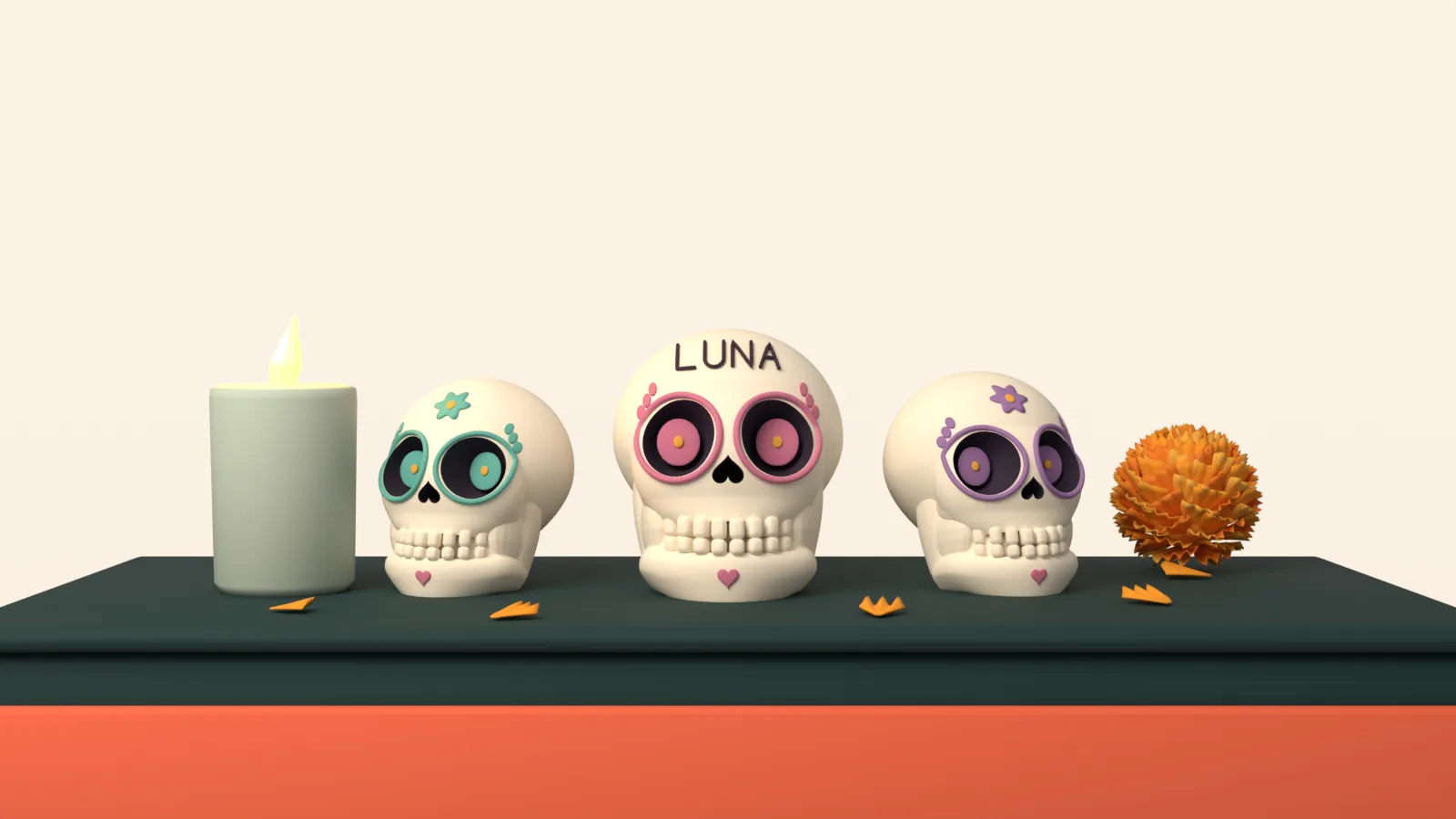
At the end of October, Mexican markets fill with rows and rows of white skulls that sparkle as if they’d been frosted. They have eyes of shiny foil, flowers of colored icing and, across the forehead, a blank space. That’s where the buyer writes a name: a grandmother who’s gone, a friend, a daughter. And the skull, which isn’t the least bit scary, becomes a gift.
Sugar skulls —calaveras de azúcar, or affectionately calaveritas— date from Mexico’s colonial period: from a candy-making technique of Arab and Andalusian origin, alfeñique, and from the cane sugar that arrived with the Spanish. By the 1760s a friar in Mexico City had already seen a whole market of sugar figures for All Saints’ Day. Skulls became the star figure later, and today they’re made above all in Toluca and Guanajuato.
Where do sugar skulls come from?
From a recipe that crossed the ocean and an ingredient that came with it.
Cane sugar reached New Spain with the Spanish, and before long there were sugar mills and plenty of sugar. With it came a way of making candy: alfeñique, a sugar paste shaped into figures.
The oldest account we know of comes from a Capuchin friar, Francisco de Ajofrín, who traveled through New Spain between 1763 and 1766. Before All Saints’ Day in Mexico City, as Stanley Brandes recounts, he saw vendors selling thousands of alfeñique figures: little sheep and lambs of sugar paste, which people called an ofrenda and which it was customary to give to the children of the houses you visited. They also sold coffins, tombs and a thousand figures of the dead —clergy, monks, nuns, bishops, horsemen— at a big, colorful fair under the merchants’ arcade.
Look at that list: sheep, lambs, coffins, tombs, figures of the dead. Skulls aren’t on it. Sugar figures for All Saints’ Day were already there, they were given to children and there was a fair; the skull as the main figure came later. Exactly when, the sources we reviewed don’t pin down.
Ajofrín already uses the name “Day of the Dead,” and according to the anthropologist Stanley Brandes, who has studied the holiday for decades, those two features —the sugar figures and the name— are among the most distinctive things about the Mexican celebration.
Do sugar skulls come from the Aztecs?
It’s the question almost every website answers with a yes. Both sides are worth seeing.
| What’s said | Who says it | What’s known |
|---|---|---|
| Sugar skulls replaced the skulls of the tzompantli, the skull rack of Aztec temples | Many websites and popular magazines, which tell it as fact | Stanley Brandes traced where the idea came from: a connection proposed by one author in 1975, with no documents behind it. He rules it out as a direct origin |
| Sugar skulls are a colonial invention, made with sugar and a European technique | Brandes, and the history of sugar in New Spain | Sugar and alfeñique arrived with colonial rule, and sugar figures for All Saints’ Day are documented in the eighteenth century |
There’s a deeper difference too: the tzompantli was solemn, and the sugar skull is playful, sweet and given as a gift. Both involve skulls; what they say is very different.
That doesn’t mean the holiday has nothing Indigenous in it. The Day of the Dead took shape in the colonial period, on the Catholic calendar of All Saints and All Souls, and region by region it took in Indigenous practices. The sugar skull is one of the most clearly colonial pieces of that blend.
What is alfeñique?
A candy made of sugar paste that can be molded. According to Larousse’s Diccionario enciclopédico de la gastronomía mexicana, the original recipe is Arab-Andalusian and was made with almonds. In Mexico the name passed to colorful sugar-paste candies of all shapes, and nineteenth-century recipe books describe it as a paste cooked and pulled into thin, twisted bars.
Today it’s made many ways. In Guanajuato there are two: soft alfeñique, made with water, and hard, made with egg white. Both are molded into skeletons and skulls for the Day of the Dead, and also into fruit, little animals, angels and even miniature dishes, like a plate of mole or enchiladas.
Sugar skulls were later joined by chocolate skulls and amaranth skulls, made with alegría, a seed that was grown in Mesoamerica long before sugar arrived.
Where are they made?
In many places, and two are especially famous:
- Toluca, in the State of Mexico, holds an ***Alfeñique* Fair** with centuries of history. The arcades of the old town fill with stalls of skulls, skeletons and sugar figures.
- Guanajuato, with its soft and hard alfeñiques, and towns like Salamanca, where skulls, skeletons and figures of every kind are made for the Day of the Dead.
What do sugar skulls mean, and why is there a name on the forehead?
They mean remembrance, with a smile. A sugar skull is a gift. One with your name on it says “I thought of you,” and it’s given to people you love: a friend, a teacher, a relative. On the altar, a skull with the name of someone who has died brings them back to the table for a few days.
It’s the same idea as calaveras literarias, the teasing Day of the Dead poems, said in sugar: death arrives, and we greet it with humor and affection. That’s also why a sugar skull works best as what it is, a gift with a name on it, rather than as a Halloween costume theme; Halloween vs. Day of the Dead has more on keeping the two apart.
What about skulls inside pumpkins?
The two holidays met at the candy stalls too. In the late 1980s, a Toluca craftsman, Wenceslao Rivas Contreras, told researchers that people urged him to stick to Mexican styles, but he liked trying new things: ten years earlier he had started putting skulls inside pumpkins, which were a North American Halloween thing, and he’d make them —witches too— as long as they sold. Even so, he said, the skulls sold best, because they belong to Mexico.
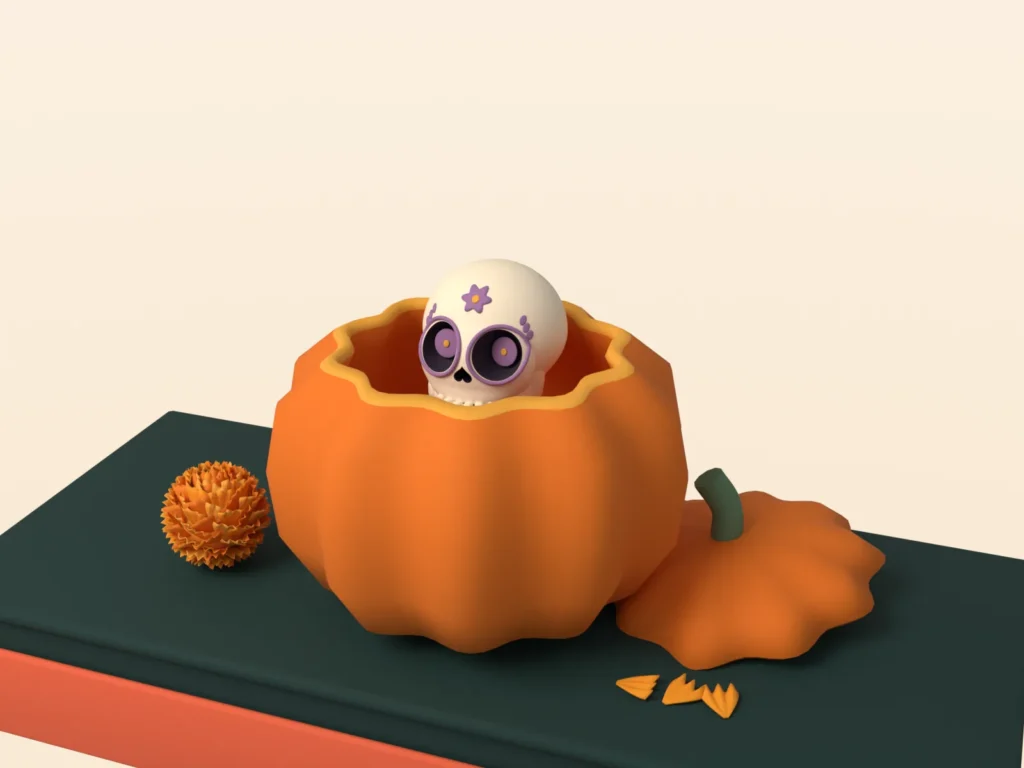
A Mexican skull inside a Halloween pumpkin that, as it happens, is Mexican too. Traditions mix in the market long before they mix in the books.
How do you make sugar skulls at home?
The traditional way calls for cooking the sugar and using clay molds. There’s a no-cook version, made for doing with kids, that gives you skulls to decorate and give away.
Materials: 2 cups granulated sugar, 2 teaspoons meringue powder (in the baking aisle of most craft and grocery stores), 2 teaspoons water, a sugar-skull mold (plastic or silicone), a piece of cardboard, and for decorating: colored royal icing, and foil or paper sequins.
- Mix the sugar and meringue powder. Add the water a little at a time and work it with your hands until it feels like wet sand.
- Press the mixture firmly into the mold and scrape the back flat with a ruler.
- Flip the mold onto the cardboard and lift it off carefully.
- Let it dry for a full day.
- Decorate: foil eyes, icing flowers around the edge, and on the forehead, the name.
Questions
Can you eat sugar skulls? You can, although many have foil or sequin decorations that should come off first. Chocolate and amaranth skulls are made to be eaten.
Why aren’t they scary? Because they’re made for giving and for remembering. On the Day of the Dead, death is welcomed as a visitor.
Are sugar skulls the same as La Catrina? They’re relatives. La Catrina is a 1913 print by José Guadalupe Posada that over the years became a symbol of the Day of the Dead. Her story is in her own article.
Day of the Dead activity books
Personalized Day of the Dead activity book
Their character as a catrina or catrín, with their name on the cover
US$5.99
Personalize
Sources
- Stanley Brandes, “El Día de Muertos, el Halloween y la búsqueda de una identidad nacional mexicana,” Alteridades 10, no. 20, 2000, pp. 7–20. Open access on Redalyc (in Spanish). Ajofrín’s account is on p. 17, and the Toluca craftsman on pp. 17–18.
- Stanley Brandes, “Sugar, Colonialism, and Death: On the Origins of Mexico’s Day of the Dead,” Comparative Studies in Society and History 39, no. 2, 1997, pp. 270–299. doi:10.1017/S0010417500020624
- Stanley Brandes, “Iconography in Mexico’s Day of the Dead: Origins and Meaning,” Ethnohistory 45, no. 2, 1998, pp. 181–218. Open access on eScholarship. On the tzompantli, pp. 185 and 193–194.
- Elizabeth Carmichael and Chloë Sayer, The Skeleton at the Feast: The Day of the Dead in Mexico, British Museum Press, 1991.
- Larousse Cocina, Diccionario enciclopédico de la gastronomía mexicana, “Alfeñique” (in Spanish).
Written by the Idunn Editorial Team, with support from AI tools in the research and drafting.
Leave a Reply