
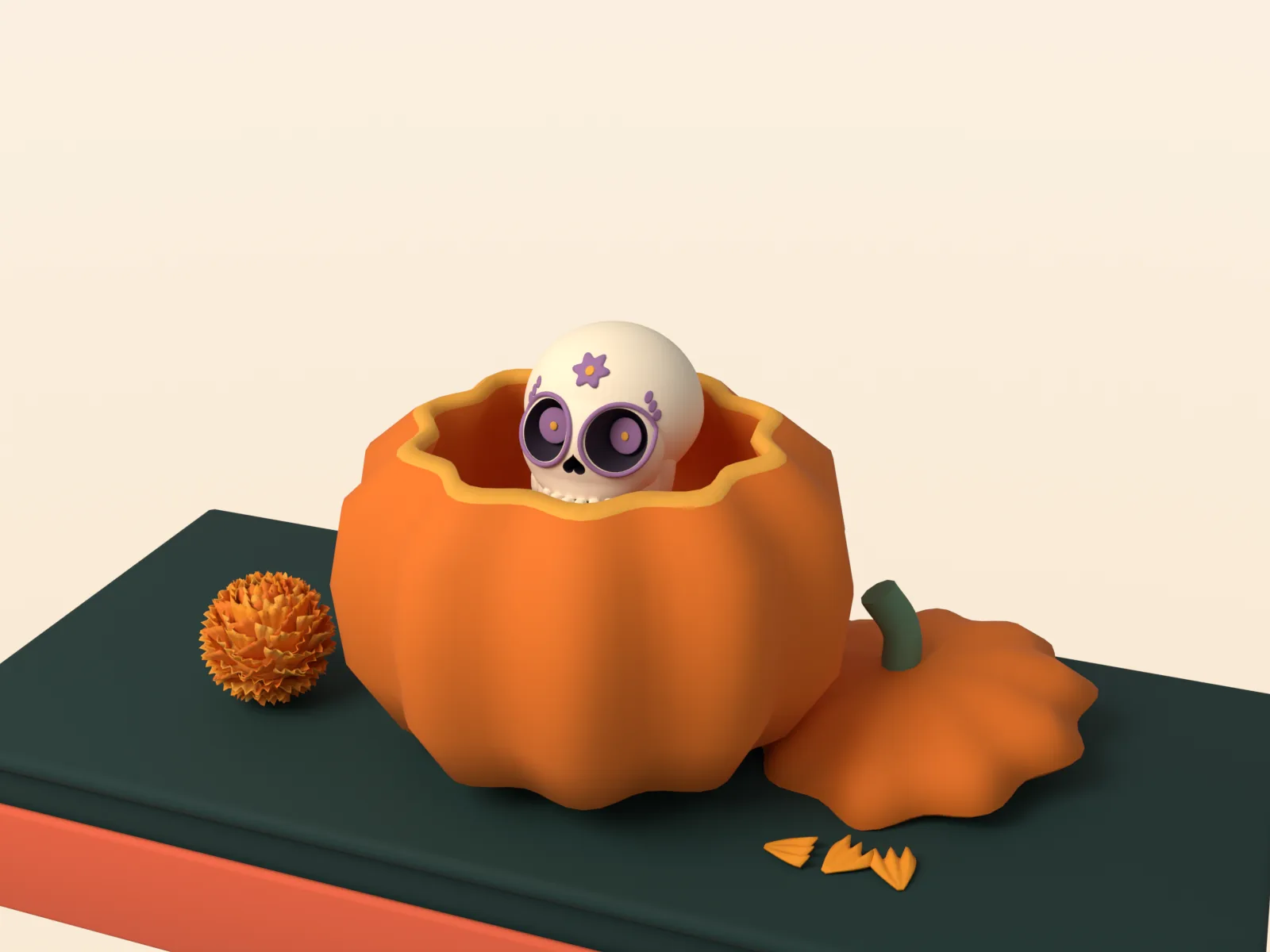
In many Mexican homes, on the night of October 31, the kids go out dressed as witches and vampires to ask for candy, and the next morning the same family sets up the ofrenda, the home altar, with marigolds, pan de muerto and a photo of Grandma. Two holidays in three days, both with skulls, both with the dead. And north of the border, the same week, a classroom hangs paper bats on one wall and cut-paper banners on the other. So are they the same thing? Is one crowding out the other?
Halloween and the Day of the Dead are two different holidays that share their dates for the same reason: both rest on the Catholic calendar of All Saints’ Day (November 1) and All Souls’ Day (November 2). Halloween is the eve, and it grew up in Ireland, Scotland, the United States and Canada as a night of costumes, frights and candy. The Day of the Dead took shape in Mexico during the colonial period, blending that calendar with Indigenous practices, and it’s a celebration for welcoming back the family’s dead. They’re cousins: same grandmother, different roads.
Is the Day of the Dead “Mexican Halloween”?
It’s the question almost everyone asks first, so it’s worth answering head-on: they’re related, and each one belongs to its own home. The Day of the Dead is a family holiday about specific people who died; Halloween is a community night of play and make-believe. They share a calendar and a few symbols, and the rest of this article is about where they meet and where they part.
How are they alike?
In more ways than you might expect:
- The date. Both hang from the same calendar. Halloween is the eve of November 1; the Day of the Dead is November 1 and 2. The story of those dates starts with the popes of Rome and the monks of Cluny.
- Death as the theme. Both are about the dead and what lies beyond, and both often handle it with humor.
- Skulls. They show up in both, though they play different parts.
- Something given or shared. Candy for whoever knocks on Halloween; bread, food and sugar skulls on the Day of the Dead.
- Both were built in layers, over centuries, and both keep changing.
How are they different?
| Halloween | Day of the Dead | |
|---|---|---|
| When | October 31 | November 1 and 2 (in many places, starting on the 31st) |
| Where it comes from | The eve of All Saints in Ireland, Scotland and England; transformed in the United States and Canada in the nineteenth and twentieth centuries | Took shape in Mexico in the colonial period, on the Catholic calendar, with the Indigenous practices of each region |
| What it celebrates | A night of fantasy, frights and play | The visit of the family’s dead |
| Who is remembered | No one in particular: the characters are witches, ghosts, monsters | Specific people: a grandmother, an uncle, a friend |
| Where it happens | Out on the street, door to door, and at parties | At home, around the ofrenda, and at the cemetery |
| What people do | Dress up, trick-or-treat, carve pumpkins | Build the ofrenda, visit and decorate graves, eat together, write calaveras |
| Its symbols | Jack-o’-lantern, witch, black cat, ghost, bat, scarecrow | Marigolds (cempasúchil), ofrenda, pan de muerto, papel picado, candles, La Catrina, literary calaveras |
| The role of death | Something that scares you, and that you play with | Someone who visits, and whom you welcome |
| Recognition | — | UNESCO inscribed it in 2008 as intangible cultural heritage: the Indigenous festivity dedicated to the dead |
If you had to say it in one sentence to a child: on Halloween we play at being scared of the dead; on the Day of the Dead, we invite them to dinner.
Whose skulls are they?
Both holidays’, with different stories.
On the Day of the Dead, skulls are playful and affectionate: sugar skulls with a name across the forehead, the teasing verses of literary calaveras, and the elegant Catrina, who was born in a print by José Guadalupe Posada in 1913.
On Halloween, for more than a century, skulls were skeletons meant to scare. The decorated Mexican skull, with its flowers, joined American Halloween very recently. According to the researcher Regina Marchi, before the 1970s it was practically unknown in the United States; it arrived with the Chicano movement, and in the 2010s it showed up in Halloween-store costumes. That’s part of how Halloween came to North America.
How did the two meet in Mexico?
Through the north first, and then everywhere. The anthropologist Stanley Brandes documented that in Chihuahua, Coahuila and Sonora, the states along the U.S. border, Halloween had been around for a long time. A friend of his from Coahuila remembered that in his childhood, in the 1940s and 1950s, his family celebrated only Halloween, and that the skulls of Mexico City frightened him.
By the 1990s, pumpkins and costumes were all over the country, and the backlash came. Brandes describes a mural in Tepoztlán, Morelos, showing a soccer player kicking a pumpkin-headed figure under the words “No to Halloween. Keep your traditions.” And altar contests that disqualified anything “foreign to our tradition.”
At the same time, the two holidays were already mixing in the markets. A craftsman in Toluca said that around then he had started making sugar skulls set inside pumpkins, “because they sell,” although the skulls were still the favorites: “they belong to us, to Mexico!” And the Halloween pumpkin, as it happens, is a Mexican plant.
Can you celebrate both?
Many families do, and each finds its own way. In some homes the 31st is costume night and the 1st and 2nd are ofrenda days; others prefer just one. Both holidays have a history, and both say something about the people who celebrate them.
In the United States and Canada, the Day of the Dead now turns up in schools, libraries and museums, and a fair question comes with it: how do you take part if it isn’t your family’s tradition? Marchi traces the appropriation debate to the moment the skull became a costume in the 2010s. The view we share, from Mexico, is simple. Learn where it comes from, and keep the ofrenda for what it’s for: remembering someone real. A classroom altar with photos of the students’ own grandparents, pets or heroes is closer to the holiday than any skull costume.
One idea that works with kids: use both holidays to talk about the same thing from two sides. Halloween opens the conversation about fear; the Day of the Dead, about memory. And both are a good excuse to ask at home: who do we remember? What did they like to eat? What stories did they tell us?
For home or the classroom
A two-circle Venn diagram. In one circle, what belongs only to Halloween; in the other, what belongs only to the Day of the Dead; in the middle, where they overlap, what they share. With the table above it takes fifteen minutes, and it gets a good conversation going. It works in English, Spanish or both, which makes it a natural fit for dual-language classes.
Questions
What day is each one celebrated? Halloween is on October 31. The Day of the Dead is November 1 and 2; in many regions of Mexico it starts earlier, and in some places one day is set aside for children who have died.
Is the Day of the Dead pre-Hispanic? It has Indigenous roots and Catholic roots. The Mexica (Aztecs) honored their dead at other times of the year; the November dates arrived with the Spanish conquest, and the holiday grew out of that encounter. The full story is in why the Day of the Dead falls on November 1 and 2.
Is Halloween celebrated in Mexico? Yes, especially by kids, and increasingly alongside the Day of the Dead rather than instead of it. Where Halloween itself came from is in its own article.
Day of the Dead activity books
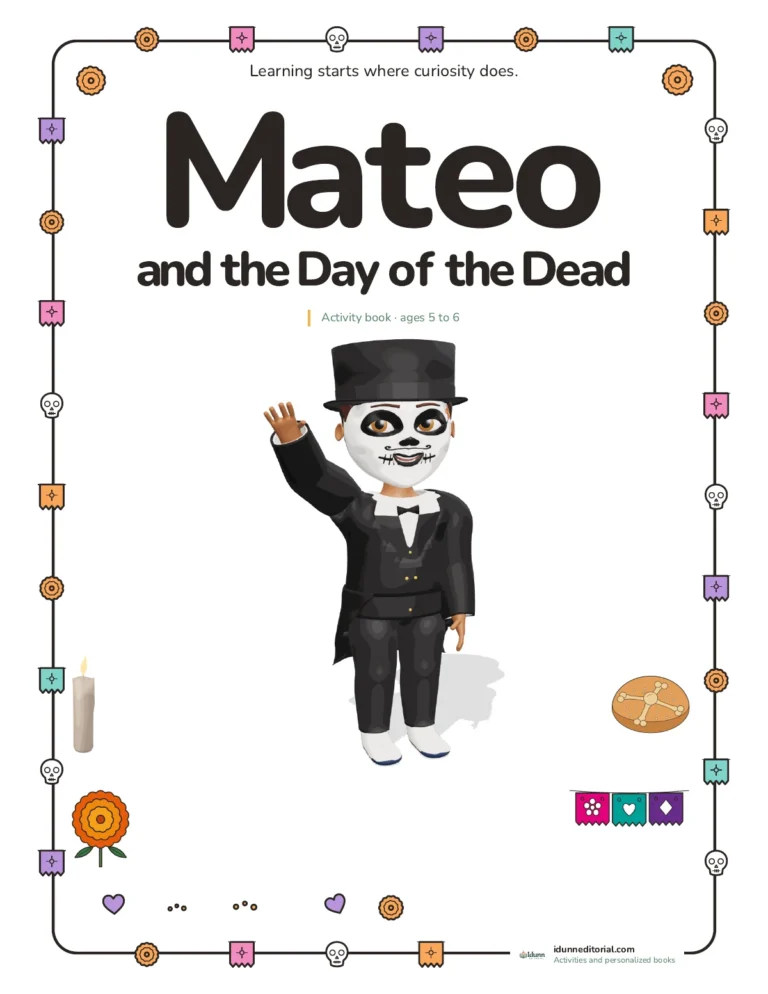
Personalized Day of the Dead activity book
Their character as a catrina or catrín, with their name on the cover
US$5.99
Personalize
Sources
- Stanley Brandes, “El Día de Muertos, el Halloween y la búsqueda de una identidad nacional mexicana,” Alteridades 10, no. 20, 2000, pp. 7–20. Open access on Redalyc (in Spanish). Coahuila and Tepoztlán, p. 16; the Toluca craftsman, pp. 17–18.
- Francis Mershman, “All Saints’ Day” and “All Souls’ Day,” The Catholic Encyclopedia, 1907. All Saints · All Souls.
- UNESCO, “Indigenous festivity dedicated to the dead”, 2008.
- Regina Marchi, “U.S. Day of the Dead: Fusing Spanish, Indigenous and U.S. Cultures to Communicate New Messages,” Camino Real 3, no. 5, 2011, pp. 103–125. Open-access PDF.
- Colin Gunckel, “Charles and Ray Eames’s Day of the Dead (1957)…,” in Screening Race in American Nontheatrical Film, Duke University Press, 2019. doi:10.1515/9781478090090-010.
- Nicholas Rogers, Halloween: From Pagan Ritual to Party Night, Oxford University Press, 2002.
Written by the Idunn Editorial Team, with support from AI tools in the research and drafting.
Leave a Reply