
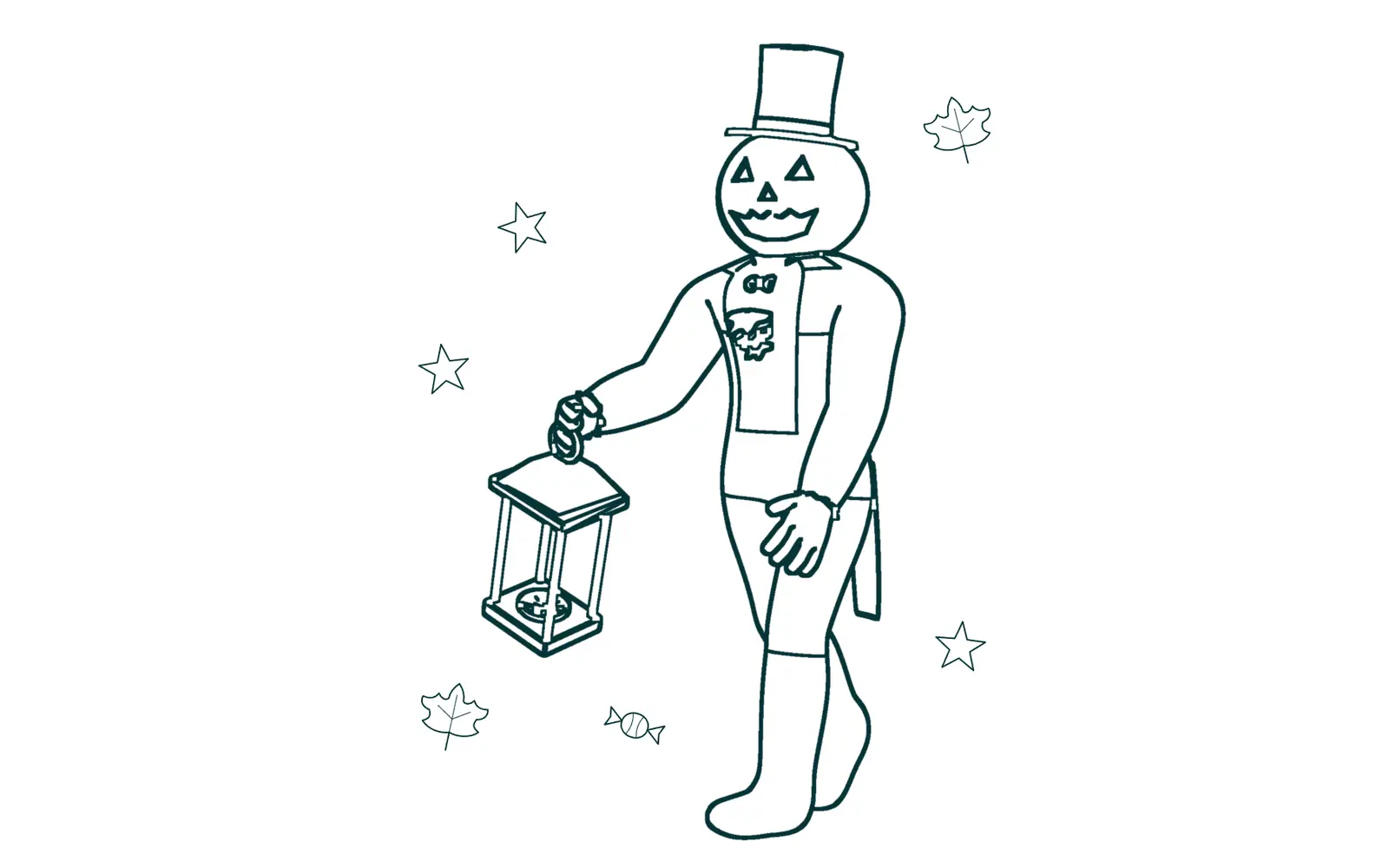
When Halloween night fills up with glowing pumpkins, each with its crooked grin and a candle inside, few people know that light belongs to someone. His name is Jack. They say he was such a cheat that he fooled the devil himself, and that’s why he’s been wandering the roads ever since, with no home and no rest, lighting his way with a single ember.
That’s the legend of the jack-o’-lantern, and it comes from folktales of Ireland and Britain. The oldest version we were able to read was published in 1894, and it didn’t have a turnip, a pumpkin or Halloween yet. Those pieces were added later, and the pumpkin, oddly enough, is from Mexico. First comes the story, to read aloud. Then, the history behind it.
What is the legend of Stingy Jack?
To read aloud (ages 6 to 10 · about four minutes)
Long ago, in a village in Ireland, there lived a man everyone called Stingy Jack. He never lent anyone anything, he never bought anyone a drink, and his tongue was so quick he could talk his way out of any trouble with a brand-new lie.
One night, at the village tavern, a very elegant gentleman sat down next to him, with eyes red as coals. It was the devil, and he had come for Jack.
“Before we go,” said Jack, not a bit afraid, “buy me one last drink.”
The devil thought that was funny. But when it was time to pay, neither of them had any money.
“You can do anything,” said Jack. “Turn yourself into a coin. We’ll pay, and then you can turn back.”
The devil, who was proud, turned himself into a silver coin. And Jack, quick as a wink, put it in his pocket, right next to a little cross he always carried. Trapped beside the cross, the devil couldn’t change back.
“Let me out!” he shouted from the pocket.
“I’ll let you out,” said Jack, “if you promise not to come for me for ten years.”
The devil promised. Ten years later, he came back.
“All right, I’ll go with you,” said Jack. “But first, fetch me an apple from that tree. I’m hungry.”
The devil climbed up. And while he was up there, Jack carved a cross into the trunk. The devil couldn’t get down.
“I’ll let you down if you promise never to take me.”
The devil promised again.
The years went by and Jack died, the way everybody does. He came to the gates of heaven, and they told him a cheat like him couldn’t come in. He came to the gates of hell, and the devil, who kept his promises, wouldn’t let him in either.
“So where do I go now?” asked Jack. “It’s very dark.”
The devil, laughing, tossed him an ember from the fires of hell. Jack hollowed out a turnip he had in his pocket, put the ember inside, and walked off with his lantern.
And they say he’s still out there. That’s why, on dark autumn nights, people in Ireland carved faces into turnips and set a light inside: to light the road, and so that Jack, seeing them, would keep on walking.
This is the version most often told today. It has many variants: in some Jack is a blacksmith, in others a farmer; sometimes the devil climbs a tree and sometimes he’s trapped in a sack. The ending is almost always the same: no heaven, no hell, and a light for the road.
What does “jack-o’-lantern” mean?
“Jack of the lantern.” In English, Jack worked like “John Doe” or “Joe”: a name for any man at all. A Jack-o’-lantern was just some fellow walking around with a lantern.
The word is much older than Halloween pumpkins. Etymological dictionaries record it in English from the mid-seventeenth century, and not for a pumpkin: it was one of the names for the will-o’-the-wisp, those small lights sometimes seen at night over marshes, which drift away when someone follows them. Today they’re usually explained as marsh gases catching fire, although the explanation is still debated.
That’s Jack’s real beginning: a strange light in the night that needed a name and a story.
How old is the legend?
Here it helps to separate what’s said from what can actually be read.
What’s said: almost every page that tells the legend calls it “ancient,” “Celtic” or “thousands of years old.” Where that Celtic idea comes from is in where Halloween came from.
What can be read: the oldest version we found is in a report of the Belfast Naturalists’ Field Club, in Northern Ireland, from 1894. It says that the will-o’-the-wisp, “or Jack o’ Lantern as he is called in some places,” is, by one account,
“the spirit of a man who was very wicked on earth, and also managed to trick and outwit the devil; and, in fact, made himself so feared by the prince of darkness, that after death he could not enter heaven, nor was even allowed into the other place, so afraid of him were the authorities there, and he must, therefore, wander about with his torch over dreary bogs and wastes for ever.”
— W. H. Patterson, “Irish Fairies,” 1894, p. 582
Almost everything is there: the trickster, the devil outwitted, both doors shut, the wandering light. What’s still missing is the turnip, the ember and Halloween. In 1894 Jack carried a torch over the bogs, on any night of the year.
Similar stories —a blacksmith or a soldier who tricks the devil and ends up with no place in the next world— are told in many countries in Europe, and folklorists group them as a single tale type. So the plot travels far beyond Ireland; the Irish touch is to have joined it to the light over the bog.
Why did Jack carry a turnip?
Because in rural Ireland and Scotland, what people had was turnips, potatoes and beets, and that’s what country people carved lanterns from on autumn nights. That custom is well documented in the nineteenth and twentieth centuries.
On when it started, there are two views:
| What’s said | Who says it |
|---|---|
| The Celts carved turnips at Samhain, more than two thousand years ago | Many websites, and even a 1982 Library of Congress pamphlet |
| There’s no trace of turnip lanterns before the modern era | Historians who went through the evidence, like Ronald Hutton of the University of Bristol |
People who study the subject lean toward the second: the carved turnip is a folk custom a couple of centuries old, lovely and very real, with no evidence linking it to the Celts.
Then came the crossing. In the nineteenth century, Irish and Scottish families by the hundreds of thousands emigrated to the United States and Canada, and there they found something much better to carve: the pumpkin, big, hollow and easy to cut. The historian Cindy Ott, in her history of the pumpkin as an American icon, gives the jack-o’-lantern a whole chapter.
And here’s the part almost nobody tells: the Halloween pumpkin is from Mexico. The oldest domesticated seeds of its species were found in a cave in Oaxaca, Guilá Naquitz, and they’re about 10,000 years old. Its full story, with the milpa and the giant pumpkins, is in pumpkins come from Mexico. So Jack’s lantern, which started out as an Irish turnip, ended up made from a Mexican plant.
By February 1852 the carved pumpkin was already in American literature. In Nathaniel Hawthorne’s story “Feathertop”, a New England witch, Mother Rigby, builds a scarecrow and gives it a pumpkin for a head, in which she “cut two holes for the eyes and a slit for the mouth.” And before she starts, she lights her pipe with an ember brought by an invisible helper. Witch, scarecrow, carved pumpkin and ember, all on the first pages. How the rest of Halloween piled up around it is in how Halloween came to North America.
What do Jack and the scarecrow have in common?
They look alike and come from different places. The scarecrow is a farm object, made to do a job; Jack is a character from legend and the lantern named after him. Both can have a pumpkin for a head, both have a bit of the trickster, and stories have put them together more than once: Hawthorne’s “Feathertop” in 1852, and L. Frank Baum’s Jack Pumpkinhead in 1904.
The other character’s full story is in why there are scarecrows at Halloween.
Are there legends like this in Mexico?
Lights that appear at night in the countryside have stories everywhere, and Mexico has its own. Some say they’re witches turned into balls of fire; others say they’re souls in torment, and in some villages people tell of a flame that rises from the ground to mark a spot where treasure is buried.
They’re different stories, with the same question underneath as Jack’s: what is that light, and who’s carrying it?
Does your family tell one? Ask your grandparents, wherever they grew up. Many of these stories live only in the voice of the person telling them, and they’re worth writing down before they’re lost.
Questions to talk about after reading
For home or the classroom:
- Why did both heaven and hell shut the door on Jack?
- Do you think what happened to him was fair? What would you have done in his place?
- Why do you think people carved faces into turnips?
- If Jack lived where you live, what fruit or vegetable would he make his lantern from?
- Make up a different ending: how could Jack finally find a place to stay?
Halloween activity books and printables
Personalized Halloween activity book
Their character in costume, with their name on the cover
US$5.99
Personalize



Sources
- W. H. Patterson, “Irish Fairies,” Annual Report and Proceedings of the Belfast Naturalists’ Field Club, series II, vol. III, 1894, pp. 573–582. Full text on Internet Archive. The quotation is on p. 582.
- Nathaniel Hawthorne, “Feathertop: A Moralized Legend,” 1852; collected in Mosses from an Old Manse. Text on Project Gutenberg.
- Ronald Hutton, The Stations of the Sun: A History of the Ritual Year in Britain, Oxford University Press, 1996.
- Cindy Ott, Pumpkin: The Curious History of an American Icon, University of Washington Press, 2012, ch. 5, “Jack-o’-Lantern Smiles.”
- Bruce D. Smith, “The Initial Domestication of Cucurbita pepo in the Americas 10,000 Years Ago,” Science 276 (1997): 932–934. doi:10.1126/science.276.5314.932
- Library of Congress, American Folklife Center, Halloween, pamphlet by Jack Santino, 1982: cited as an example of the Celtic version that later research revised.
Written by the Idunn Editorial Team, with support from AI tools in the research and drafting.
Leave a Reply