
Holidays and traditions

Where the holidays we celebrate come from, told with sources: Halloween, the Day of the Dead and the traditions that got added along the way.

  • Free advent calendar printable: 24 family activities

    Free advent calendar printable: 24 family activities

    Twenty-four folded notes fit in a shoebox. One says “choose tonight’s book”; another says “teach us a silly dance.” Open one after dinner, and there’s a small plan waiting between the dishes and pajamas.

    Download this free advent calendar printable for 24 activities to share from December 1 through Christmas Eve. It includes a countdown sheet and cut-apart activity cards, in color and black and white. Use paper, books, and supplies you already have, and move the cards around to fit your family’s week. Jump to: printable and 24 activities · what an advent calendar is · Advent in 2026 · activities by age · DIY calendars · calendar fillers · ideas by theme

    Printable advent calendar: 24 activities

    Print the countdown sheet and activity cards on US Letter paper, single-sided, at actual size. Choose black and white for a version your child can color. You can display the whole sheet or tuck the cards into a calendar you already own.

    The numbers below are December dates: open number 1 on December 1 and number 24 on Christmas Eve. Read through the plans before filling your calendar, especially the baking day, and swap anything that needs supplies you’re out of.

    December dateActivity to share
    1Pick one of the Christmas coloring pages. Share the picture: your child colors one part, and you color another.
    2Write or draw a letter to Santa. Your child can tell you what to write, then add a picture beside the words.
    3Fold scrap paper and draw a snowflake design. You cut the folded paper; your child opens it to see the pattern.
    4Choose tonight’s story from your shelf. For a daily reading countdown, use the book advent calendar to plan more reading nights.
    5Bake cookies with a familiar recipe and ingredients you have; you handle the oven. Or draw paper cookies and open a pretend bakery.
    6Read one of the Christmas poems for kids aloud. Take turns choosing a line to repeat, with a different voice each time.
    7Play holiday charades. Act out wrapping a present, stirring cookie dough, or pulling on boots while the others guess.
    8Work on a Christmas word search together. Your child chooses a word; you help find its first letter and follow the rest.
    9Look for neighborhood lights together, on a short walk or from a window. Each person picks a favorite shape or color.
    10Read Santa’s reindeer names and choose one to draw. Tell each other what that reindeer might do on a day off.
    11Put on a song you already have and take turns leading a silly dance. The leader chooses the moves; everyone else follows.
    12Learn how to say Merry Christmas in Spanish. Write the greeting in a homemade card for someone you want to wish a happy holiday.
    13Make a reading nook with a blanket and cushions. Bring a book inside and read until someone wants to come out.
    14Choose one of the Christmas elf ideas using things at home. A paper elf or a sock puppet can join the game.
    15Ask a relative about a December they remember from childhood. Listen together in person or on a call, then draw one detail.
    16Turn a piece of used cardboard into a star. You cut the outline; your child decorates it and chooses where to display it.
    17Hide a drawing in the living room and give clues to find it. Switch roles so your child can send you searching, too.
    18Arrange a snack you already have into a festive picture. You do any cutting; your child chooses the shapes and puts them together.
    19Fold paper into a little book. Draw something you enjoyed together this month, and add a title your child chooses.
    20Pick a small act from the kindness advent calendar. Ask someone at home what would help, and do that together.
    21Sing a Christmas song your family knows. Take turns keeping the beat with claps, or humming while someone else sings.
    22Leave a thank-you note for something specific: a ride, a meal, a bedtime story. Your child can write, draw, or dictate it.
    23Make place cards for the people sharing your holiday meal. Let your child draw a small picture beside each person’s name.
    24Choose one of your family’s Christmas Eve traditions: read “‘Twas the Night Before Christmas,” follow Santa with NORAD, or share a family memory.

    For the last card, Project Gutenberg’s illustrated edition of A Visit from St. Nicholas, commonly called “‘Twas the Night Before Christmas,” gives you the complete poem to read legally for free. The NORAD Tracks Santa program follows Santa each December 24; its official tracker is at noradsanta.org.

    If your family skips Santa, address the letter to someone your child loves and turn the elf day into a puppet game. A missed day can stay missed, move to the weekend, or become another reading night. Start with today’s number if December is already underway.

    What is an advent calendar?

    An advent calendar is a way to count the days until Christmas by opening a numbered door, envelope, or pocket each day. A common format runs from December 1 through December 24. Each number reveals a picture, message, treat, or activity; this printable uses activities for families to do together.

    Open the number that matches the date. On December 10, that means number 10. You can then count the unopened spaces to see how many activities remain before Christmas. This calendar ends on Christmas Eve; other calendars include December 25.

    The tradition grew from earlier ways of marking the wait. The Weimar City Museum’s history of advent calendars describes homemade counting aids, including chalk marks children erased one at a time, and early printed calendars in Germany. Its collection includes picture sheets, calendars with doors, and a little book with a page to turn each day.

    The printable’s fixed December dates make it reusable each year. The religious season of Advent follows a different starting date, which shifts with the calendar.

    When does Advent start in 2026?

    Advent starts on Sunday, November 29, 2026, in the Roman Catholic calendar. The USCCB’s official 2026 liturgical calendar lists the four Sundays as November 29 and December 6, 13, and 20. Advent is a Christian season of preparation for Christmas; this activity calendar begins on December 1.

    If your family observes Advent, you can begin your Sunday traditions on November 29 and open the first activity card on December 1. Families using the calendar as a Christmas countdown can follow the same numbered cards.

    An Advent wreath traditionally holds four candles in a circle of evergreen branches. The USCCB’s explanation of Advent describes lighting an additional candle each Sunday as a sign of expectation and hope for Christ’s coming. In Catholic practice, three candles are usually purple and one is rose; the rose candle is lit on the third Sunday. You can make a paper version together and add a paper flame each week.

    Activities by age

    Adjust what your child does within the activity. These age bands are suggestions for sharing the calendar; choose the version that suits your child’s interests and comfort with the materials.

    Ages 2–4: you read and prepare; your child chooses

    Read the card aloud and offer a concrete choice: the red crayon or the green one, the mouse picture or the reindeer. You prepare the snowflake cuts and cardboard star. Your child can unfold, arrange, and decorate.

    For the word search, point to a picture or find a familiar letter together. A letter to Santa can be a drawing with a sentence you write underneath. During a poem, pause for a sound your child wants to repeat. Keep the rest of the page for another evening.

    Ages 5–7: share the words and the jobs

    Your child might read a familiar word, number the envelopes, or dictate a clue for the treasure hunt. On the card-making day, you can write the greeting on scrap paper for them to copy or trace if they want.

    Give siblings different parts of one plan. One child chooses the snack design while another arranges the food; you handle the cutting. Let them alternate who opens the daily card, and keep a shared place for finished drawings.

    Ages 8–10: offer decisions they can carry through

    Invite your child to rearrange a few cards around the family schedule. They can write the treasure-hunt clues, read a familiar recipe with you, or record a relative’s memory in the little book.

    If they want a longer project, let yesterday’s book or drawing continue today. An older child can choose a poem for you to read together and explain which part caught their attention. You can still take a turn choosing, too.

    How to make a DIY advent calendar

    Start with the container or paper you have. A shoebox of numbered notes works immediately; envelopes, a paper chain, and reused bags give you three other ways to reveal one activity at a time.

    The assembly times below are planning estimates with supplies gathered. Children around age 3 and up can choose colors and decorate alongside you; you prepare the cuts and set up the calendar. Use child-safe scissors and a glue stick; hot glue and craft knives stay with adults.

    Numbered envelopes in a box

    Materials: 24 used envelopes or sheets of scrap paper, a pencil, tape, and a shoebox. Assembly: about 20–30 minutes.

    1. Check used envelopes for personal information and cover it. If you’re making envelopes, fold paper around a card and tape the sides.
    2. Have your child write or decorate numbers 1–24 on the fronts.
    3. Fold one activity card into each envelope. Keep December 24’s plan in the last one.
    4. Stand the envelopes in the box in date order. Put opened cards behind the unopened ones.

    A paper-chain countdown

    Materials: scrap paper, a pencil, scissors, and tape or a glue stick. Assembly: about 20–30 minutes.

    1. You cut 24 broad strips. Together, number them and copy one activity onto each strip.
    2. Turn strip 1 into a loop, with its number visible, and secure it.
    3. Thread strip 2 through the first loop before closing it. Continue through number 24.
    4. Keep the chain where you can bring it to the table. Open the dated end link each day and read its activity together.

    Leave enough room around the writing to open a link without tearing through the words. Your child can color each strip before you assemble it.

    Reused paper bags on a shelf

    Materials: 24 clean paper bags, or a mix of bags and envelopes, plus scrap-paper labels and tape. Assembly: about 15–25 minutes.

    1. Check that the bags are empty and dry. Fold large ones down to a handy size.
    2. Let your child decorate number labels; you tape one to each bag.
    3. Place one folded activity inside and fold the top closed.
    4. Arrange them on a shelf or in a basket, with numbers facing out. Bring down the day’s bag together.

    You can save the bags for next year and replace only the notes. If you have fewer bags, fill the gaps with folded, numbered paper.

    What to put in an advent calendar (no candy, no shopping)

    Fill the pockets with activity slips, shared-time coupons, clues, or personal notes. Paper fits small spaces, and you can change the plan before opening it.

    Activity slips: cut apart the printable cards and use one per date. Put baking on a day when you’ll be home, and keep a reading or talking card handy for an evening with less time. The paper-cookie option keeps the bakery game available when ingredients run out.

    Shared-time coupons: name something you can do with what’s available, such as “choose our bedtime book,” “teach me your favorite game,” or “pick a song for us to dance to.” Add when you’ll use it: after dinner today or Saturday morning. That gives your child something definite to look forward to.

    Treasure-hunt clues: lead to a familiar book, a drawing, or the next activity. “Look where we keep the blankets” can send your child to the reading-nook card. Draw the location for a child who prefers pictures, and keep hiding spots within easy reach.

    Personal notes: write down a moment you enjoyed: “I liked hearing you do the reindeer voice.” Your child can make a note for you as well. Keep a pencil nearby so a favorite activity can become tomorrow’s card.

    Advent calendar ideas by theme

    Books: fill the dates with stories from your shelf or library. A book advent calendar follows one reading choice each day and helps you plan a countdown around books you can access.

    Kindness: use the kindness advent calendar for small acts children can help choose and carry out. It gives this theme its own daily prompts; the mixed calendar above includes one day to try it.

    Reverse advent calendar: instead of opening something each day, your family adds one item to a box: a can of food, a pair of warm socks, a book in good condition. On Christmas Eve, take the box together to a food bank, shelter, or library drive near you. Your child chooses the item; you check what the place accepts.

    Dinosaurs, horses, or unicorns: let your child draw a favorite creature beside each number on the black-and-white sheet. Keep the activities, or borrow the reading-day idea from the book advent calendar and choose stories about that interest.

    Nativity or Christian Advent calendar: your family can pair a daily card with a short reading or a figure in your Nativity scene. Add one figure each day, and place the baby on Christmas Eve or Christmas morning, as your family’s tradition goes.

    Idunn’s take

    At Idunn, we want to nurture curiosity in children and in the adults sharing the page. Our choice for this calendar is a mix of reading, making, listening, and playing, with room to repeat a favorite. Let your child choose where today’s drawing goes, or which story you’ll open tonight.

    Sources

    Sources checked October 15, 2026. The activity selection, age adaptations, and assembly-time estimates are Idunn editorial suggestions.


  • Book advent calendar: a story a day until Christmas

    Book advent calendar: a story a day until Christmas

    A familiar book feels different with a December number on the front. Your child recognizes the torn corner as the paper comes off and starts telling you what happens next. That favorite can return every year.

    A book advent calendar gives your family one reading choice each day from December 1 through Christmas Eve. Wrap books you own or borrow, put story titles in numbered envelopes, or divide a longer book into 24 readings. Start with the printable tags, then choose from 24 picture books and six free stories below. Jump to: how it works · printable book tags · 24 picture books · free stories online · fit reading around December · sources

    How does a book advent calendar work, and how do you make one?

    It works like any advent calendar, with a story where the chocolate would go: every December date opens one reading, and the last one falls on Christmas Eve. To make one, choose one format, number the reading choices 1–24, and open the number that matches the December date. This countdown ends on December 24. If you want reading days mixed with games and making things, use the advent calendar printable with 24 family activities.

    FormatGatherYour daily reading
    Wrapped booksBooks, reused wrapping paper or bags, tape, numbered tagsOpen and share one book
    Title cardsPaper or envelopes, a pencil, access to the books or free textsReveal a title and find the story
    One longer bookA book, a bookmark, a list of 24 stopping pointsContinue yesterday’s story

    Wrap books from home or the library

    1. Gather what you can read together. Start at your shelf, then ask your library for Christmas picture books. Mix holiday titles with familiar favorites.
    2. Plan the dates. Save longer stories for evenings with more time. Note each title and its library due date on a separate list. Check your library’s loan and renewal rules before wrapping.
    3. Wrap and number. Use paper you already have, reusable bags, or a folded sheet around each cover. Keep tape on the wrapping so it stays clear of the book and library labels.
    4. Put the books in a basket. After reading, return the book to the shelf or the library-return bag.

    You can prepare a few days at a time. If you have eight books, read those, then use title cards for rereading or borrow another batch. Tell your child which books are visiting from the library and which belong to your family.

    Reveal a story title each day

    1. Cut out the tags below or fold scrap paper into cards. Write a date outside and a title inside.
    2. Add the author and where to find the story: your shelf, a library copy, or one of the free links below. Open online texts in advance so you can find them again.
    3. Arrange the cards in a box or numbered envelopes. Open today’s card together and bring the story to your reading spot.

    A card can say “reread your favorite from this week.” If your child likes decorating the envelopes, the Christmas coloring pages give them pictures to add around the numbers.

    Read one longer book in 24 installments

    Choose a book your child wants to hear over several evenings. If it has 24 chapters of manageable length, assign one to each date. Otherwise, divide it into 24 sections and write down the page ranges before December starts. Use scene endings as stopping points; chapter numbers can stay exactly as printed.

    Keep a bookmark in the book. Tomorrow, recall where the characters were and continue. If you finish early, give the remaining dates to favorite passages or another story.

    Where can you get printable book advent tags?

    Download the 24 numbered tags, write your book choices in the blank spaces, and attach them to the wrapping or use them as title cards.

    Print on US Letter or A4 paper, single-sided, at actual size. The black-and-white tags leave room for coloring; the planning sheet keeps titles and library due dates together.

    You handle difficult cuts and supervise scissors; keep loose wrapping and small supplies away from young children.

    Which 24 Christmas picture books can you wrap?

    Use these as choices for your calendar and swap in books you can borrow. Our criterion is variety across the month: rhymes, visual jokes, adventures, family gatherings, and Christian Christmas stories. Published reviews and library recommendations support the selection. Source numbers lead to those records below; ages suggest reading together.

    Ask your librarian for these titles and authors, or browse the longer selection of Christmas picture books. Dates here are suggestions.

    1. Pick a Pine Tree

    Patricia Toht; illustrated by Jarvis. Candlewick, 2017. Ages 3–7.

    A family chooses a tree and decorates it with friends. Put this early in the month: its step-by-step verse lets your child follow the transformation from outdoor pine to indoor Christmas tree. Source 1

    2. Dream Snow

    Written and illustrated by Eric Carle. Philomel, 2000. Ages 4–7.

    A farmer dreams of snow covering his five animals, then prepares Christmas gifts for them. Choose it for counting and guessing which animal hides beneath each snowy shape, with Carle’s bright collage colors to look at together. Source 2

    3. Bear Stays Up for Christmas

    Karma Wilson; illustrated by Jane Chapman. Margaret K. McElderry Books, 2004. Ages 3–7.

    Bear’s friends wake him for Christmas preparations; later, he has a surprise for them. The rhyming text and animals working together make this a choice for a child who enjoys hearing familiar characters return. Source 3

    4. Snowmen at Christmas

    Caralyn Buehner; illustrated by Mark Buehner. Dial, 2005. Ages 4–8.

    Snow people gather after dark for their own celebration. Leave time to search the pictures: hidden shapes give your child something to discover while you read about icy snacks and a snowman Santa. Source 4

    5. Mr. Willowby’s Head Over Heels Christmas

    Written and illustrated by Robert Barry. Doubleday, 2025. Ages 4–7.

    A bear tries to deliver a Christmas tree by riding it downhill, collecting other animals along the way. This rhyming tumble adds a comic evening; the story stands on its own if you haven’t read Barry’s earlier Willowby book. Source 5

    6. Olive, the Other Reindeer

    J.otto Seibold and Vivian Walsh; illustrated by J.otto Seibold. Chronicle Books, 1997. Ages 4–8.

    A dog hears a Christmas song as an invitation to join Santa’s team. Her sniffing and fetching come in handy. Choose this for the mistaken identity and busy cartoon pictures; explain the sound-alike name if the joke needs help. Source 6

    7. Red & Lulu

    Written and illustrated by Matt Tavares. Candlewick, 2017. Ages 3–7.

    Two cardinals become separated when their tree travels to New York City. The search and reunion give the pictures a journey to follow, including wordless spreads where you can pause and let your child find the bird. Source 7

    8. The Christmas Owl

    Ellen Kalish and Gideon Sterer; illustrated by Ramona Kaulitzki. Little, Brown, 2021. Ages 4–8.

    Inspired by the owl rescued from Rockefeller Center’s tree, this story imagines the bird wondering what Christmas means. Pair it with yesterday’s tree journey; the photographs and author’s note distinguish the real rescue from the animal’s imagined thoughts. Source 8

    9. Dasher

    Written and illustrated by Matt Tavares. Candlewick, 2019. Ages 3–8.

    A young doe escapes a traveling circus and meets Santa. The flight scenes make this an adventure choice. Read it ahead if animal captivity worries your child: the beginning shows the reindeer confined before the story reaches its happy reunion. Source 9

    10. Night Tree

    Eve Bunting; illustrated by Ted Rand. Harcourt, 1991. Ages 3–8.

    A family visits the woods to decorate a living tree for animals. Moonlit watercolors and the return home offer a quieter evening after Dasher’s escape. Ask which detail your child would want to look at again. Source 10

    11. Jingle the Christmas Clown

    Written and illustrated by Tomie dePaola. Putnam, 1992. Ages 4–8.

    A young clown and baby circus animals give a free performance in an Italian village. An angel appears at the end. Choose it for a celebration built around what the performers can share, with older villagers helping the show happen. Source 11

    12. Too Many Tamales

    Gary Soto; illustrated by Ed Martinez. Putnam, 1993. Ages 4–8.

    Maria thinks her mother’s ring has disappeared into the Christmas tamales. Her cousins help with an increasingly difficult search. The comic predicament and the family cooking another batch give you plenty to talk about without adding a lesson afterward. Source 12

    13. May Your Life Be Deliciosa

    Michael Genhart; illustrated by Loris Lora. Cameron + Company, 2021. Ages 5–10.

    During a Christmas Eve tamalada, Abuela pairs cooking instructions with wishes for her family. This gives the month a second tamale story with a different purpose: passing on memories. English narration includes Spanish words. Source 13

    14. La Noche Buena: A Christmas Story

    Antonio Sacre; illustrated by Angela Dominguez. Abrams Books for Young Readers, 2010. Suggested ages 5–8.

    Nina spends Christmas with her Cuban relatives in warm Miami, away from familiar New England snow. Choose this for a child celebrating between households or places: cooking, music, and relatives help her get to know another family Christmas. Source 14

    15. The Legend of the Poinsettia

    Retold and illustrated by Tomie dePaola. Putnam, 1994. Ages 4–8.

    Lucida worries that she has nothing to offer the baby Jesus after her mother becomes ill. The weeds she brings turn into poinsettias. This Mexican Christmas legend adds a Christian miracle story, told through bold areas of color. Source 15

    16. The Night of Las Posadas

    Written and illustrated by Tomie dePaola. Putnam, 1999. Ages 4–8.

    A procession in Santa Fe receives two mysterious visitors when its Mary and Joseph are delayed. Choose it to introduce the reenactment and its religious meaning. The guide to Las Posadas continues that conversation. Source 16

    17. The Trees of the Dancing Goats

    Written and illustrated by Patricia Polacco. Simon & Schuster, 1996. Ages 7–9.

    A Jewish family preparing for Hanukkah helps neighbors whose Christmas preparations have stopped because of scarlet fever. Save a longer reading slot for the family’s handmade gifts and the different traditions they carry between homes. Source 17

    18. Santa in the City

    Tiffany D. Jackson; illustrated by Reggie Brown. Dial, 2021. Ages 4–8.

    Deja wonders how Santa can reach her apartment without a chimney. Her mother answers her questions in a city setting. This directly discusses doubts about Santa; choose its date with your own family’s conversations in mind. Source 18

    19. Carla and the Christmas Cornbread

    Carla Hall with Kristen Hartke; illustrated by Cherise Harris. Denene Millner Books, 2021. Ages 3–8.

    Carla eats a cookie meant for Santa, and Granny helps her prepare something else. The grandparents’ kitchen gives this story its place in the calendar. You can follow it with a letter to Santa about your child’s own Christmas preparations. Source 19

    20. The Nutcracker in Harlem

    T.E. McMorrow; illustrated by James Ransome. Harper, 2017. Ages 4–8.

    At a Christmas party in 1920s Harlem, shy Marie receives a nutcracker and dreams of a battle she helps end with music. Choose this for its jazz setting and movement-filled watercolors; the dream includes an army of mice. Source 20

    21. The Christmas Miracle of Jonathan Toomey

    Susan Wojciechowski; illustrated by P.J. Lynch. Candlewick, 1995. Suggested ages 5–9.

    A widow and her son ask a woodcarver to make Nativity figures. Detailed watercolors accompany a story about company and loss. Jonathan is grieving his wife and child; allow time to talk. Source 21

    22. Christmas in the Barn

    Margaret Wise Brown; illustrated by Anna Dewdney. Harper, 2016 edition. Ages 2–6.

    Mary, Joseph, and the animals gather around the newborn Jesus. Choose this for a short, rhythmic Nativity reading. Brown’s text dates to 1952; this edition has Dewdney’s paintings and some older words you may want to explain. Source 22

    23. The Little Reindeer

    Written and illustrated by Nicola Killen. Paula Wiseman Books, 2017 US edition. Ages 4–8.

    Ollie follows jingling into snowy woods, returns a reindeer’s collar, and receives a ride home. The mostly black-and-white pictures leave small red details to spot. Save it for an evening when your child wants a nighttime adventure. Source 23

    24. The Polar Express

    Written and illustrated by Chris Van Allsburg. Houghton Mifflin, 1985. Suggested ages 4–8.

    A boy boards a Christmas Eve train and returns with a sleigh bell. The 1986 Caldecott Medal winner closes this list with a journey and glowing pictures. Its ending connects hearing the bell with believing in Santa; a family favorite can take this date instead. Source 24

    Which free stories can you read online?

    These six texts are free to read in English through Project Gutenberg, which identifies the linked editions as public domain in the United States. Use a title card for each. The first three are by Jacob and Wilhelm Grimm; the next two are by Hans Christian Andersen.

    Story and legal reading linkWhat to expect
    The Elves and the ShoemakerTiny helpers finish the shoes; a Christmas gift thanks them. A gentle choice to read aloud.
    The Travelling Musicians, also known as the Bremen Town MusiciansFour animals frighten robbers and find a home. This older version includes threats to kill the animals, scratches, a bite, and a kick.
    The Golden GooseA growing procession gets stuck together. Choose it for comic repetition; the opening includes axe injuries and unkind names for the youngest brother.
    The Real Princess, also known as The Princess and the PeaA very short fairy tale for a busy evening. This English version puts three peas beneath the mattresses.
    The Fir TreeA tree longs to grow and become a Christmas tree. The ending is sad: the tree is chopped up and burned. Read it yourself before choosing its evening.
    The Gift of the Magi, by O. HenryA couple secretly sell treasured things to buy each other gifts. A choice for older listeners who enjoy an ironic ending; its older vocabulary may need explanation.

    How can reading fit around a busy December?

    Put shorter books on busy dates and let rereading take a date of its own. With siblings, alternate who opens the package while everyone shares the story. A child who reads independently can take a character’s lines while you carry the narration.

    If a day gets away from you, open the next book when you have time. Start midway through December with the remaining numbers. Let the final reading join your family’s Christmas Eve traditions, at bedtime or earlier in the day.

    Idunn’s take

    Our choice is a calendar with room for books your child already loves. Leave the tags blank until you know which library copies you can bring home, and let your child choose which story earns another evening. On the nights without a book, a small gesture from the kindness advent calendar fits the same basket.

    Sources

    Picture-book editions and selection sources

    The numbers match the choices above. Reviews support the descriptions; suggested calendar placement is Idunn’s editorial judgment.

    1. Toht and Jarvis, Pick a Pine Tree. Publishers Weekly review, September 4, 2017.
    1. Carle, Dream Snow. Kirkus review, July 15, 2000.
    1. Wilson and Chapman, Bear Stays Up for Christmas. Kirkus review, November 1, 2004.
    1. Buehner and Buehner, Snowmen at Christmas. Kirkus review, November 1, 2005.
    1. Barry, Mr. Willowby’s Head Over Heels Christmas. Kirkus review, August 15, 2025.
    1. Seibold and Walsh, Olive, the Other Reindeer. Kirkus review, November 1, 1997.
    1. Tavares, Red & Lulu. Publishers Weekly review, September 4, 2017.
    1. Kalish, Sterer, and Kaulitzki, The Christmas Owl: Based on the True Story of a Little Owl Named Rockefeller. Publishers Weekly review, September 9, 2021.
    1. Tavares, Dasher: How a Brave Little Doe Changed Christmas Forever. Kirkus review, September 1, 2019.
    1. Bunting and Rand, Night Tree. Kirkus review, September 15, 1991.
    1. DePaola, Jingle the Christmas Clown. Kirkus review, September 15, 1992.
    1. Soto and Martinez, Too Many Tamales. Kirkus review, September 1, 1993.
    1. Genhart and Lora, May Your Life Be Deliciosa. Kirkus review, September 1, 2021.
    1. Sacre and Dominguez, La Noche Buena. Worlds of Words, University of Arizona, catalog entry, ISBN 9780810989672, 2010.
    1. DePaola, The Legend of the Poinsettia. Kirkus review, October 15, 1994.
    1. DePaola, The Night of Las Posadas. Kirkus review, November 1, 1999.
    1. Polacco, The Trees of the Dancing Goats. Kirkus review, November 1, 1996.
    1. Jackson and Brown, Santa in the City. Kirkus review, September 1, 2021.
    1. Hall, Hartke, and Harris, Carla and the Christmas Cornbread. Kirkus review, September 1, 2021.
    1. McMorrow and Ransome, The Nutcracker in Harlem. Publishers Weekly review, September 4, 2017.
    1. Wojciechowski and Lynch, The Christmas Miracle of Jonathan Toomey. Publishers Weekly review of the 2002 reissue; Open Library record of the 1995 US edition; Candlewick’s description and reissue record.
    1. Brown and Dewdney, Christmas in the Barn. Kirkus review of the 2016 edition, September 1, 2016.
    1. Killen, The Little Reindeer. Publishers Weekly review, September 4, 2017.
    1. Van Allsburg, The Polar Express. Arkansas State University’s 1986 Caldecott record; Vicky Smith, “Who’s Hearing Those Christmas Bells?”, Kirkus, September 10, 2015.

    Free reading editions

    Sources checked October 15, 2026. Ages and reading arrangements are guidance for sharing a story with an adult.

  • Kindness advent calendar: 24 small acts for kids

    Kindness advent calendar: 24 small acts for kids

    The first act on this calendar can happen at dinner: thank someone for one thing they did today. A ride home, a bedtime story, help finding a missing shoe—your child chooses what to name.

    A kindness advent calendar counts down to Christmas with one small act of care each day. This free printable has 24 prompts for December 1–24, with ideas for kids ages 3–10 to try at home, at school, with neighbors, and with animals. Every act uses what you already have. Jump to: printable and 24 acts · using the calendar · ideas by age · kindness and rewards · school ideas · easy swaps

    What are the 24 acts in the kindness advent calendar?

    Download the calendar below. Its 24 numbered spaces each hold one small act, from setting out napkins to listening to a relative who lives far away. If you want a mix of crafts, games, and reading alongside these gestures, use our advent calendar printable.

    Print the calendar on US Letter or A4 paper, in landscape orientation, single-sided, at actual size. The black-and-white sheet works with an ordinary pencil; you can also read the prompts from the screen.

    December dateSmall act to try together
    1Thank someone at home for one specific thing they did for you today.
    2Set out napkins for everyone sharing your meal.
    3Let someone else choose a game you will play together.
    4Draw a hello for a faraway relative; ask your grown-up to send it.
    5Thank a teacher or school helper for something you noticed them doing.
    6Greet a neighbor you know, with your grown-up beside you.
    7Let someone at home finish their story, then ask a question about it.
    8Help your grown-up refill your pet’s water bowl.
    9Invite a classmate to join a game and explain how to play.
    10Tidy one shared shelf together so everyone can find what belongs there.
    11Ask a faraway relative about a childhood game and listen to their answer.
    12Make a thank-you note on scrap paper for a neighbor; deliver it with your grown-up.
    13Offer someone a crayon or pencil you are ready to share.
    14Give a resting pet some quiet space by moving your game elsewhere.
    15Ask someone at home what would help and do one small part together.
    16Tell a sibling, cousin, or friend something you enjoy doing with them.
    17Put shared classroom supplies back where the next person can find them.
    18Tell a faraway relative one happy memory you share; your grown-up can pass it along.
    19Watch birds quietly from a window, giving them space to carry on.
    20Listen while a friend explains something they enjoy, then ask one question.
    21Offer to bring in a known neighbor’s empty recycling bin with your grown-up.
    22Leave a thank-you drawing for someone who helps at school.
    23Make space beside you for someone who wants to join a family activity.
    24Help clear unbreakable dishes after your family’s meal.

    Move school activities to school days and neighbor activities to a time you can go together. The faraway-family prompts can become words or drawings saved for the next call. A friend your family keeps in touch with can receive them, too.

    Stay with your child for neighbor visits and animal care, and handle any difficult cutting yourself.

    How do you use a kindness advent calendar?

    Print it during the last week of November, so it is on the wall when December 1 arrives. Then begin with the number that matches today’s December date. Read it together, decide who could use that gesture, and choose a moment to try it. If you start on December 10, read number 10 and continue from there.

    Put the sheet where you can read it comfortably together. At breakfast, you might choose a school prompt; after dinner, a listening or helping prompt may fit better. If you already have a nightly story from a book advent calendar, read the kindness idea at that same gathering.

    Before offering help, ask what the other person wants. A neighbor may prefer to move their own bin. A classmate may want to keep drawing alone. Your child can accept the answer and choose another act. Help can also mean leaving someone’s project just as they arranged it.

    You can mark the date after reading the prompt, whether you try it, change it, or leave it for another time. Keep that mark as a way to find your place. If siblings share the sheet, let one read or choose while another suggests how to help; switch roles tomorrow.

    On December 24, the clearing-up prompt can fit around your family’s Christmas Eve traditions. Ask what needs putting away, choose something your child can carry comfortably, and work alongside them.

    How can you adapt the acts of kindness by age?

    Change the part your child takes on. These age bands are editorial suggestions for sharing the calendar; use whichever version fits their interests and the help they want today.

    Ages 3–4: offer a small, visible job

    You read the prompt and prepare what is needed. Your child can place a napkin beside each plate, choose a crayon to offer, or make marks on a note while you write their words. Stay beside them and take part yourself.

    Let a thank-you sound like your child. In NAEYC’s “Raising a Thankful Child,” Julie A. Riess encourages adults to help children find their own meaning in appreciation and to model it sincerely. You might thank your child for carrying the napkins and say where you will put their drawing.

    Ages 5–7: share the words and the decision

    Your child can choose the recipient, dictate a message, or write a few familiar words. On day 12, ask what the neighbor did that they want to thank them for. You arrange the visit; your child decides what goes on the note.

    For a larger picture, choose one of the Christmas coloring pages and leave room to add a personal message. Scrap paper works just as well. Keep the child’s own wording, even if the spelling needs your help.

    Ages 8–10: let them plan and follow through

    Invite your child to rearrange prompts around school and family plans. They might arrange a call through you, explain a game to a classmate, or ask a neighbor which small task would be useful. You handle adult arrangements and help carry out anything you have agreed to together.

    An older sibling can participate in their own right. Give them a choice of recipient or task, alongside any help they choose to offer a younger child.

    How can you talk about kindness and rewards?

    Keep the conversation on the person receiving the gesture: “What would help?” and, afterward, “Did that work for them?” Harvard’s Making Caring Common guide recommends routine opportunities to care for others and treating everyday helping as an ordinary responsibility, without rewards. Say a sincere thank-you when your child helps, and keep the calendar separate from prizes, points, or decisions about Christmas presents. If your family writes a letter to Santa, the wishes can stand on their own. On a tired or upset day, offer your child care as well: “I’ll help you put these away, then we can rest.” Choose another prompt together when they are ready.

    How can teachers use the calendar at school?

    Choose one shared prompt for a school day and adapt the recipient to your class. Day 2 can mean placing napkins for snack; day 17 can mean returning crayons to a spot everyone can reach. Read the prompt aloud so participation is open to children who are still learning to read.

    Use pairs or a small group for a shared job. One child can point out where the supplies belong while another carries the box. If you keep a class record, write down the action the group tried, such as “We made room at the art table.” Keep children’s names and individual totals off the display.

    Give children a choice about sharing personal experiences afterward. Someone may want to draw what happened; another may prefer to listen. A child who is upset can ask an adult for support. Your classroom’s usual help with conflict still applies throughout the countdown.

    What can you swap when a prompt doesn’t fit?

    For a household without pets: use the bird-watching prompt or help care for a plant you already have. Sesame Workshop’s “Experimenting With Kindness” suggests plant care as a way to practice caring for living things. You check whether the plant needs water; your child can help if it does.

    During school break: replace a classmate with a cousin, friend, or person at home. Shared supplies can be the family’s crayons or board-game pieces. If a neighbor’s bin is too big or you live in an apartment, offer a greeting or note instead.

    When your child prefers quieter contact: a drawing, dictated message, or place made at the table can carry the gesture. Let each person choose whether they want a hug, a conversation, or company.

    Idunn’s take

    At Idunn, we want to nurture curiosity in children and in the adults sharing the page. With this calendar, that curiosity turns toward the people nearby: what they enjoy, what they need, and what they want to tell us. Start with today’s prompt and let your child choose whom to think about.

    Sources

    • Making Caring Common, Harvard Graduate School of Education. “7 Tips for Raising Caring Kids”, 2018; last reviewed November 2022. Section 4: everyday opportunities for caring, responsibilities, and rewards.
    • Riess, Julie A. “Raising a Thankful Child”. National Association for the Education of Young Children, undated. Children’s own expressions of gratitude and adults’ example.
    • Sesame Workshop. “Experimenting With Kindness”, undated. Caring for plants as an activity for young children.

    Sources checked October 15, 2026. The 24 prompts, age adaptations, and classroom ideas are Idunn editorial suggestions.
  • The legend of the jack-o’-lantern, and where it really comes from

    The legend of the jack-o’-lantern, and where it really comes from

    When Halloween night fills up with glowing pumpkins, each with its crooked grin and a candle inside, few people know that light belongs to someone. His name is Jack. They say he was such a cheat that he fooled the devil himself, and that’s why he’s been wandering the roads ever since, with no home and no rest, lighting his way with a single ember.

    That’s the legend of the jack-o’-lantern, and it comes from folktales of Ireland and Britain. The oldest version we were able to read was published in 1894, and it didn’t have a turnip, a pumpkin or Halloween yet. Those pieces were added later, and the pumpkin, oddly enough, is from Mexico. First comes the story, to read aloud. Then, the history behind it.


    What is the legend of Stingy Jack?

    To read aloud (ages 6 to 10 · about four minutes)

    Long ago, in a village in Ireland, there lived a man everyone called Stingy Jack. He never lent anyone anything, he never bought anyone a drink, and his tongue was so quick he could talk his way out of any trouble with a brand-new lie.

    One night, at the village tavern, a very elegant gentleman sat down next to him, with eyes red as coals. It was the devil, and he had come for Jack.

    “Before we go,” said Jack, not a bit afraid, “buy me one last drink.”

    The devil thought that was funny. But when it was time to pay, neither of them had any money.

    “You can do anything,” said Jack. “Turn yourself into a coin. We’ll pay, and then you can turn back.”

    The devil, who was proud, turned himself into a silver coin. And Jack, quick as a wink, put it in his pocket, right next to a little cross he always carried. Trapped beside the cross, the devil couldn’t change back.

    “Let me out!” he shouted from the pocket.

    “I’ll let you out,” said Jack, “if you promise not to come for me for ten years.”

    The devil promised. Ten years later, he came back.

    “All right, I’ll go with you,” said Jack. “But first, fetch me an apple from that tree. I’m hungry.”

    The devil climbed up. And while he was up there, Jack carved a cross into the trunk. The devil couldn’t get down.

    “I’ll let you down if you promise never to take me.”

    The devil promised again.

    The years went by and Jack died, the way everybody does. He came to the gates of heaven, and they told him a cheat like him couldn’t come in. He came to the gates of hell, and the devil, who kept his promises, wouldn’t let him in either.

    “So where do I go now?” asked Jack. “It’s very dark.”

    The devil, laughing, tossed him an ember from the fires of hell. Jack hollowed out a turnip he had in his pocket, put the ember inside, and walked off with his lantern.

    And they say he’s still out there. That’s why, on dark autumn nights, people in Ireland carved faces into turnips and set a light inside: to light the road, and so that Jack, seeing them, would keep on walking.

    This is the version most often told today. It has many variants: in some Jack is a blacksmith, in others a farmer; sometimes the devil climbs a tree and sometimes he’s trapped in a sack. The ending is almost always the same: no heaven, no hell, and a light for the road.


    What does “jack-o’-lantern” mean?

    “Jack of the lantern.” In English, Jack worked like “John Doe” or “Joe”: a name for any man at all. A Jack-o’-lantern was just some fellow walking around with a lantern.

    The word is much older than Halloween pumpkins. Etymological dictionaries record it in English from the mid-seventeenth century, and not for a pumpkin: it was one of the names for the will-o’-the-wisp, those small lights sometimes seen at night over marshes, which drift away when someone follows them. Today they’re usually explained as marsh gases catching fire, although the explanation is still debated.

    That’s Jack’s real beginning: a strange light in the night that needed a name and a story.


    How old is the legend?

    Here it helps to separate what’s said from what can actually be read.

    What’s said: almost every page that tells the legend calls it “ancient,” “Celtic” or “thousands of years old.” Where that Celtic idea comes from is in where Halloween came from.

    What can be read: the oldest version we found is in a report of the Belfast Naturalists’ Field Club, in Northern Ireland, from 1894. It says that the will-o’-the-wisp, “or Jack o’ Lantern as he is called in some places,” is, by one account,

    “the spirit of a man who was very wicked on earth, and also managed to trick and outwit the devil; and, in fact, made himself so feared by the prince of darkness, that after death he could not enter heaven, nor was even allowed into the other place, so afraid of him were the authorities there, and he must, therefore, wander about with his torch over dreary bogs and wastes for ever.”
    — W. H. Patterson, “Irish Fairies,” 1894, p. 582

    Almost everything is there: the trickster, the devil outwitted, both doors shut, the wandering light. What’s still missing is the turnip, the ember and Halloween. In 1894 Jack carried a torch over the bogs, on any night of the year.

    Similar stories —a blacksmith or a soldier who tricks the devil and ends up with no place in the next world— are told in many countries in Europe, and folklorists group them as a single tale type. So the plot travels far beyond Ireland; the Irish touch is to have joined it to the light over the bog.


    Why did Jack carry a turnip?

    Because in rural Ireland and Scotland, what people had was turnips, potatoes and beets, and that’s what country people carved lanterns from on autumn nights. That custom is well documented in the nineteenth and twentieth centuries.

    On when it started, there are two views:

    What’s saidWho says it
    The Celts carved turnips at Samhain, more than two thousand years agoMany websites, and even a 1982 Library of Congress pamphlet
    There’s no trace of turnip lanterns before the modern eraHistorians who went through the evidence, like Ronald Hutton of the University of Bristol

    People who study the subject lean toward the second: the carved turnip is a folk custom a couple of centuries old, lovely and very real, with no evidence linking it to the Celts.

    Then came the crossing. In the nineteenth century, Irish and Scottish families by the hundreds of thousands emigrated to the United States and Canada, and there they found something much better to carve: the pumpkin, big, hollow and easy to cut. The historian Cindy Ott, in her history of the pumpkin as an American icon, gives the jack-o’-lantern a whole chapter.

    And here’s the part almost nobody tells: the Halloween pumpkin is from Mexico. The oldest domesticated seeds of its species were found in a cave in Oaxaca, Guilá Naquitz, and they’re about 10,000 years old. Its full story, with the milpa and the giant pumpkins, is in pumpkins come from Mexico. So Jack’s lantern, which started out as an Irish turnip, ended up made from a Mexican plant.

    By February 1852 the carved pumpkin was already in American literature. In Nathaniel Hawthorne’s story “Feathertop”, a New England witch, Mother Rigby, builds a scarecrow and gives it a pumpkin for a head, in which she “cut two holes for the eyes and a slit for the mouth.” And before she starts, she lights her pipe with an ember brought by an invisible helper. Witch, scarecrow, carved pumpkin and ember, all on the first pages. How the rest of Halloween piled up around it is in how Halloween came to North America.


    What do Jack and the scarecrow have in common?

    They look alike and come from different places. The scarecrow is a farm object, made to do a job; Jack is a character from legend and the lantern named after him. Both can have a pumpkin for a head, both have a bit of the trickster, and stories have put them together more than once: Hawthorne’s “Feathertop” in 1852, and L. Frank Baum’s Jack Pumpkinhead in 1904.

    The other character’s full story is in why there are scarecrows at Halloween.


    Are there legends like this in Mexico?

    Lights that appear at night in the countryside have stories everywhere, and Mexico has its own. Some say they’re witches turned into balls of fire; others say they’re souls in torment, and in some villages people tell of a flame that rises from the ground to mark a spot where treasure is buried.

    They’re different stories, with the same question underneath as Jack’s: what is that light, and who’s carrying it?

    Does your family tell one? Ask your grandparents, wherever they grew up. Many of these stories live only in the voice of the person telling them, and they’re worth writing down before they’re lost.


    Questions to talk about after reading

    For home or the classroom:

    1. Why did both heaven and hell shut the door on Jack?
    2. Do you think what happened to him was fair? What would you have done in his place?
    3. Why do you think people carved faces into turnips?
    4. If Jack lived where you live, what fruit or vegetable would he make his lantern from?
    5. Make up a different ending: how could Jack finally find a place to stay?

    Sources

    • W. H. Patterson, “Irish Fairies,” Annual Report and Proceedings of the Belfast Naturalists’ Field Club, series II, vol. III, 1894, pp. 573–582. Full text on Internet Archive. The quotation is on p. 582.
    • Nathaniel Hawthorne, “Feathertop: A Moralized Legend,” 1852; collected in Mosses from an Old Manse. Text on Project Gutenberg.
    • Ronald Hutton, The Stations of the Sun: A History of the Ritual Year in Britain, Oxford University Press, 1996.
    • Cindy Ott, Pumpkin: The Curious History of an American Icon, University of Washington Press, 2012, ch. 5, “Jack-o’-Lantern Smiles.”
    • Bruce D. Smith, “The Initial Domestication of Cucurbita pepo in the Americas 10,000 Years Ago,” Science 276 (1997): 932–934. doi:10.1126/science.276.5314.932
    • Library of Congress, American Folklife Center, Halloween, pamphlet by Jack Santino, 1982: cited as an example of the Celtic version that later research revised.

    Written by the Idunn Editorial Team, with support from AI tools in the research and drafting.

  • Halloween pumpkins come from Mexico

    Halloween pumpkins come from Mexico

    In October, orange pumpkins fill porches across the United States and Canada, farm stands, grocery-store bins and, more and more, Halloween parties in Mexico. They seem so thoroughly North American, so straight out of a movie, that it’s hard to picture their story starting in a cave in Oaxaca, in southern Mexico, some ten thousand years ago, when someone saved the seeds of a wild squash to plant again.

    The Halloween pumpkin belongs to the species Cucurbita pepo, and the oldest known domesticated seeds of it come from Guilá Naquitz cave, in Oaxaca, between 8,000 and 10,000 years old. It’s one of the oldest cultivated plants in the Americas, a companion of corn and beans in the milpa. From there it traveled to Europe in the sixteenth century, and today it’s grown above all in India and China.


    Is the pumpkin really Mexican?

    The Halloween pumpkin, yes. But “pumpkin” and “squash” are names for many plants, and the full story is more interesting.

    Every squash and pumpkin of the genus Cucurbita is from the Americas. What they don’t have is a single birthplace: genetic studies count at least six separate domestications, in different parts of the continent. Peoples who never knew each other did the same thing, each on their own: pick the least bitter squashes, save their seeds and plant them again, generation after generation.

    SpeciesWhere it was domesticatedWe know it as
    Cucurbita pepoSouthern Mexico (Oaxaca); and again, separately, in what is now the eastern United StatesThe Halloween pumpkin, zucchini, acorn squash, summer squash
    Cucurbita argyrospermaSouthwestern Mexico, the same region as cornThe cushaw, and the squash whose seeds go into Mexican pipián
    Cucurbita maximaSouth America, from a wild squash of Argentina and BoliviaHubbard and buttercup squash, and the giant pumpkins
    Cucurbita moschataDebated: probably northern South America, though some propose MesoamericaButternut squash, and most canned pumpkin
    Cucurbita ficifoliaFrom the Americas; its exact origin is still unresolvedFigleaf gourd, chilacayote in Mexico

    So the complete answer is this: the Halloween pumpkin is Mexican; the giant ones at the fair are South American; and all of them are from the Americas. And one branch of Cucurbita pepo was domesticated independently right here, in the eastern United States, long before Europeans arrived.


    Pumpkin or squash: what’s the difference?

    Botanically, there isn’t a clean one. “Pumpkin” is what English speakers call the round, orange, thick-skinned kinds, and “squash” covers most of the rest, but the same species can wear either name: a zucchini and a jack-o’-lantern pumpkin are both Cucurbita pepo.

    The words themselves come from two very different places:

    WordWhere it comes from
    PumpkinFrom English pompion, by way of French pompon and Latin pepo, from Greek pépōn: “melon,” “ripened by the sun.” It’s the same root as the scientific name Cucurbita pepo
    SquashFrom the Narragansett (Algonquian) word askutasquash, recorded in English in the 1640s. According to the Online Etymology Dictionary, it literally means “the things that may be eaten raw”
    CalabazaSpanish, and much older than the voyage of Columbus: in the tenth century it named an Old World bottle gourd. When the Spanish met the American squashes, they used the name they already had
    AyoteFrom the Nahuatl ayotli, “squash.” Used in Mexico and Central America
    ZapalloFrom the Quechua sapallu. The general word across South America

    What does the milpa have to do with it?

    Everything. The Mexican pumpkin grew up in the milpa and with the milpa.

    The milpa is the traditional way of planting in Mexico and Central America: corn, beans and squash grow together in the same plot, along with chiles, tomatoes and wild greens. The word comes from the Nahuatl milpan: milli, “planted field,” and pan, “on top of.” North of the border, the same partnership is known through Indigenous agriculture as the Three Sisters.

    Each plant helps the others:

    • Corn grows tall and serves as a pole for the beans.
    • Beans climb the corn and return nutrients to the soil.
    • Squash spreads across the ground with its big leaves, which shade the soil, hold in moisture and keep weeds down.

    The three complement each other on the plate too: tortillas, beans and squash, a complete meal that’s been eaten in Mexico for thousands of years.

    Which came to the milpa first? The Oaxaca squash seeds are between 8,000 and 10,000 years old; the oldest known corn, found in the state of Guerrero, about 8,700. For a while it was said that squash was domesticated thousands of years before corn. With today’s dates the gap is much shorter, and at the Guerrero site they appear together. What’s certain is that squash was among the first plants ever sown in the Americas.


    How did it spread around the world?

    By ship, in the exchange that followed 1492. And you can follow its trail through paintings.

    • 1503–1508. The French painter Jean Bourdichon draws a squash in a prayer book for Queen Anne of Brittany. It’s a wild-looking form of Cucurbita pepo: the oldest known European image of an American squash.
    • 1515–1518. In Rome, Giovanni da Udine paints garlands of fruits and vegetables on the ceilings of the Villa Farnesina. Among them are American squashes of several species, including the first known image of Cucurbita maxima, the South American one.
    • 1542. The German botanist Leonhart Fuchs includes two American squashes in his great book of plants.

    Within a few decades squash was being grown in Europe, and from there it spread to Africa and Asia. Today, according to the FAO, the countries that grow the most pumpkins and squash are India and China, followed by Egypt, Russia and Ukraine. Mexico ranked eleventh in 2024. The plant that came out of a cave in Oaxaca went around the world and is now harvested mostly on the other side of the planet.


    How did it end up at Halloween?

    By a swap of vegetables, in a holiday that came from Britain and Ireland. In Ireland and Scotland people carved lanterns from turnips on autumn nights; when those families emigrated to North America in the nineteenth century, they found the pumpkin, big and easy to hollow out, and the turnip was left behind.

    By February 1852 the carved pumpkin already appears in a story by Nathaniel Hawthorne, “Feathertop,” in which a witch cuts eyes and a mouth into a pumpkin to make a scarecrow’s head. The story of that lantern, and of the man who’s said to carry it, is in the legend of the jack-o’-lantern. And the one about the figure with a pumpkin head is in why there are scarecrows at Halloween.


    How do giant pumpkins get so big?

    With a different species and years of patience. Contest pumpkins are Cucurbita maxima, the South American species, and nearly all of them descend from one variety, ‘Atlantic Giant’, credited to Howard Dill, a farmer in Nova Scotia, Canada, in the late 1970s. They grow so large because their stems move far more food into the fruit than an ordinary pumpkin’s do.

    The heaviest pumpkin in the world, according to Guinness World Records, weighed 2,819 pounds (1,278.8 kg). It was grown by twins Ian and Stuart Paton in England and weighed on October 6, 2025. They named it “Muggle.” That’s roughly the weight of a small car, and it measured about 21 feet (6.5 m) around: it would take about five kids holding hands to circle it.

    The previous record belonged to Travis Gienger, of Minnesota: 2,749 pounds (1,246.9 kg), in 2023.


    What do people cook with pumpkin?

    In the United States and Canada, pumpkin pie. The first cookbook written by an American, American Cookery, by Amelia Simmons (1796), already has two recipes for “pompkin” baked in a crust with eggs, spices and ginger. The pie became tied to Thanksgiving dinner thanks to the writer Sarah Josepha Hale, who in her novel Northwood (1827) gave it “the most distinguished niche” on the table and who later persuaded Abraham Lincoln to make Thanksgiving a national holiday, in 1863. In Canada it lands on the table earlier, for Thanksgiving on the second Monday of October.

    You’ll sometimes hear that pumpkin pie was served at the first Thanksgiving, in 1621. No document shows it, and the story is told far more often than it can be proven.

    In Mexico, almost everything. And each part of the plant has its recipe:

    • **Calabaza en tacha**, candied pumpkin: pumpkin simmered in piloncillo (unrefined cane sugar) with cinnamon, which goes on the Day of the Dead altar. The holiday behind that altar is in why the Day of the Dead falls on November 1 and 2.
    • Pipián: a mole made with pumpkin seeds.
    • Squash blossoms: in quesadillas, soups, or stuffed. The smallest flowers are the most prized.
    • Calabacitas: young squash stewed with corn, tomato and cheese, the whole milpa on one plate.
    • Pepitas: pumpkin seeds toasted on a griddle, with salt and lime.

    Something to do at home

    Plant pumpkin seeds. Save a few raw seeds from the pumpkin you carve, let them dry for two days and plant three in a cup of soil, about three-quarters of an inch (2 cm) deep. Water lightly and put them somewhere sunny. In one or two weeks, two little round leaves appear. It’s a small-scale version of what someone did in Oaxaca ten thousand years ago.


    Questions

    Is a pumpkin a fruit or a vegetable? To a botanist it’s a fruit, because it holds the seeds. In the kitchen it’s used as a vegetable. Both answers are right, each in its own territory.

    Are all Halloween pumpkins orange? The most common ones are, because they were bred that way. At farm stands you’ll find green, white, striped and speckled pumpkins, and all of them can be carved.

    Can you eat a carving pumpkin? You can, although carving varieties have watery, less sweet flesh. For cooking, smaller “pie” or “sugar” pumpkins do much better.


    Sources

    • Bruce D. Smith, “The Initial Domestication of Cucurbita pepo in the Americas 10,000 Years Ago,” Science 276, 1997, pp. 932–934. doi:10.1126/science.276.5314.932
    • Olga I. Sanjur, Dolores R. Piperno et al., “Phylogenetic relationships among domesticated and wild species of Cucurbita (Cucurbitaceae) inferred from a mitochondrial gene: Implications for crop plant evolution and areas of origin,” PNAS 99, 2002, pp. 535–540. doi:10.1073/pnas.012577299
    • Dolores R. Piperno et al., “Starch grain and phytolith evidence for early ninth millennium B.P. maize from the Central Balsas River Valley, Mexico,” PNAS 106, 2009, pp. 5019–5024. doi:10.1073/pnas.0812525106
    • CONABIO, “Milpa” (in Spanish).
    • Gran Diccionario Náhuatl, UNAM: ayotli.
    • ASALE, Diccionario de americanismos: “zapallo” and “ayote”.
    • Joan Corominas and José A. Pascual, Diccionario crítico etimológico castellano e hispánico, s.v. “calabaza.”
    • Online Etymology Dictionary, “pumpkin” and “squash”.
    • Harry S. Paris et al., “First known image of Cucurbita in Europe, 1503–1508,” Annals of Botany 98, 2006, pp. 41–47. doi:10.1093/aob/mcl082
    • Jules Janick and Harry S. Paris, “The cucurbit images (1515–1518) of the Villa Farnesina, Rome,” Annals of Botany 97, 2006, pp. 165–176. doi:10.1093/aob/mcj025
    • FAO, FAOSTAT, production of “Pumpkins, squash and gourds,” 2024.
    • R. W. Robinson, Squash and Pumpkin, report of the Cucurbit Crop Germplasm Committee, USDA-ARS, 1995.
    • Jessica A. Savage et al., “The making of giant pumpkins,” Plant, Cell & Environment 38, 2015, pp. 1543–1554. doi:10.1111/pce.12502
    • Guinness World Records, “Heaviest pumpkin”, accessed September 25, 2026.
    • Larousse Cocina, Diccionario enciclopédico de la gastronomía mexicana: “Calabaza en dulce o en tacha” (in Spanish).
    • Amelia Simmons, American Cookery, Hartford, 1796. Text on Project Gutenberg.
    • Plimoth Patuxet Museums, “Sarah Josepha Hale”.

    Written by the Idunn Editorial Team, with support from AI tools in the research and drafting.

  • Calaveras literarias: what they are, examples and how to write one

    Calaveras literarias: what they are, examples and how to write one

    Every November, Death goes out for a stroll across Mexico. She shows up in the newspapers, in classrooms, in the family group chat. She’s looking for the teacher, the neighbor, the politician everyone’s talking about, the cousin who’s always late, and she dedicates a few verses to each one before carrying them off. Nobody’s scared: everybody laughs. These are calaveras literarias, “literary skulls,” often called by the affectionate diminutive calaveritas.

    A calavera literaria is a short, teasing poem, usually in four-line stanzas of eight syllables, in which Death comes for someone who’s alive and pokes fun at their habits. They’re written for the Day of the Dead. As a genre, its origin is usually placed in the newspapers and popular print shops of nineteenth-century Mexico. Below: its history, examples in Spanish and English, and how to write one in four steps.


    What is a calavera literaria?

    A poem with three rules of play:

    1. Death comes for someone. La Calaca, la Flaca (“Skinny”), la Pelona (“Baldy”): she has many names. She comes to take a real person who’s still alive.
    2. She teases that person. About what they love, what they always do, what everyone knows about them. That’s the joke: in the face of death we’re all equal, so everyone gets laughed at a little.
    3. It rhymes. Usually in quatrains (four-line stanzas) with eight syllables per line.

    The historian Grecia Monroy Sánchez, of the National Autonomous University of Mexico (UNAM), sums it up: calaveras can be written by “anyone who wants to make fun of their friends, relatives or some public figure of the moment,” and today they’re kept alive largely by schools, contests and the press.


    When did the first one appear?

    It depends on whom you ask, and it’s worth telling carefully.

    What gets repeated on many websites: that the first calavera was published in the newspaper El Socialista, in Guadalajara, in 1849. Other pages say 1879. None shows the issue, and it doesn’t appear in the academic sources we reviewed. It may be true; for now it’s a claim copied from page to page without anyone producing the newspaper.

    What’s documented:

    WhenWhatWho documents it
    Eighteenth centuryJoaquín de Bolaños publishes La portentosa vida de la Muerte (“The Portentous Life of Death”), a book in which Death is a character. Traits of the calaveras already appearMonroy Sánchez, citing Gutiérrez and López Casillas
    1835 and 1836Two prints with engravings of skeletons acting like people, around All Saints’ Day. The historian Montserrat Galí sees them as forerunners; Monroy Sánchez notes they’re in prose and not yet calaveras as suchGalí 2013; Monroy Sánchez 2025
    1847An illustrated newspaper called El Calavera (“The Skull”) comes out in Mexico CityStanley Brandes, anthropologist at the University of California
    From the 1870sWriting calaveras against politicians is already common practice in the satirical pressRafael Barajas Durán, cited by Monroy Sánchez
    1880–1917Antonio Vanegas Arroyo’s print shop in Mexico City publishes calaveras on cheap single sheets, with engravings. This is where the genre settlesMonroy Sánchez, as a working hypothesis
    TodayWritten in schools, in contests and in newspapersMonroy Sánchez

    So the honest answer is that calaveras took shape over the nineteenth century, among mocking newspapers, broadsheets and the theater of the day: performances of Don Juan Tenorio, with its cemetery scenes, may also have played a part. And their roots go much further back: to the medieval danse macabre, where Death dances with kings and peasants alike.


    What did José Guadalupe Posada have to do with it?

    A lot, even though he didn’t write the verses.

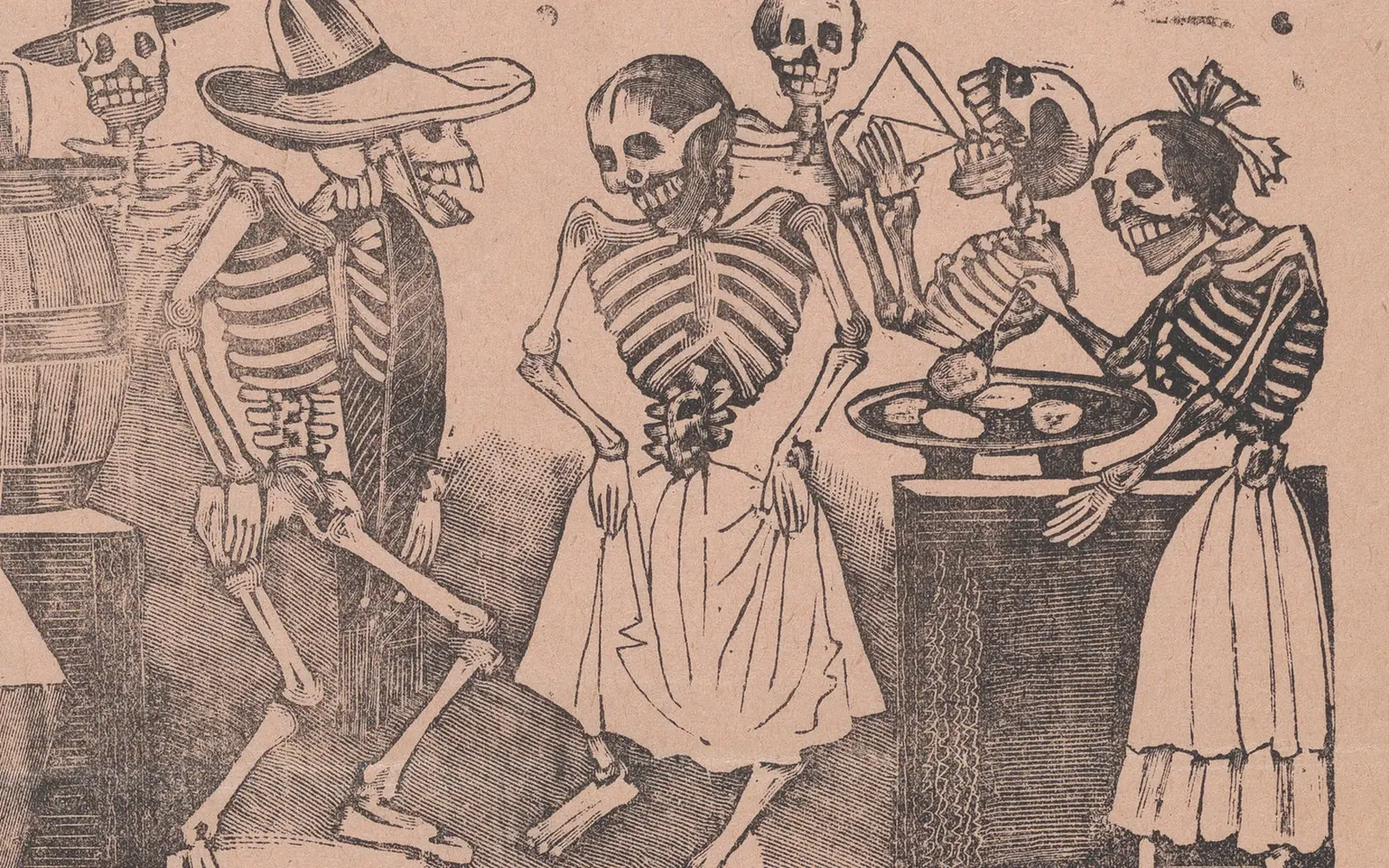
    Posada was an engraver. He worked for Vanegas Arroyo’s print shop making the images: skeletons dancing, riding bicycles, dressed to the nines. The calavera sheets carried one large engraving with the verses around it. Some engravings were made for the occasion and others were reused from earlier sheets.

    And the verses? Other people at the print shop wrote them, and they almost never signed them. Monroy Sánchez examined sixteen of those sheets: most give the year, and none says who wrote them. They ran from 15 to 50 stanzas, in quatrains, and the lines were always eight syllables.

    Posada’s most famous skull, the one we now call La Catrina, appeared on one of those sheets in 1913. That story, with her name and her trip around the world, has its own article.


    Calavera examples for kids, in Spanish

    Three written by our team, to show how they work. All in eight-syllable quatrains, with a plain English gloss so you can follow the joke.

    For the teacher

    La Muerte llegó a la escuela
    buscando a doña Inés,
    pero ella puso tarea:
    y ahora cuenta hasta diez.

    Death came to the school / looking for Mrs. Inés, / but she assigned homework: / and now Death is counting to ten.

    For the brother who’s always hungry

    A mi hermano comelón
    la Calaca fue a buscar;
    comiendo un gran chicharrón,
    y se quedó a merendar.

    For my greedy little brother / Death came calling; / she found him eating a big pork rind, / and stayed for a snack.

    For whoever writes it (fill in the blanks):

    A ________, que siempre ________,
    la Flaca vino a llevar,
    pero ________ ________
    y se tuvo que ________.

    Skinny Death came to take ______, who always ______, / but ______ / and she had to ______.

    Notice the trick in the first two: Death arrives in all her seriousness and ends up caught in the person’s habit. That twist is the joke.


    Can you write one in English?

    Yes, and plenty of classrooms do. English doesn’t count syllables the way Spanish does, so aim for lines of about seven or eight syllables and rhyme the second line with the fourth. Keep the three rules: Death comes for someone real, the joke is about their habit, and it ends with a twist.

    For the teacher, in English

    Skinny Death came to our school
    to take our teacher, Ms. Lee;
    she gave Death a spelling test,
    and Death’s still stuck on letter C.

    For the brother, in English

    Death came knocking for my brother,
    who eats from dawn to night;
    he offered her a taco,
    and now they share each bite.

    In a dual-language or Spanish class, a good challenge is to write the same calavera twice, once in each language, and compare which jokes survive the trip.


    How do you write a calavera step by step?

    1. Pick who it’s for. Someone you know well: your grandpa, your teacher, your dog, yourself. A calavera is written with affection; the joke is for laughing together.

    2. List their habits. What they love to eat, what they always say, what they do when they’re mad, what they play. That list is your rhyme mine.

    3. Imagine the encounter. Death comes for that person and… something happens: she gets distracted, stays to play, has to wait in line, ends up doing the homework. The funny ending comes from your list in step 2.

    4. Rhyme and count. Write four lines. In Spanish, the first rhymes with the third and the second with the fourth (or the first with the fourth and the second with the third). To count syllables, clap each one: la-Muer-te-lle-gó-a-la es-cue-la. Two Spanish tricks:

    • When one word ends in a vowel and the next begins with one, they count as a single syllable: lle-gó a sounds like lle-góa.
    • If a line ends in a word stressed on the last syllable, like Inés or diez, add one syllable to the count.

    The first version is almost never perfect: read it aloud, change a word, and try again.


    How can you use them in the classroom?

    A 50-minute session, from third grade up, or from Spanish II in a world-language class:

    1. Read two calaveras aloud and guess who they’re teasing (10 min).
    2. Clap out the syllables as a whole class, using the example lines (10 min).
    3. Write in pairs, with the fill-in quatrain: each pair picks a character from a book the class has read, so nobody in the room is the target (20 min).
    4. A calavera gallery on the wall or on the class ofrenda (10 min).

    The book-character trick works well: it keeps all the fun and keeps anyone from feeling singled out. If your class is building an ofrenda, Halloween vs. Day of the Dead has ideas for keeping it about real memories. And to decorate the poems, sugar skulls are the natural companion.


    Questions

    Isn’t it in bad taste to make fun of death? It’s a tradition more than a century old, and its point is the reverse: to remember, with humor, that death makes us all equal. What does matter is making sure the joke doesn’t hurt anyone.

    Do they have to be eight syllables? It’s the most common form, and the one that sounds like a calavera. Some calaveras use other line lengths; to start, eight-syllable lines are the easiest to rhyme. In English, aim for the rhythm rather than the count.

    Can you write them about people who have died? The tradition dedicates them to the living: the fun is that Death comes for someone who’s still here. The ofrenda is for remembering those who are gone.


    Sources

    • Grecia Monroy Sánchez, “Muerte, política y sátira en la imprenta popular mexicana: las calaveras del porfiriato a la revolución,” Caracol (Universidade de São Paulo), no. 29, 2025, pp. 442–476. doi:10.11606/issn.2317-9651.i29p442-476 (open access, in Spanish). The references in this article are on pp. 448–452.
    • Stanley Brandes, “Iconography in Mexico’s Day of the Dead: Origins and Meaning,” Ethnohistory 45, no. 2, 1998, pp. 181–218. Open access on eScholarship. El Calavera (1847), p. 202.
    • Cited by Monroy Sánchez: Rafael Barajas Durán, Posada, mito y mitote (FCE, 2009); Montserrat Galí Boadella, “De romances, relaciones y otras hojas volantes…,” in Posada. 100 años de calavera (Fundación BBVA / RM, 2013); Herón Pérez Martínez, “La sátira popular mexicana. Las calaveras” (El Colegio de Michoacán, 2015).

    Written by the Idunn Editorial Team, with support from AI tools in the research and drafting.

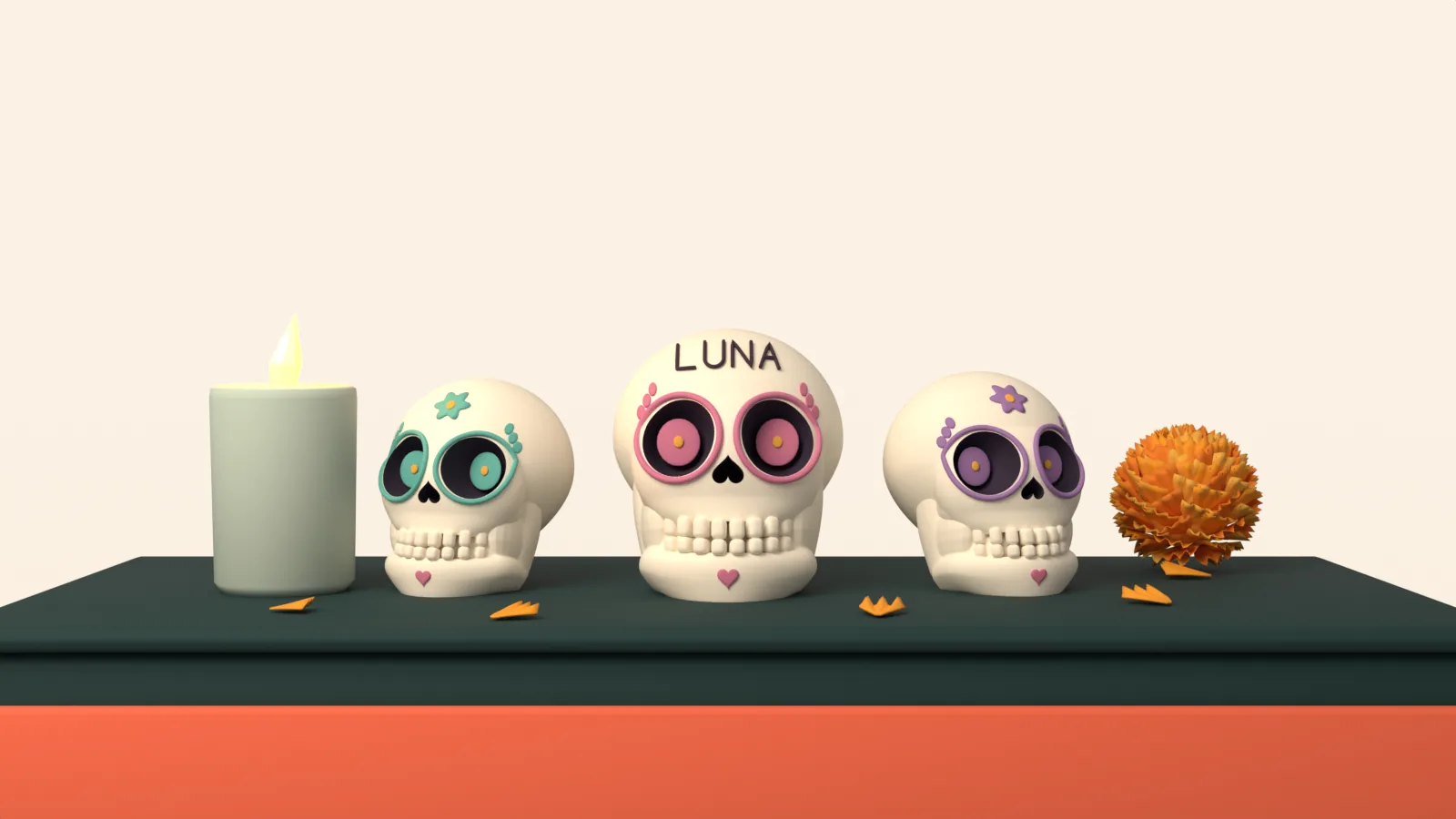
  • Three sugar skulls decorated with flowers on a Day of the Dead altar; the one in the middle has the name Luna on its forehead

    Sugar skulls: where they come from, what they mean and how to make them

    At the end of October, Mexican markets fill with rows and rows of white skulls that sparkle as if they’d been frosted. They have eyes of shiny foil, flowers of colored icing and, across the forehead, a blank space. That’s where the buyer writes a name: a grandmother who’s gone, a friend, a daughter. And the skull, which isn’t the least bit scary, becomes a gift.

    Sugar skulls —calaveras de azúcar, or affectionately calaveritas— date from Mexico’s colonial period: from a candy-making technique of Arab and Andalusian origin, alfeñique, and from the cane sugar that arrived with the Spanish. By the 1760s a friar in Mexico City had already seen a whole market of sugar figures for All Saints’ Day. Skulls became the star figure later, and today they’re made above all in Toluca and Guanajuato.


    Where do sugar skulls come from?

    From a recipe that crossed the ocean and an ingredient that came with it.

    Cane sugar reached New Spain with the Spanish, and before long there were sugar mills and plenty of sugar. With it came a way of making candy: alfeñique, a sugar paste shaped into figures.

    The oldest account we know of comes from a Capuchin friar, Francisco de Ajofrín, who traveled through New Spain between 1763 and 1766. Before All Saints’ Day in Mexico City, as Stanley Brandes recounts, he saw vendors selling thousands of alfeñique figures: little sheep and lambs of sugar paste, which people called an ofrenda and which it was customary to give to the children of the houses you visited. They also sold coffins, tombs and a thousand figures of the dead —clergy, monks, nuns, bishops, horsemen— at a big, colorful fair under the merchants’ arcade.

    Look at that list: sheep, lambs, coffins, tombs, figures of the dead. Skulls aren’t on it. Sugar figures for All Saints’ Day were already there, they were given to children and there was a fair; the skull as the main figure came later. Exactly when, the sources we reviewed don’t pin down.

    Ajofrín already uses the name “Day of the Dead,” and according to the anthropologist Stanley Brandes, who has studied the holiday for decades, those two features —the sugar figures and the name— are among the most distinctive things about the Mexican celebration.


    Do sugar skulls come from the Aztecs?

    It’s the question almost every website answers with a yes. Both sides are worth seeing.

    What’s saidWho says itWhat’s known
    Sugar skulls replaced the skulls of the tzompantli, the skull rack of Aztec templesMany websites and popular magazines, which tell it as factStanley Brandes traced where the idea came from: a connection proposed by one author in 1975, with no documents behind it. He rules it out as a direct origin
    Sugar skulls are a colonial invention, made with sugar and a European techniqueBrandes, and the history of sugar in New SpainSugar and alfeñique arrived with colonial rule, and sugar figures for All Saints’ Day are documented in the eighteenth century

    There’s a deeper difference too: the tzompantli was solemn, and the sugar skull is playful, sweet and given as a gift. Both involve skulls; what they say is very different.

    That doesn’t mean the holiday has nothing Indigenous in it. The Day of the Dead took shape in the colonial period, on the Catholic calendar of All Saints and All Souls, and region by region it took in Indigenous practices. The sugar skull is one of the most clearly colonial pieces of that blend.


    What is alfeñique?

    A candy made of sugar paste that can be molded. According to Larousse’s Diccionario enciclopédico de la gastronomía mexicana, the original recipe is Arab-Andalusian and was made with almonds. In Mexico the name passed to colorful sugar-paste candies of all shapes, and nineteenth-century recipe books describe it as a paste cooked and pulled into thin, twisted bars.

    Today it’s made many ways. In Guanajuato there are two: soft alfeñique, made with water, and hard, made with egg white. Both are molded into skeletons and skulls for the Day of the Dead, and also into fruit, little animals, angels and even miniature dishes, like a plate of mole or enchiladas.

    Sugar skulls were later joined by chocolate skulls and amaranth skulls, made with alegría, a seed that was grown in Mesoamerica long before sugar arrived.


    Where are they made?

    In many places, and two are especially famous:

    • Toluca, in the State of Mexico, holds an ***Alfeñique* Fair** with centuries of history. The arcades of the old town fill with stalls of skulls, skeletons and sugar figures.
    • Guanajuato, with its soft and hard alfeñiques, and towns like Salamanca, where skulls, skeletons and figures of every kind are made for the Day of the Dead.

    What do sugar skulls mean, and why is there a name on the forehead?

    They mean remembrance, with a smile. A sugar skull is a gift. One with your name on it says “I thought of you,” and it’s given to people you love: a friend, a teacher, a relative. On the altar, a skull with the name of someone who has died brings them back to the table for a few days.

    It’s the same idea as calaveras literarias, the teasing Day of the Dead poems, said in sugar: death arrives, and we greet it with humor and affection. That’s also why a sugar skull works best as what it is, a gift with a name on it, rather than as a Halloween costume theme; Halloween vs. Day of the Dead has more on keeping the two apart.


    What about skulls inside pumpkins?

    The two holidays met at the candy stalls too. In the late 1980s, a Toluca craftsman, Wenceslao Rivas Contreras, told researchers that people urged him to stick to Mexican styles, but he liked trying new things: ten years earlier he had started putting skulls inside pumpkins, which were a North American Halloween thing, and he’d make them —witches too— as long as they sold. Even so, he said, the skulls sold best, because they belong to Mexico.

    A sugar skull decorated with flowers peeks out from inside a pumpkin, on a Day of the Dead altar

    A Mexican skull inside a Halloween pumpkin that, as it happens, is Mexican too. Traditions mix in the market long before they mix in the books.


    How do you make sugar skulls at home?

    The traditional way calls for cooking the sugar and using clay molds. There’s a no-cook version, made for doing with kids, that gives you skulls to decorate and give away.

    Materials: 2 cups granulated sugar, 2 teaspoons meringue powder (in the baking aisle of most craft and grocery stores), 2 teaspoons water, a sugar-skull mold (plastic or silicone), a piece of cardboard, and for decorating: colored royal icing, and foil or paper sequins.

    1. Mix the sugar and meringue powder. Add the water a little at a time and work it with your hands until it feels like wet sand.
    2. Press the mixture firmly into the mold and scrape the back flat with a ruler.
    3. Flip the mold onto the cardboard and lift it off carefully.
    4. Let it dry for a full day.
    5. Decorate: foil eyes, icing flowers around the edge, and on the forehead, the name.

    Questions

    Can you eat sugar skulls? You can, although many have foil or sequin decorations that should come off first. Chocolate and amaranth skulls are made to be eaten.

    Why aren’t they scary? Because they’re made for giving and for remembering. On the Day of the Dead, death is welcomed as a visitor.

    Are sugar skulls the same as La Catrina? They’re relatives. La Catrina is a 1913 print by José Guadalupe Posada that over the years became a symbol of the Day of the Dead. Her story is in her own article.


    Sources

    • Stanley Brandes, “El Día de Muertos, el Halloween y la búsqueda de una identidad nacional mexicana,” Alteridades 10, no. 20, 2000, pp. 7–20. Open access on Redalyc (in Spanish). Ajofrín’s account is on p. 17, and the Toluca craftsman on pp. 17–18.
    • Stanley Brandes, “Sugar, Colonialism, and Death: On the Origins of Mexico’s Day of the Dead,” Comparative Studies in Society and History 39, no. 2, 1997, pp. 270–299. doi:10.1017/S0010417500020624
    • Stanley Brandes, “Iconography in Mexico’s Day of the Dead: Origins and Meaning,” Ethnohistory 45, no. 2, 1998, pp. 181–218. Open access on eScholarship. On the tzompantli, pp. 185 and 193–194.
    • Elizabeth Carmichael and Chloë Sayer, The Skeleton at the Feast: The Day of the Dead in Mexico, British Museum Press, 1991.
    • Larousse Cocina, Diccionario enciclopédico de la gastronomía mexicana, “Alfeñique” (in Spanish).

    Written by the Idunn Editorial Team, with support from AI tools in the research and drafting.

  • La Catrina: who created her, who named her and what she means

    La Catrina: who created her, who named her and what she means

    Every November, thousands of people in Mexico paint their faces as skulls, put on a feathered hat and go out into the street dressed as La Catrina. The elegant lady made of bones is on altars, in bakeries, in movies and in clay figures of every size, and in recent years on posters and in parades from Los Angeles to Toronto. She seems to have always been there. And yet she started out as something else: a lone skull in an outrageous hat, on a sheet of cheap paper a little over a hundred years ago.

    La Catrina was born as a print by José Guadalupe Posada published in 1913 under the name Calavera garbancera. It was just a skull in a hat, with no body, and it mocked people who flaunted an elegance they didn’t have. The name Catrina appears in 1930, in a book about Posada with an introduction by Diego Rivera. And in 1947 Diego Rivera gave her a body, a dress and a feather boa in a mural, and put her at the center of Mexico’s history.


    Who created La Catrina?

    José Guadalupe Posada, an engraver from Aguascalientes, born in 1852. He worked for several publishers, above all for Antonio Vanegas Arroyo’s print shop in Mexico City, which sold cheap single sheets with news, songs, miracles and, every November, calaveras: teasing verses paired with engravings.

    Posada supplied the image. Other people at the print shop wrote the verses, almost always unsigned.

    The first recorded appearance of his skull in a hat is in 1913, on a sheet titled Remate de calaveras alegres y sandungueras, now held by the National Museum of Art (MUNAL) in Mexico City. By then Posada had already died, early that year, never knowing how far his drawing would travel. The print shop kept using the same plate for years, with other verses: in 1924 it came out again in El panteón de las pelonas.

    When did he engrave it? Nobody knows exactly. Some propose 1910; the certain date is still its first publication, 1913.


    What does “garbancera” mean?

    There are two readings, and both are worth knowing.

    The most widespread: the skull mocked people who pretended to a social position they didn’t have. In the Mexico of Porfirio Díaz, anything European was seen as elegant, and some people were ashamed of their Indigenous roots and wore ostrich-plume hats to pass for another class. Posada drew her that way: in a huge, luxurious hat, even though she was nothing but bones. It’s the reading found, for example, in Esmeralda Álvarez Contreras’s study (2026).

    Another reading: at the time, garbancera also meant a woman who sold chickpeas (garbanzos), and some researchers read the verses on that sheet as a jab aimed at them in particular.

    Both agree on what matters: the Garbancera was born as satire, a joke about appearances. And the punchline is the same as in every calavera: however much you dress up, underneath we’re all the same.


    Did the original Catrina have a body?

    No. This is the fact that surprises people most: Posada’s Calavera garbancera is only a head. A grinning skull under a wide-brimmed hat heaped with flowers and plumes. No dress, no arms, no boa. No painted face either: it was a black-and-white print, in a single ink.

    Everything else came later, from other hands.


    Who named her “Catrina”?

    The name appears in 1930, in a book collecting hundreds of Posada’s prints: the Monografía de 406 grabados de José Guadalupe Posada, edited by Frances Toor, Blas Vanegas Arroyo and Paul O’Higgins, with an introduction by Diego Rivera. On page 160, the print is titled “Calavera Catrina.”

    In Mexico, catrín and catrina described people who were very well dressed, elegant and a bit of a show-off: a dandy, a fancy lady. The name fit perfectly, and from then on the Garbancera was La Catrina.

    You’ll sometimes read that Posada named her. No document shows it: in Posada’s lifetime, the print wasn’t called that.


    What did Diego Rivera do with her?

    He gave her a body and made her famous. In 1947 Rivera painted an enormous mural in the Hotel del Prado in Mexico City: Dream of a Sunday Afternoon in the Alameda Central. Figures from the whole of Mexican history parade through it: the colonial period, Independence, the Reform, the Revolution.

    And at the center, La Catrina. For the first time full-length, in a long dress and Posada’s hat, with a feather boa shaped like a plumed serpent, like the god Quetzalcóatl. On one arm is José Guadalupe Posada himself, very dapper, and holding her hand is a boy: Diego Rivera, painting himself as a child.

    With that, Rivera paid two tributes at once: to the skull and to the man who engraved it. The mural can be seen today at the Museo Mural Diego Rivera, beside the Alameda park in Mexico City.

    See the full mural on the Museo Mural Diego Rivera website (opens in a new tab). Rivera’s work is still under copyright, so we describe it here and you can see it whole there.

    That’s where the myth that Diego Rivera created La Catrina comes from. What he did was give her a body, a dress and a place of honor. The skull was already Posada’s.


    What’s told and what’s known

    The story goes that…What’s known
    Diego Rivera created La CatrinaJosé Guadalupe Posada engraved her. Rivera painted her full-length in 1947
    Posada named her CatrinaPosada knew her as a calavera, without that name. “Calavera Catrina” appears in 1930
    Posada wrote the Garbancera’s versesPosada made the engravings; the verses were by other writers at the print shop, almost always anonymous
    La Catrina was always a symbol of the Day of the DeadShe was born as a satire on appearances. She became a national symbol over the twentieth century
    The original Catrina had a face painted with flowers and colorsThe print was black and white. The colorful face came much later

    How did she become a symbol of Mexico?

    Little by little, in four steps:

    1. 1920s and 1930s. Artists like Jean Charlot and Diego Rivera, and the editor Frances Toor, rediscover Posada and present him as a great artist of the people. His skulls start to be seen as something deeply Mexican.
    2. 1947. Rivera’s mural puts La Catrina at the center of Mexican history.
    3. From the 1980s. In Capula, Michoacán, a potters’ village, the artist Juan Torres Calderón champions clay Catrinas, now sold all over the country. In 2014 a giant Catrina went up at the entrance to the village.
    4. The movies. The Book of Life (2014), produced by Guillermo del Toro, and Pixar’s Coco (2017) take La Catrina and skull face paint around the world.

    Some say Mexico City’s big Day of the Dead parade, first held in 2016, was inspired by the 2015 James Bond film Spectre, which opens with one that didn’t exist yet. The press and tourism officials have told it that way; we didn’t find a study documenting it, but it’s a good example of how traditions keep moving. How the skull traveled north and into Halloween is in how Halloween came to North America.

    From a joke on a broadsheet to the symbol of a country: La Catrina took about a hundred years to make that trip.


    What does La Catrina mean today?

    Many things at once. For some people she’s the whole Day of the Dead in one figure. For others, a reminder that death comes for everyone, feathered hat or not, which was Posada’s joke. And for many families she’s above all a joyful way of welcoming those who are gone.

    For home or the classroom: draw your own Catrina. Start the way Posada did, with the skull and the hat, and then decide the rest yourself: what flowers does she wear? What color is her dress? What’s her name? And if you want to write her some verses, like the ones on Vanegas Arroyo’s sheets, here’s how to write a calavera literaria.


    Questions

    Is La Catrina a man or a woman? A woman. Her partner, in many figures and costumes, is El Catrín.

    Is La Catrina a Halloween costume? She belongs to the Day of the Dead. In recent years she shows up at Halloween parties too, especially outside Mexico, but she was born here, on the calavera sheets. If you dress as her, the respectful way is the one that knows her story: an elegant skull who reminds everyone that underneath we’re all equal. How the two holidays cross paths is in Halloween vs. Day of the Dead, and her sweet cousins are the sugar skulls.

    Where can you see the original print? Original impressions are held at the National Museum of Art (MUNAL) in Mexico City, and Rivera’s mural is at the Museo Mural Diego Rivera, beside the Alameda.


    Sources

    • Esmeralda Itzel Álvarez Contreras, “Traslado semántico en la imagen del grabado La calavera garbancera del litógrafo mexicano José Guadalupe Posada a principios del siglo XX,” Cuadernos del Centro de Estudios de Diseño y Comunicación (Universidad de Palermo), no. 305, 2026, pp. 149–163. doi:10.18682/cdc.vi305.13641 (open access, in Spanish).
    • Grecia Monroy Sánchez, “Muerte, política y sátira en la imprenta popular mexicana: las calaveras del porfiriato a la revolución,” Caracol, no. 29, 2025, pp. 442–476. doi:10.11606/issn.2317-9651.i29p442-476 (open access, in Spanish).
    • Stanley Brandes, “Iconography in Mexico’s Day of the Dead: Origins and Meaning,” Ethnohistory 45, no. 2, 1998, pp. 181–218. Open access on eScholarship.
    • Ariadna Lorea Ruiz Gómez, “Esqueletos, catrinas y judas en el universo decorativo de Diego Rivera,” Res Mobilis 8, no. 9, 2019, pp. 175–196. doi:10.17811/rm.8.9.2019.175-196 (in Spanish).
    • Frances Toor, Paul O’Higgins and Blas Vanegas Arroyo (eds.), Monografía: las obras de José Guadalupe Posada, grabador mexicano, Mexican Folkways, 1930 (reissued by Editorial RM, 2014).
    • Museo Nacional de Arte, Remate de calaveras alegres y sandungueras, 1913.
    • Museo Mural Diego Rivera, gallery sheet for the mural (in Spanish).

    Written by the Idunn Editorial Team, with support from AI tools in the research and drafting.

  • How Halloween came to North America, layer by layer

    How Halloween came to North America, layer by layer

    On almost any street in the United States or Canada, on the night of October 31, there are lit pumpkins on the steps, scarecrows on the porches, cotton cobwebs in the windows, and knots of kids in costume going door to door with a pillowcase in hand. It all looks as old as the continent. And yet that night, the way we know it, is only a little over a hundred years old.

    Halloween arrived in North America in the nineteenth century with Irish and Scottish families who crossed the Atlantic, and here it was rebuilt one layer at a time. The pumpkin replaced the turnip. Early twentieth-century postcards fixed the witches and black cats in place. Trick-or-treating took hold in the 1920s and 1930s, and the phrase itself was first printed in Canada. And only a few decades ago, a Mexican layer was added: the skull. This is how it was put together, piece by piece.


    What did Irish and Scottish families bring with them?

    Games, pranks and a bit of magic. In Ireland, Scotland and Wales, Halloween night had been tied for centuries to fairies, mischief and, above all, fortune-telling about love.

    The most famous witness is a poem. In 1785 the Scottish poet Robert Burns wrote “Halloween,” published the following year. It describes a night in the countryside when young people play games to find out whom they’ll marry. In one, you pulled a kale plant from the garden and looked at the stalk: if it came up straight, your future spouse would be tall and strong; if it came up crooked, less so. In another, you set nuts by the fire, each one named for someone, and watched how they behaved as they roasted. And the poem opens with fairies dancing on the hills that night.

    Then came the crossing. Between 1845 and 1852, the Great Famine drove hundreds of thousands of people out of Ireland, most of them to the United States and many to British North America, today’s Canada. According to the folklorist Lisa Gabbert, they brought with them the pranks and mischief of that night and the rounds from house to house asking for something.


    Was there anything here before?

    There was autumn, harvest and ghost stories. And one book that brings them all together.

    Around 1820, Washington Irving published The Legend of Sleepy Hollow. In it, a schoolmaster named Ichabod Crane walks past fields where ears of corn peek out from their leafy coverts and, below, yellow pumpkins lie turning their bellies to the sun, “giving ample prospects of the most luxurious of pies.” He arrives at a farmhouse party with apple, peach and pumpkin pies, and by the end of the night the guests are telling ghost stories.

    That same night, Ichabod meets the dreaded Headless Horseman. The next morning all anyone finds by the brook is his hat and, close beside it, a shattered pumpkin. The reader gets the joke: his rival had dressed up as the rider and thrown a pumpkin at him.

    The story doesn’t take place on Halloween, but it already has nearly everything: corn, pumpkins, apples, pranks and ghosts. When the Irish holiday arrived, it found the stage already set.


    When did the pumpkin get a face?

    In the mid-nineteenth century. In Ireland and Scotland people carved turnips; in North America pumpkins were bigger and easier to hollow out, and the turnip was left behind.

    By February 1852 the carved pumpkin was already in literature: in Nathaniel Hawthorne’s story “Feathertop”, a witch cuts “two holes for the eyes and a slit for the mouth” in a pumpkin to make a scarecrow’s head.

    The story of the lantern is in the legend of the jack-o’-lantern, the scarecrow has an article of its own, and the pumpkin, which comes from Mexico, is in where pumpkins come from.


    What did postcards have to do with it?

    They gave Halloween its face. Between 1900 and 1920 the United States went through the “golden age” of the postcard, and Halloween had its own.

    The historian Adrienne Darrah explains how it happened:

    • In 1898 Congress allowed postcards printed by private companies to be mailed at the same cheap one-cent rate.
    • By 1909 more than a billion postcards were being sold in the United States a year. Many of the prettiest were printed in Germany.
    • That same year a tariff made German postcards more expensive, and around 1910 the craze began to fade.

    In those twenty years, Halloween postcards filled up with witches, black cats, pumpkins, moons and love-divination games: apples, mirrors, couples peering into the future. The people who bought and mailed them most were women of the new middle class. And so what used to vary from one town to the next became a single picture shared by the whole country. If you’ve ever bought a “vintage Halloween” print, you’ve bought that picture.


    And the party games?

    They came out of fortune-telling. Bobbing for apples floating in a tub of water, hanging apple peels to see who walks under them, setting nuts by the fire: all of them were love-divination games that came over from Britain and Ireland and turned into party games. In the early twentieth century, Halloween parties at home, with costumes and games, became fashionable.

    More than a hundred years later, bobbing for apples is still one of the night’s favorite games.


    When did trick-or-treating start?

    In the 1920s and 1930s, and it became the custom of the whole continent after the Second World War.

    Before that, the night was known for pranks: gates taken off their hinges, wagons hoisted onto roofs, windows soaped. Trick-or-treating brought some order to that night. Instead of random mischief, kids in costume went from house to house, and anyone who handed over a treat was spared the trick.

    The words appear first in Canada. The Dictionary of Canadianisms on Historical Principles, from the University of British Columbia, finds them in Ontario in 1917, as “tricks or treats” in Sault Ste. Marie and “treat or trick” in Owen Sound. The exact phrase turns up in 1927, in a report from Blackie, Alberta: kids at the back door and the front “demanding edible plunder by the word ‘trick or treat.’” From there it spread south and west until it was simply what Halloween sounded like.

    Its distant relatives are the rounds of Britain and Ireland: souling, asking for food in exchange for praying for the souls of the dead, and guising, going from house to house in disguise. The step from those to trick-or-treating hasn’t been documented in a straight line; the family resemblance has.

    In the 1970s another layer appeared: the fear of razor blades and poison in Halloween candy. The historian Nicholas Rogers devotes a whole chapter to it and studies it as a collective panic. It left behind a habit that’s still alive: checking the candy when you get home.


    And the Mexican skull?

    It’s the most recent layer, and its dates are fairly clear. According to the researcher Regina Marchi:

    WhenWhat happened
    Before the 1970sIn the United States, sugar skulls, pan de muerto and the altars of southern Mexico were practically unknown
    Early 1970sIn Los Angeles and San Francisco, Chicano artists organize the first public Day of the Dead celebrations, with sugar-skull workshops and altar exhibitions. The skull becomes a symbol of Chicano identity
    2000sDay of the Dead imagery reaches mass media: TV series, films, magazines
    2010sSkulls and the Catrina show up in Halloween-store costumes, phone cases and beer cans, and the debate over cultural appropriation begins
    2013Disney tries to trademark “Día de los Muertos” and withdraws after public backlash
    2017Coco is released

    So the skull has been in the United States for half a century, and mixed in with Halloween for about fifteen years. Sugar skulls and La Catrina have histories of their own, which began in Mexico long before. And how the two holidays sit side by side is in Halloween vs. Day of the Dead.


    The history of Halloween in North America, in one table

    LayerWhenFrom where
    Love divination, fairies and pranksEighteenth and nineteenth centuriesScotland and Ireland (Burns, 1785)
    Autumn, harvest and ghost storiesAround 1820United States (Irving)
    The great Irish migration1845–1852Ireland, to the United States and Canada
    The pumpkin instead of the turnipMid-nineteenth centuryNorth America, with a plant from Mexico
    Witches, black cats and pumpkins on postcards1900–1920Printers in the United States and Germany
    The scarecrow as an autumn figureFrom 1900Seasonal decorations in the United States
    Costume parties and gamesEarly twentieth centuryUnited States and Canada
    Trick-or-treating1920s–1930s; the whole continent after 1945The phrase: Ontario 1917, Alberta 1927
    The Mexican skullChicano since the 1970s; part of Halloween since the 2010sMexico, by way of the Chicano movement

    Questions

    Is Halloween an American holiday? The way it’s celebrated today, yes: it was assembled in the United States and Canada between the nineteenth and twentieth centuries. Its name and date are much older and come from the Christian eve of All Saints in Britain and Ireland. That’s the subject of where Halloween came from.

    Is Halloween in Canada the same as in the United States? Almost layer for layer, since both countries received the same immigrants and the same customs. Canadians often keep the older spelling, Hallowe’en, and the earliest printed “trick or treat” is Canadian.

    When did Halloween reach Mexico? In the north, many decades ago; in the rest of the country it became visible mainly in the 1990s. How it relates to the Day of the Dead is in this article.


    Sources

    • Lisa Gabbert, “Divination Games and the Romantic Halloween Postcard,” Ritsumeikan Bungaku 683, 2023, pp. 291–306. Open-access PDF.
    • Adrienne Darrah, “May fortune’s lantern burn serene: An analysis of golden age Halloween postcards as middle-class promotional culture,” Journal of American Culture 47, no. 3, 2024, pp. 218–230. doi:10.1111/jacc.13580 (open access).
    • Washington Irving, “The Legend of Sleepy Hollow,” in The Sketch Book of Geoffrey Crayon, 1819–1820. Text on Project Gutenberg.
    • Nathaniel Hawthorne, “Feathertop: A Moralized Legend,” The International Magazine, February and March 1852. Text on Project Gutenberg.
    • Nicholas Rogers, Halloween: From Pagan Ritual to Party Night, Oxford University Press, 2002.
    • Tad Tuleja, “Trick or Treat: Pre-Texts and Contexts,” in Jack Santino (ed.), Halloween and Other Festivals of Death and Life, University of Tennessee Press, 1994, pp. 82–102.
    • “Trick or treat,” DCHP-3: Dictionary of Canadianisms on Historical Principles, University of British Columbia. Entry.
    • Regina Marchi, “U.S. Day of the Dead: Fusing Spanish, Indigenous and U.S. Cultures to Communicate New Messages,” Camino Real 3, no. 5, 2011, pp. 103–125. Open-access PDF, Instituto Franklin (UAH). Dates in the table, pp. 109–114.
    • Colin Gunckel, “Charles and Ray Eames’s Day of the Dead (1957)…,” in Screening Race in American Nontheatrical Film, Duke University Press, 2019, pp. 136–156. doi:10.1515/9781478090090-010 (open access).
    • Orquidea Morales, “Horror and Death: Rethinking Coco‘s Border Politics,” Film Quarterly 73, no. 4, 2020, pp. 41–49. doi:10.1525/fq.2020.73.4.41

    Written by the Idunn Editorial Team, with support from AI tools in the research and drafting.

  • A sugar skull decorated with flowers peeks out from inside a pumpkin, on a Day of the Dead altar

    Halloween vs. Day of the Dead: how they’re alike and how they differ

    In many Mexican homes, on the night of October 31, the kids go out dressed as witches and vampires to ask for candy, and the next morning the same family sets up the ofrenda, the home altar, with marigolds, pan de muerto and a photo of Grandma. Two holidays in three days, both with skulls, both with the dead. And north of the border, the same week, a classroom hangs paper bats on one wall and cut-paper banners on the other. So are they the same thing? Is one crowding out the other?

    Halloween and the Day of the Dead are two different holidays that share their dates for the same reason: both rest on the Catholic calendar of All Saints’ Day (November 1) and All Souls’ Day (November 2). Halloween is the eve, and it grew up in Ireland, Scotland, the United States and Canada as a night of costumes, frights and candy. The Day of the Dead took shape in Mexico during the colonial period, blending that calendar with Indigenous practices, and it’s a celebration for welcoming back the family’s dead. They’re cousins: same grandmother, different roads.


    Is the Day of the Dead “Mexican Halloween”?

    It’s the question almost everyone asks first, so it’s worth answering head-on: they’re related, and each one belongs to its own home. The Day of the Dead is a family holiday about specific people who died; Halloween is a community night of play and make-believe. They share a calendar and a few symbols, and the rest of this article is about where they meet and where they part.


    How are they alike?

    In more ways than you might expect:

    • The date. Both hang from the same calendar. Halloween is the eve of November 1; the Day of the Dead is November 1 and 2. The story of those dates starts with the popes of Rome and the monks of Cluny.
    • Death as the theme. Both are about the dead and what lies beyond, and both often handle it with humor.
    • Skulls. They show up in both, though they play different parts.
    • Something given or shared. Candy for whoever knocks on Halloween; bread, food and sugar skulls on the Day of the Dead.
    • Both were built in layers, over centuries, and both keep changing.

    How are they different?

    HalloweenDay of the Dead
    WhenOctober 31November 1 and 2 (in many places, starting on the 31st)
    Where it comes fromThe eve of All Saints in Ireland, Scotland and England; transformed in the United States and Canada in the nineteenth and twentieth centuriesTook shape in Mexico in the colonial period, on the Catholic calendar, with the Indigenous practices of each region
    What it celebratesA night of fantasy, frights and playThe visit of the family’s dead
    Who is rememberedNo one in particular: the characters are witches, ghosts, monstersSpecific people: a grandmother, an uncle, a friend
    Where it happensOut on the street, door to door, and at partiesAt home, around the ofrenda, and at the cemetery
    What people doDress up, trick-or-treat, carve pumpkinsBuild the ofrenda, visit and decorate graves, eat together, write calaveras
    Its symbolsJack-o’-lantern, witch, black cat, ghost, bat, scarecrowMarigolds (cempasúchil), ofrenda, pan de muerto, papel picado, candles, La Catrina, literary calaveras
    The role of deathSomething that scares you, and that you play withSomeone who visits, and whom you welcome
    Recognition—UNESCO inscribed it in 2008 as intangible cultural heritage: the Indigenous festivity dedicated to the dead

    If you had to say it in one sentence to a child: on Halloween we play at being scared of the dead; on the Day of the Dead, we invite them to dinner.


    Whose skulls are they?

    Both holidays’, with different stories.

    On the Day of the Dead, skulls are playful and affectionate: sugar skulls with a name across the forehead, the teasing verses of literary calaveras, and the elegant Catrina, who was born in a print by José Guadalupe Posada in 1913.

    On Halloween, for more than a century, skulls were skeletons meant to scare. The decorated Mexican skull, with its flowers, joined American Halloween very recently. According to the researcher Regina Marchi, before the 1970s it was practically unknown in the United States; it arrived with the Chicano movement, and in the 2010s it showed up in Halloween-store costumes. That’s part of how Halloween came to North America.


    How did the two meet in Mexico?

    Through the north first, and then everywhere. The anthropologist Stanley Brandes documented that in Chihuahua, Coahuila and Sonora, the states along the U.S. border, Halloween had been around for a long time. A friend of his from Coahuila remembered that in his childhood, in the 1940s and 1950s, his family celebrated only Halloween, and that the skulls of Mexico City frightened him.

    By the 1990s, pumpkins and costumes were all over the country, and the backlash came. Brandes describes a mural in Tepoztlán, Morelos, showing a soccer player kicking a pumpkin-headed figure under the words “No to Halloween. Keep your traditions.” And altar contests that disqualified anything “foreign to our tradition.”

    At the same time, the two holidays were already mixing in the markets. A craftsman in Toluca said that around then he had started making sugar skulls set inside pumpkins, “because they sell,” although the skulls were still the favorites: “they belong to us, to Mexico!” And the Halloween pumpkin, as it happens, is a Mexican plant.


    Can you celebrate both?

    Many families do, and each finds its own way. In some homes the 31st is costume night and the 1st and 2nd are ofrenda days; others prefer just one. Both holidays have a history, and both say something about the people who celebrate them.

    In the United States and Canada, the Day of the Dead now turns up in schools, libraries and museums, and a fair question comes with it: how do you take part if it isn’t your family’s tradition? Marchi traces the appropriation debate to the moment the skull became a costume in the 2010s. The view we share, from Mexico, is simple. Learn where it comes from, and keep the ofrenda for what it’s for: remembering someone real. A classroom altar with photos of the students’ own grandparents, pets or heroes is closer to the holiday than any skull costume.

    One idea that works with kids: use both holidays to talk about the same thing from two sides. Halloween opens the conversation about fear; the Day of the Dead, about memory. And both are a good excuse to ask at home: who do we remember? What did they like to eat? What stories did they tell us?


    For home or the classroom

    A two-circle Venn diagram. In one circle, what belongs only to Halloween; in the other, what belongs only to the Day of the Dead; in the middle, where they overlap, what they share. With the table above it takes fifteen minutes, and it gets a good conversation going. It works in English, Spanish or both, which makes it a natural fit for dual-language classes.


    Questions

    What day is each one celebrated? Halloween is on October 31. The Day of the Dead is November 1 and 2; in many regions of Mexico it starts earlier, and in some places one day is set aside for children who have died.

    Is the Day of the Dead pre-Hispanic? It has Indigenous roots and Catholic roots. The Mexica (Aztecs) honored their dead at other times of the year; the November dates arrived with the Spanish conquest, and the holiday grew out of that encounter. The full story is in why the Day of the Dead falls on November 1 and 2.

    Is Halloween celebrated in Mexico? Yes, especially by kids, and increasingly alongside the Day of the Dead rather than instead of it. Where Halloween itself came from is in its own article.


    Sources

    • Stanley Brandes, “El Día de Muertos, el Halloween y la búsqueda de una identidad nacional mexicana,” Alteridades 10, no. 20, 2000, pp. 7–20. Open access on Redalyc (in Spanish). Coahuila and Tepoztlán, p. 16; the Toluca craftsman, pp. 17–18.
    • Francis Mershman, “All Saints’ Day” and “All Souls’ Day,” The Catholic Encyclopedia, 1907. All Saints · All Souls.
    • UNESCO, “Indigenous festivity dedicated to the dead”, 2008.
    • Regina Marchi, “U.S. Day of the Dead: Fusing Spanish, Indigenous and U.S. Cultures to Communicate New Messages,” Camino Real 3, no. 5, 2011, pp. 103–125. Open-access PDF.
    • Colin Gunckel, “Charles and Ray Eames’s Day of the Dead (1957)…,” in Screening Race in American Nontheatrical Film, Duke University Press, 2019. doi:10.1515/9781478090090-010.
    • Nicholas Rogers, Halloween: From Pagan Ritual to Party Night, Oxford University Press, 2002.

    Written by the Idunn Editorial Team, with support from AI tools in the research and drafting.