Author: Equipo Editorial Idunn

  • Where did Halloween come from? Origins and myths

    Where did Halloween come from? Origins and myths

    Every October the same things come out of the basement: the plastic skeleton, the orange lights, the bag of fun-size candy you buy too early and have to buy again. On the last night of the month, millions of kids put on costumes and walk the block in the dark, ringing doorbells, half scared and half delighted. It feels ancient. Some of it is. A surprising amount of it is younger than your great-grandparents.

    The short answer: Halloween began as the eve of All Saints’ Day —All Hallows’ Eve— in Ireland, Scotland and England, with one foot in Samhain, the Irish festival that marked the end of summer, though historians still argue about how much it contributed. In the nineteenth century it crossed the Atlantic with Irish and Scottish immigrants, and in the United States and Canada it became the holiday we know. Everything in between —the Celts, the turnips, Stingy Jack— is a tangle of history and legend worth pulling apart.


    What does the word “Halloween” mean?

    “The eve of All Saints.” In Old English, hallow meant “saint” or “holy person,” and All Hallows was All Saints’ Day, November 1. The night before was All Hallows’ Even, and over the centuries the name squeezed down to Hallowe’en —the spelling many Canadians still use— and then to Halloween.

    The name already tells half the story: Halloween is, first of all, the night before a Christian feast day.


    Who put All Saints’ Day on November 1?

    The popes in Rome, one step at a time. According to the Catholic Encyclopedia of 1907, which summarizes the history of the feast:

    WhenWhat happened
    609 or 610Pope Boniface IV dedicates the Pantheon in Rome to the Virgin Mary and all the martyrs, on May 13
    731–741Pope Gregory III consecrates a chapel in St. Peter’s to all the saints and sets their feast on November 1
    827–844Pope Gregory IV extends that feast to the whole Church
    Around the year 1000Saint Odilo, abbot of Cluny in France, orders an annual remembrance of all the dead the day after: November 2, All Souls’ Day

    That is how the two days ended up side by side: November 1 for the saints, November 2 for all the dead. Centuries later, that same pair of dates traveled to Mexico and gave shape to the Day of the Dead. That story is in why Day of the Dead falls on November 1 and 2.


    What was Samhain?

    An Irish festival on November 1. Its name is usually translated as “summer’s end,” and it marked the turn into the dark half of the year. Most of what we know about it comes from medieval Irish texts, written down by Christian monks several centuries after the times they describe. In those stories, Samhain was when people gathered and feasted, and a night when supernatural things could happen.

    That much you can read in the sources. The rest is where the debate starts.

    What you’ll read on a lot of websites: that Samhain was the Celtic New Year and the great festival of the dead, that it has been celebrated for more than three thousand years, and that Halloween is its direct descendant.

    What the people who study it say: Ronald Hutton, a historian at the University of Bristol, published an article in 2024 about exactly those two ideas. He explains that by the early twenty-first century they had become an “established orthodoxy” in books about the Celts, and that they trace back mainly to two Victorian scholars, John Rhys and James Frazer. His work goes back over the evidence they offered for it.

    There’s one more detail that matters. It’s often said that the Church moved All Saints’ Day to November 1 to paper over Samhain. Historians who have looked at the calendar, like Hutton and Nicholas Rogers, point out that November 1 caught on first in England and Germany, around the year 800, while Ireland kept celebrating its saints in the spring. If the plan was to replace an Irish festival, it started in the wrong place.

    Where that leaves us: Samhain existed, and it fell on the same date. How much it gave to Halloween is what’s argued over. Most of the specific customs —praying for souls, going door to door— come, according to Rogers, from the Christian cycle of All Saints and All Souls.


    Where does trick-or-treating come from?

    From several customs in Britain and Ireland, and from a twentieth-century North American invention.

    • Souling: in England, around All Saints and All Souls, children and poor people went from house to house asking for food in exchange for praying for the souls of the family’s dead.
    • Guising: in Scotland and Ireland, groups of young people in disguise went around the houses on Halloween night, singing or performing in exchange for something.

    Those rounds and trick-or-treating are clearly related, although scholars haven’t been able to show a direct line from one to the other. What is documented is how the phrase itself appeared. The Dictionary of Canadianisms on Historical Principles, from the University of British Columbia, records it first in Ontario: in 1917 a newspaper in Sault Ste. Marie heard gangs of kids calling out “tricks or treats,” and one in Owen Sound heard “treat or trick.” The exact words “trick or treat” show up in 1927, in a report from Blackie, Alberta, about children at the back door and the front “demanding edible plunder.” So the phrase is, as far as anyone can tell, Canadian.

    The custom spread across the United States and Canada in the 1920s and 1930s, paused with sugar rationing during the Second World War, and came back after it as the holiday of an entire continent.

    What gets repeated: that trick-or-treating “comes from the Celts.” No document supports it.


    Did the Celts carve turnips?

    This is the internet’s favorite Halloween story, and it has two sides.

    For a long time it was said that the Celts carved faces into turnips to scare off spirits at Samhain. Books said so, and so did a 1982 Library of Congress pamphlet. Historians who went looking for the evidence, like Ronald Hutton, don’t find turnip lanterns before the modern era: the custom is documented in Ireland, Scotland and England in the nineteenth and twentieth centuries.

    The carved turnip is real, and it’s lovely. It’s just much younger than the story says. How it went from turnip to pumpkin, and who is supposed to be carrying that light, is the subject of the legend of the jack-o’-lantern. And the pumpkin itself, as it happens, is from Mexico: that’s in this other article.


    How did it become the holiday we know?

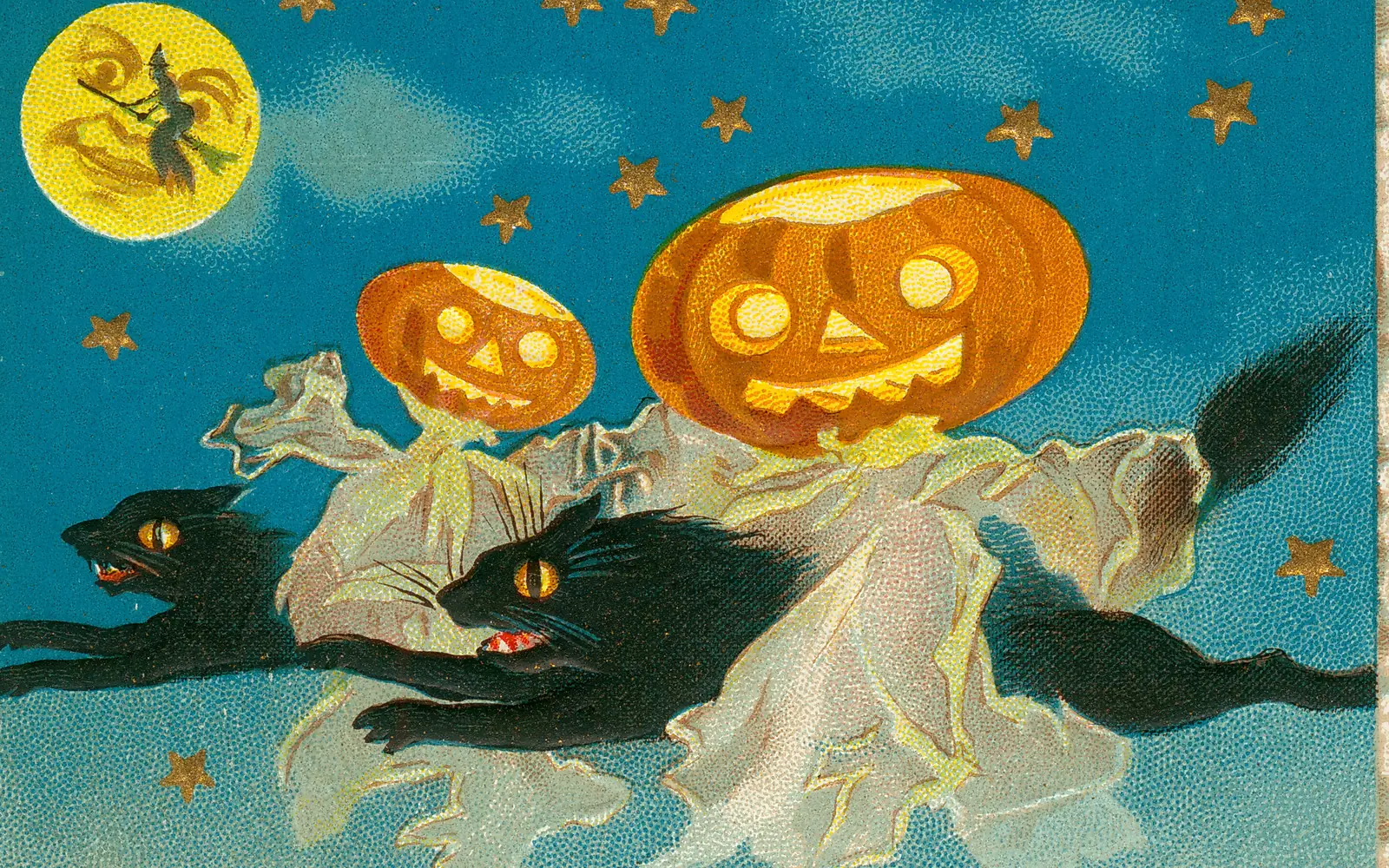
    By crossing the ocean. In the nineteenth century, hundreds of thousands of Irish and Scottish families emigrated to the United States and Canada and brought their autumn customs with them. There, in a little over a hundred years, Halloween picked up new layers: the pumpkin instead of the turnip, postcards with witches and black cats, the harvest-season scarecrows, costume parties and, last of all, trick-or-treating.

    That transformation, layer by layer, has its own article.


    And in Mexico?

    The traffic went both ways. The anthropologist Stanley Brandes, who studied the Day of the Dead for decades, documented that in the northern states of Chihuahua, Coahuila and Sonora Halloween was present long before it reached the rest of Mexico. A friend of his from Coahuila told him that in his childhood, in the 1940s and 1950s, his family celebrated only Halloween, and that the skulls of Mexico City frightened him.

    By the 1990s, pumpkins and costumes were everywhere in Mexico, and so was the backlash. Brandes describes a mural in Tepoztlán, Morelos, with a sign reading “No to Halloween. Keep your traditions,” and altar contests that disqualified anything “foreign to our tradition.”

    Today many Mexican families celebrate both: Halloween on the 31st and the Day of the Dead on the 1st and 2nd. Meanwhile, the Day of the Dead has traveled north and has its own place in schools and neighborhoods across the United States and Canada. How the two holidays are alike and how they differ is in Halloween vs. Day of the Dead.


    What’s told and what’s known

    The story goes that…What’s documentedWho says so
    Halloween is a Celtic festival more than three thousand years oldIts name and date come from the Christian eve of All Saints. Samhain existed on the same date; how much it contributed is debatedRogers 2002; Hutton 2024
    Samhain was the Celtic New Year and the festival of the deadIt became an “established orthodoxy” tracing back mainly to Rhys and Frazer, Victorian scholars. Hutton re-examines their evidenceHutton 2024
    The Church put All Saints on November 1 to cover up SamhainThe date caught on first in England and Germany; Ireland celebrated its saints in the springHutton 1996; Rogers 2002
    The Celts carved turnipsTurnip lanterns are documented in the nineteenth and twentieth centuriesHutton 1996
    The legend of Jack is from ancient IrelandThe oldest version anyone has been able to read is from 1894, and it has no turnip and no Halloween yetPatterson 1894
    Trick-or-treating comes from the CeltsIt has relatives in British and Irish souling and guising; the phrase appears in Ontario in 1917 and in its exact form in Alberta in 1927Hutton 1996; Rogers 2002; Tuleja 1994; DCHP-3

    Questions

    Is Halloween a religious holiday? It began as the eve of a religious feast, All Saints’ Day. Today, for most people who celebrate it, it’s a night of costumes and candy.

    Are Halloween and the Day of the Dead the same thing? They’re two different holidays that share dates, because both lean on the calendar of All Saints and All Souls. How they’re alike and how they differ is in their own article.

    Why is Halloween on October 31? Because it’s the eve of November 1, All Saints’ Day.

    Is “trick or treat” American? The custom grew up in the United States and Canada together, but the earliest printed records of the phrase are Canadian: Ontario in 1917, and Alberta in 1927 for the exact words.


    Sources

    • Nicholas Rogers, Halloween: From Pagan Ritual to Party Night, Oxford University Press, 2002. doi:10.1093/oso/9780195146912.001.0001
    • Ronald Hutton, “The Celtic New Year and Feast of the Dead,” Folklore 135, no. 1, 2024, pp. 69–86. doi:10.1080/0015587X.2023.2282282 (open access).
    • Ronald Hutton, The Stations of the Sun: A History of the Ritual Year in Britain, Oxford University Press, 1996.
    • Francis Mershman, “All Saints’ Day” and “All Souls’ Day,” The Catholic Encyclopedia, vol. 1, 1907. All Saints · All Souls.
    • Tad Tuleja, “Trick or Treat: Pre-Texts and Contexts,” in Jack Santino (ed.), Halloween and Other Festivals of Death and Life, University of Tennessee Press, 1994, pp. 82–102.
    • W. H. Patterson, “Irish Fairies,” Proceedings of the Belfast Naturalists’ Field Club, 1894, p. 582. Internet Archive.
    • “Trick or treat,” DCHP-3: Dictionary of Canadianisms on Historical Principles, University of British Columbia. Entry.
    • Stanley Brandes, “El Día de Muertos, el Halloween y la búsqueda de una identidad nacional mexicana,” Alteridades 10, no. 20, 2000, pp. 7–20. Open access on Redalyc. Coahuila and Tepoztlán, p. 16.

    Written by the Idunn Editorial Team, with support from AI tools in the research and drafting.
  • Until what age to read aloud: there is a number

    Until what age to read aloud: there is a number

    There was a year when it stopped. Almost nobody decides it. They learned to read on their own, the evenings got busier, a new activity took over Tuesdays, and one night the book simply stayed in their room. Nobody noticed it was the last time.

    Whether that was fine has an answer, and the answer comes with a number.

    Until seventh or eighth grade, around twelve or thirteen. The reason: all through elementary school, the ceiling on what a child can understand by reading is set by what they can understand by ear. And for years, the ear runs well ahead.

    This is one of ten reasons a child won’t read, seen from the side of the bridge between listening and reading.

    Until what age? The short answer

    Andrew Biemiller, of the Institute of Child Study at the University of Toronto, put it this way: “average children don’t reach the point of being able to read what they could understand if they heard it until around 7th or 8th grade” (American Educator, 2003).

    For a family, that means that all through elementary school there’s a band of stories, ideas and words that your child follows perfectly when someone reads them aloud, and can’t yet reach alone. That band is the reason to keep going.

    The figure needs two notes to be used well. It comes from a research synthesis published in 2003, which rests in turn on work from the eighties, and the question has been re-examined since. Take it as an order of magnitude, the whole of elementary school, and let go of the exact birthday.

    Why: the ear sets the ceiling

    The mechanism sits in one sentence of the same article: “during elementary school, a child’s maximum level of reading comprehension is determined by the child’s level of listening comprehension.”

    Reading does two jobs at once. One is decoding, turning letters into words. The other is understanding: following the plot, keeping the characters straight, catching the joke. While the first one still takes effort, the second gets whatever is left over.

    When someone reads aloud, the decoding job disappears entirely. All of a child’s capacity to understand is free for the story, which is where the good part lives.

    That’s why an eight-year-old can follow, by ear, a novel they’d abandon on page twelve if they read it themselves, and ask for “just one more chapter” with a straight face.

    What a child who can already read gains

    Three concrete gains.

    Vocabulary that conversation can’t supply. Adult books carry 52.7 rare words per thousand, and children’s books 30.9. Conversation between two college graduates carries 17.3 (Cunningham and Stanovich, 1998). A book read aloud above their level hands them words that neither their day nor their own reading will. The full table is in the article on graphic novels.

    Long sentences. A sentence with three layers of clauses is understood by ear long before it’s understood on the page. Hearing them is how they get learned.

    The time itself. Fifteen minutes a day with someone reading to them is one of the few things in the early teen years that can be scheduled without a negotiation.

    One note on differences, to read without labeling anyone: the gap between children in listening vocabulary is wide, and it shows up early. Biemiller sizes it by saying that a sixth grader at the 25th percentile has the listening vocabulary a 75th-percentile third grader already had. That describes how much there is to gain through the ear, and it describes groups. About one particular child, it says very little.

    There’s a fourth gain, and it’s for the grown-up. Reading aloud belongs to both people on the couch. The book you’d never have picked for yourself, the chapter that made you both laugh at the same line: the adult’s curiosity gets fed too.

    Why it stops too early

    Rarely for teaching reasons. Usually for three that nobody says out loud:

    • It looks like babying them. The most common one, and it tends to come from outside the house.
    • They said they can read on their own now. Which is true, and a different question from the one here.
    • The routine moved. Bedtime changed, a baby arrived, soccer started.

    All three are about the calendar, and none of them touches what gets gained. The first one has its answer in the figure above: seventh or eighth grade.

    How to read aloud to a ten-year-old

    It works differently from reading to a five-year-old, and that’s the part nobody explains.

    1. Raise the level of the book. The target is exactly what they wouldn’t read alone. If they can read it unaided, let them read it unaided.
    2. Chapters, with no obligation to finish. One a night, stopping right where it gets good.
    3. Give them the chooser’s role. Let them pick between two, and let them veto.
    4. Try somewhere new. The kitchen while you cook, the car, the couch. Bedtime already has its own negotiations.
    5. Take turns if they want to. A page for you, a page for them. And when they tire of their page, carry on without comment.
    6. Read it the way stories are meant to be read aloud. Short sentences, pauses, and no fear of doing voices. The guide to writing a story has the test: if you run out of breath, the sentence was too long.

    And if you can’t be the voice every day, an audiobook does part of this job. With its limit, explained in the article on formats: it carries the story, and decoding practice happens separately. On the busiest nights, five minutes of reading together keeps the thread alive.

    Where to start

    Tonight, without announcing that anything is starting again: sit down with a book that’s a little too big for them and read one chapter. If they say they can read on their own now, tell them you know, and keep reading.

    And if the problem turns out to be something else, there are nine more reasons in the ten, ordered from the cheapest to rule out to the slowest to change.

    Where these numbers come from

    • Biemiller, Andrew, “Oral Comprehension Sets the Ceiling on Reading Comprehension,” American Educator, Spring 2003. The author is at the Institute of Child Study, University of Toronto. The seventh-or-eighth-grade figure comes from a synthesis of earlier research, and the question has been re-examined since. Source
    • Cunningham, Anne E. and Stanovich, Keith E., “What Reading Does for the Mind,” American Educator, 1998. Table 1, adapted from Hayes and Ahrens (1988). Source
  • Reading games for kids: seven worth playing tonight

    Reading games for kids: seven worth playing tonight

    The reading log has been on the fridge since September. Three weeks of initials, then a long row of empty boxes that nobody mentions anymore.

    There’s another way into the same place. Seven word games to play at home, with the age, the minutes and the best spot for each one. All seven pass the same test: take away whatever you win, and the round is still worth its five minutes. That test is what sorts them, and what separates a game from a sticker chart on the fridge door.

    This is one of ten reasons a child won’t read: reading and being graded arrived in the same year and stayed stuck together.

    What can we play tonight?

    All seven run on voices alone. No materials, no quiet room, no open book on the table.

    1. Secret word. Someone picks a short word and says it one sound at a time, stretched far apart: c… a… t. The other person puts it back together, then you swap. With the letters written on a scrap of paper in front of you, the game does even more, and the reason has been measured (it’s below).
    2. I spy with sounds. Regular I spy, played by the sound a thing starts with, or the sound it ends with. It works in the car, in the checkout line and in any waiting room.
    3. The chain. The last sound of one word starts the next: dog · goat · table · leaf. Whoever gets stuck picks the category for the next round.
    4. The back cover you invent. Pick up a closed book, look at the cover, and everyone says what they think it’s about. Then open it and compare. The book lands back on the table, and reading it is up to whoever wants to.
    5. Twelve questions. Invent a character together, taking turns answering. Twelve questions for inventing a character work as a dinner game just as well as the start of a story.
    6. The made-up dictionary. Someone finds an odd word. Everyone writes a fake definition, the real one goes into the pile, and you vote. Whoever fools the most people wins.
    7. The cast. Hand out the characters on one page, and everyone reads their own part out loud, in voice. The page turns into a play, and the graphic novel fan walks right in through this door.
    GameAgeMinutesWhere
    Secret word4 to 73The table, letters in view
    I spy with sounds4 to 75The car, the line, the waiting room
    The chain6 to 105Anywhere
    The back cover you invent5 to 125Wherever the books live
    Twelve questions6 to 1210Dinner
    The made-up dictionary8 to 1215The table, with paper
    The cast6 to 1210Bedtime

    Every one of them works in whatever language your family speaks. In a bilingual house, try alternating rounds: one in English, one in Spanish, or French, or whatever the grandparents speak. Some of the best laughs come from the words that refuse to translate.

    What about the reading log from school?

    The log usually comes home with instructions to fill it in, and following them was the right call. What deserves a closer look is the mechanism that ships inside it.

    Deci, Koestner and Ryan pulled together 128 experiments on what happens to someone’s appetite for an activity once that activity gets rewarded. The finding held up: tangible rewards, and rewards announced in advance, lower free-choice persistence, the kind measured when a person is left alone and nobody’s watching. One line from the abstract matters here: “Tangible rewards tended to be more detrimental for children than college students” (Deci, Koestner and Ryan, Psychological Bulletin, 1999).

    Before that finding travels to a kitchen, three caveats come with it:

    • The experiments used interesting activities, across many kinds of task. None of the 128 studies measured a sticker chart on a fridge. What carries over is the mechanism.
    • Praise behaves differently from a prize. In that same analysis, positive feedback lifted both free-choice persistence and self-reported interest. That lift showed up in college students and stopped there: with children, the authors measured zero.
    • If something has to be given, give the thing itself. Among third graders, the ones handed a book and the ones handed nothing came back to reading more readily than the ones handed a token (Marinak and Gambrell, 2008).

    One number for scale. In 2023, the NAEP long-term trend assessment asked 13-year-olds how often they read for fun on their own. “In 2023, fourteen percent of students reported reading for fun almost every day. This percentage was 3 percentage points lower than 2020, and 13 percentage points lower than 2012” (NAEP Long-Term Trend, NCES, 2023). Appetite is what’s draining, and appetite is exactly what a prize wears down. Games feed it.

    What happens while the book is open has its own page: reading together in five minutes. This one is about the rest of the day, the rounds played with words when no book is open at all.

    Which of these games has actually been measured?

    One of the seven has evidence of its own, and it’s the first one.

    Playing with the sounds inside words, pulling them apart, pushing them together, dropping one to see what’s left, has a technical name: phonemic awareness. The National Reading Panel reviewed 52 studies with 96 comparisons and measured three effects: 0.86 on that skill itself, 0.53 on reading and 0.59 on spelling. Teaching children to move sounds around with letters in view beat doing it by ear alone (National Reading Panel, 2000).

    That’s where the scrap of paper with letters in game 1 comes from. And so does the limit, which the panel spells out itself: learning phonemic awareness “is a means rather than an end,” valuable for what it does for reading and writing.

    So it helps to be exact about what was measured:

    What the panel measuredWhat your kitchen has
    Explicit instruction, 5 to 18 hoursThree minutes before dinner
    Small groups, at schoolHome, one or two children
    Largest effects in preschool and first gradeWhatever age is at the table

    Game 1 shares a mechanism with what was measured. That’s the whole promise: three minutes of pulling sounds apart exercises the same skill those sessions built, in a much smaller dose.

    Is this a game, or a reward with a new name?

    One question, and it fits on a line:

    Take away whatever you win. Would you still play?

    A game survives the question, because what you win is the round itself. A reward goes out the window, because what you were playing for sat outside the game.

    Played for the roundDone for what comes after
    Guessing the secret wordFilling in Tuesday’s box
    Fooling everyone with a fake definitionScoring well on the book quiz
    Reading the villain’s lines in a villain voiceAdding points toward the end-of-term prize
    Inventing a plot from a coverFinishing the book before the next table

    A craft impression, labeled as exactly that: writing stories in this house, we’ve watched an odd word stick when someone used it to win a round, and slip away when it showed up underlined on a test. That’s an observation from the workshop, offered as one.

    What if they’re too old for this?

    The last three games scale up on their own, and at eleven they land better than at six. The made-up dictionary turns ruthless once a player can keep a straight face. The cast can hold a whole scene. The chain can run by category: kitchen words only, scary things only.

    What changes with an older child is who runs the round. At six, the adult suggests. At eleven, let the player decide: pick the word, pick the rule, pick when it ends. That choice does half the work.

    And one signal deserves its own look. If playing with the sounds inside words is consistently hard, and reading out loud feels heavy too, a conversation with someone qualified is worth having. It’s information, and it helps you ask a better question.

    Where do we start tonight?

    One round. Whichever one fits the evening.

    Three minutes? Secret word, with a pencil and a scrap of paper. A ten-minute drive to school? I spy with sounds. A table and an appetite for laughing? The made-up dictionary.

    The log can stay on the fridge. It just stops being the point.

    And if you’d love a book where the main character carries your child’s own name and their own street, we’re making personalized books by hand right now. You can ask us to let you know when they’re ready.

    Where the numbers come from

    • Deci, Edward L., Koestner, Richard and Ryan, Richard M., “A Meta-Analytic Review of Experiments Examining the Effects of Extrinsic Rewards on Intrinsic Motivation,” Psychological Bulletin 125(6), 627–668, 1999. Read it
    • Marinak, Barbara A. and Gambrell, Linda B., “Intrinsic Motivation and Rewards: What Sustains Young Children’s Engagement with Text?”, Literacy Research and Instruction 47(1), 9–26, 2008. Finding taken from the author abstract published by ERIC, as the journal sits behind a paywall. Read it
    • National Reading Panel, Teaching Children to Read, chapter 2, part I: phonemic awareness instruction. National Institute of Child Health and Human Development, 2000. Read it
    • NAEP Long-Term Trend Assessment Results: Reading and Mathematics, age 13, 2023. National Center for Education Statistics. Read it
  • A reading nook built from what’s already home

    A reading nook built from what’s already home

    You scroll past twenty photos of reading nooks, and all twenty have a whole room to spend: a canvas teepee, fairy lights, a window seat with cushions. In your apartment, the only clear surface is the dining table, and by six o’clock it’s set for dinner.

    The good news is that a reading nook runs on three things, and all three are free. They can pull a book out and put it back without asking for help. The spot is free at the hour when there’s time. And no screen is on nearby. Meet those three, and you have a reading nook, even if it fits in a shoebox.

    This is one of ten reasons a child won’t read: there’s nowhere to do it.

    What does a reading nook actually need?

    Three conditions, and each one has a test that takes ten seconds.

    ConditionThe testWhat it costs
    ReachCan they pull a book out and put it back without asking?Lowering one shelf, or raising one box
    AvailabilityIs the spot free at the hour when there’s time?Picking the hour before the furniture
    Quiet around itIs a screen on nearby?Turning it off

    The first one gets skipped the most, and it has the most evidence behind it. A book that lives on the top shelf belongs to whoever can reach the top shelf.

    What shows up in the photos, the teepee, the rattan chair, the felt letter garland, the chunky knit throw, is decoration. Decoration is lovely, and it costs money; this page is about everything else.

    Light deserves an answer of its own, and it has one: check their eyes before you blame the lamp. It’s the cause almost nobody checks, and the fastest one to settle.

    What if there’s not a square foot to spare?

    Then the nook moves. The word “nook” suggests a fixed corner, and a fixed corner is a luxury of square footage, handed out by the housing market at the prices it charges.

    What your home looks likeWhere the nook goes
    Siblings sharing a roomOne box each, under each bed. Each kid runs their own
    Apartment with no spare cornerA tray or a tote bag that lands on the table at six and leaves at seven
    The dining table is the only surfaceThe lowest shelf of furniture you already own, cleared out
    A living room with a couchThe arm of the couch and a basket beside it. The spot already existed
    Weekdays at Grandma’sA small copy over there: four books in a bag that travels

    The portable nook solves most cases. A shoebox, a plastic tray or a tote bag with six books inside meets all three conditions: it’s within reach because it’s light, it shows up at the right hour because you put it there, and it lands wherever the TV ends up behind you.

    And it has one advantage the fixed corner gives up: it goes to bed, into the car, and into the dentist’s waiting room. Curiosity travels better with a bag.

    How high, and facing which way?

    At their height, facing out. That’s the whole answer, and there’s a meta-analysis behind half of it.

    Jim Lindsay reviewed, for Reading Is Fundamental, the research on children’s access to print material. The finding: access was positively related to all eight categories of outcomes the review covered. Those are attitudes toward reading, motivation to read, reading behavior, basic language abilities, emergent literacy skills, reading performance, writing performance and general academic achievement. All the average weighted effect sizes landed in the medium range (Lindsay, Learning Point Associates, 2010).

    That finding comes with two caveats, and the second matters more:

    • It was commissioned by an organization that gives books away, and written by an affiliate of the American Institutes for Research. The methodology is published, which is why the figure is here, with its provenance said out loud.
    • Narrow it to the studies that allow causal inference, and the effect splits. It held for attitudes toward reading, reading behavior, emergent literacy skills and reading performance. It came out near zero for motivation to read, basic language abilities and writing performance. A shelf within reach moves some things and leaves others where they were.

    There’s a second reason for care. NAEP, the Nation’s Report Card, counts “About how many books are there in your home?” as one component of its socioeconomic index, alongside school lunch eligibility and parental education. Those four together “explained more variance in performance than using any one of these variables as the sole measure” (NAEP Reading 2024, NCES). Books at home travel with reading scores, and they travel with everything else a household has. Treating the shelf as a lever all on its own would be reading that backwards.

    As for facing out, that one is craft from people who make books, offered as exactly that: a cover facing out gets picked, and a spine among thirty gets passed over. Six or eight facing out, at shoulder height, do more than forty spines up high.

    How many books does it take?

    Six or eight in view, and the rest put away.

    Rotation does the work: every two or three weeks, swap three or four of the ones facing out for some that have been in the closet. A book that reappears after a month reads like a new one, and it’s free.

    To decide which six, there’s how to tell if a book is right for your child, table and all.

    And for gathering books without buying them, from the public library to swaps to the box from an older cousin, the full table lives in nobody reads in our house.

    What about the TV on in the background?

    It’s the cheapest of the three conditions, and the hardest to keep.

    Kirkorian and her team observed 51 children aged 12, 24 and 36 months, each with one parent, during an hour of free play in a lab set up to look like a family room. For half the hour, an adult program played in the background; for the other half, the set was off. With the TV on, both the quantity and the quality of parent-child interaction went down (Kirkorian et al., Child Development, 2009).

    That’s what was measured: very young children, playing, in a lab. What carries over to a house with a nine-year-old is the mechanism, and it fits in one line: a screen that’s on pulls adult attention even when nobody is watching it. There’s more on which screens compete with a book, and which ones count as reading.

    So the third condition gets met by switching something off, and it can be tested in a single evening.

    Where do we start this weekend?

    A box and half an hour.

    Clear the lowest shelf you already own, or fill a shoebox with six books. Put it where the light is and where the screen ends up behind them. Then run the test: ask them to take one out and put it back, with nobody helping.

    If it goes back crooked, the nook works.

    And if you’d love a book where the main character carries your child’s own name and their own street, we’re making personalized books by hand right now. You can ask us to let you know when they’re ready.

    Where the numbers come from

    • Lindsay, Jim, Children’s Access to Print Material and Education-Related Outcomes: Findings From a Meta-Analytic Review. Learning Point Associates, commissioned by Reading Is Fundamental, August 2010. Read it
    • NAEP Reading 2024, grades 4 and 8, reporting and socioeconomic indices. National Center for Education Statistics. Read it
    • Kirkorian, Heather L., Pempek, Tiffany A., Murphy, Lauren A., Schmidt, Marie E. and Anderson, Daniel R., “The Impact of Background Television on Parent-Child Interaction,” Child Development 80(5), 1350–1359, 2009. Author abstract published by ERIC. Read it
  • Reading exercises by grade, and what backs each one

    Reading exercises by grade, and what backs each one

    It’s Friday afternoon, and the printer is warm. Twenty worksheets come out, and one of them asks your child to color the cover and copy down the author’s name. By Sunday night, eighteen are still blank, and the pile on the counter has started to feel like a small reproach.

    That pile can be shorter and better. A reading exercise is worth what it practices. The US Department of Education’s guide to teaching comprehension sorts the ways of working with a text into five, and it says out loud how much evidence stands behind each one. Below are eight exercises by grade, with that rating right beside them.

    This sits alongside ten reasons a child won’t read: it’s what you put in their hands on the days when having something in your hands helps.

    Which reading exercises actually hold up?

    One clarification first, because it changes how the table reads.

    The What Works Clearinghouse rates its recommendations at three levels: strong, moderate and minimal evidence. “Minimal” means the panel recommends the practice on professional judgment, with direct research that stops short of the moderate bar. It’s still recommended, just with less behind it.

    This is how the panel rated each one:

    What the guide recommendsEvidence
    Teach students how to use reading comprehension strategiesStrong
    Teach students to identify and use the text’s organizational structureModerate
    Establish an engaging and motivating contextModerate
    Guide students through focused discussion on the meaning of textMinimal
    Select texts purposefullyMinimal

    Those are the five recommendations in Improving Reading Comprehension in Kindergarten Through 3rd Grade, with the level the panel gave each one (What Works Clearinghouse, IES, 2010).

    And its scope, said before anyone leans on it: the guide was written for teachers, for classrooms, and for kindergarten through 3rd grade. The table below runs to sixth grade and gets used at a kitchen table. From fourth grade up, it’s a reasonable carryover.

    Which exercise fits which grade?

    Eight exercises. Each one names what it practices and how much evidence that practice carries.

    GradeThe exerciseMinutesWhat it practices
    K–1Retell the story with three drawings in order10Text structure · moderate
    K–1Predict from the cover, check at the end, two boxes5Comprehension strategies · strong
    2–3Beginning, problem and ending, in three lines10Text structure · moderate
    2–3Write two questions to ask the character10Comprehension strategies · strong
    4–5Summarize the chapter in exactly twenty words10Comprehension strategies · strong
    4–5Map an informational text: what it is, what it’s like, what it’s for15Text structure · moderate
    6Pick the sentence that backs the claim, and say why15Comprehension strategies · strong
    6Retell it from another character’s point of view, one paragraph20Text structure · moderate

    The two in each pair do different jobs. The structure one asks how the text is built. The strategy one asks what the reader’s head did: predict, summarize, question, find the sentence that holds the claim up. Together they teach a child to be curious about a text from the outside and the inside.

    If writing is the part that stalls, all eight work out loud. Say the summary, say the two questions, tell it from the other character’s side while you drive. The exercise is the thinking; the page is just where it lands. And if the questions run dry, there are twelve good ones to ask a child.

    Which text to use is a separate decision, and it’s settled in how to tell if a book is right for your child, table and all.

    What about the color-the-cover worksheets?

    They practice coloring, which has its own charm.

    None of the five recommendations mentions decorating, copying the publication details, or counting how many pages the book has. That tidies up the notebook and leaves comprehension exactly where it was.

    One detail in the same guide deserves a closer look. Of the fourteen studies behind the motivating-context recommendation, one produced no detectable effects on reading comprehension. In that study, the activities were the good kind, like partner reading, retelling and story structure, and teams were rewarded for showing good collaborative behavior.

    It’s one study out of fourteen, and the reward is one difference among several. We note it as a coincidence. The same signal shows up, measured head-on, in seven reading games for kids: 128 experiments on what happens to the appetite for something once you start rewarding it.

    What about the summer slide?

    Here the evidence is smaller than the headline.

    Workman, von Hippel and Merry compared three recent US data sources that followed elementary students through school years and summers. Their finding: “Most patterns did not generalize beyond a single test.” Summer losses “looked substantial on some tests but not on others.” And where gaps did grow, “they did not consistently grow faster during summer than during school” (Workman, von Hippel and Merry, Sociological Science, 2023).

    So the months-of-learning-lost figure that shows up in every June newsletter rests on ground that keeps shifting. Which is a relief, and it changes what these exercises are for.

    They’re for the weeks when having something in your hands helps. That reason stands on its own, and it holds in July just as well as in February.

    How many, and how often?

    One per sitting, and it fits on one page.

    That’s the rule in this house, which makes printable material and has watched both versions play out. A single page with one exercise gets finished, sometimes proudly. A twelve-page packet gets opened, looked at and closed.

    And the limit, which matters more than the dose: your child already has a school. When the week runs tight, the exercise gets skipped, with no harm done. There are seven games that need no paper at all for the days when printing anything is one thing too many.

    One number from our own side, with its size stated. On our site, the printable worksheets page holds the highest click-through rate in the whole catalog: 2.19%, across 183 impressions over sixteen months. The wider worksheet family runs at 1.56%. Those are small samples, and we’re calling them small. As a signal from our own data, it points where we suspected: families come for something they can print and use tonight.

    Where do we start?

    With one. Their grade, the strong-evidence column, this week.

    Second grade: two questions to ask the character. Fourth: summarize the chapter in exactly twenty words, and count them on your fingers together. Kindergarten: the cover and two boxes, one before and one after.

    And if you’d love a book where the main character carries your child’s own name, family and street, we’re making personalized books by hand right now. You can ask us to let you know when they’re ready.

    Where the numbers come from

    • What Works Clearinghouse, Improving Reading Comprehension in Kindergarten Through 3rd Grade, IES Practice Guide NCEE 2010-4038. National Center for Education Evaluation and Regional Assistance, US Department of Education, 2010. Read it
    • Workman, Joseph, von Hippel, Paul T. and Merry, Joseph, “Findings on Summer Learning Loss Often Fail to Replicate, Even in Recent Data,” Sociological Science 10: 251–285, 2023. DOI 10.15195/v10.a8. Read it
    • Search Console for idunneditorial.com, sixteen months. Our own measurement, samples of 183 and 256 impressions.
  • Nobody reads in our house: what is actually measured

    Nobody reads in our house: what is actually measured

    Someone said it at back-to-school night, or over Sunday dinner, the way people say things they’ve heard somewhere: if nobody reads at home, the child won’t read either. And it stuck, because your house runs on shifts, and the last book that came through the front door came home in a backpack.

    There’s a finding that moves that conversation somewhere much more hopeful.

    What predicts how many years of school a child will complete, independently of the education, job and social class of the people raising them, is that books are present in the house. The books that are there, ahead of who reads them. This is one of ten reasons a child won’t read, and the one most often delivered as a verdict. The research suggests reading it as an invitation instead.

    What was measured: the books that are there

    A research team looked at data from 27 countries and compared children raised in homes without books to children raised in homes with a library of five hundred.

    The result, in their words: that difference “has as great an effect on the level of education a child will attain as having parents who are barely literate (3 years of education) compared to having parents who have a university education.” Both factors “propel a child 3.2 years further in education” (Evans, Kelley, Sikora and Treiman, 2010).

    What matters most on this page is this: the effect shows up independently of the education, job and social class of the people raising the child, and of the country’s wealth and political system.

    So a parent’s schooling counts, and the books in the house count on their own. Two separate levers, and the second one can be moved without anyone going back to school.

    How far that finding goes

    Three caveats, because a number like this can be used for the opposite of what it’s good for.

    It’s an association. The two things were measured traveling together. Books may be doing something; a household that manages to gather books may also be doing ten other things. The study controls for a great deal, including education, job, class and country, and still leaves the direction open.

    The size depends on where you live. In the United States, the effect was 2.4 years, against the 3.2-year average across the 27 countries.

    Five hundred books marks the far end of the scale, and was never a target. The study compares two distant points so the effect becomes visible. Everything in between is a gradient: twenty books beat zero, and a hundred beat twenty.

    How to build a home library without buying books

    This is the part you can act on, and most of it is free:

    Where they come fromHow
    The public libraryBorrowing. Ten books rotating every month fill a shelf and cost nothing
    Swapping with other familiesOne box traveling between two houses with kids of similar ages
    Old books from the familyScience ones, with their illustrations, work better than you’d think
    Thrift stores, yard sales, used bookstores, Little Free LibrariesSecondhand children’s books are among the cheapest things sold anywhere
    SchoolMany have books nobody takes out. Asking is usually enough
    What’s already in the houseCookbooks, manuals, atlases, magazines. Those are all books

    Books in your home language count just as much, by the way. A shelf that holds English and Spanish, or English and Tagalog, or French and Punjabi, is a shelf that tells a child both of their languages are worth reading.

    Where the books sit matters as much as the books, and two rules cover it:

    • At their height. A book on a high shelf is a book that requires asking permission.
    • Covers facing out. A spine among thirty spines almost never gets picked up.

    There’s a whole article on building a reading nook from what’s already at home, if you’d like to take the shelf a step further.

    What counts as reading in a house where “nobody reads”

    “Nobody reads in this house” usually turns out to be a question of definition. Plenty of reading is already happening; it just doesn’t look like a novel in an armchair.

    What counts, and tends to get overlooked:

    Anyone doing any of those in front of a child is teaching them that reading is good for something. That’s the example, and it’s already happening in your kitchen.

    The public library, which belongs to everyone

    It’s the most complete answer to this whole question, and the least used.

    A public library solves all three problems on this page at once: cost, variety and renewal. Ten books borrowed a month means a hundred and twenty books passing through a house in a year, without buying a single one. And whoever staffs the children’s room knows exactly what to hand a seven-year-old who has abandoned the last three.

    What it takes: one afternoon, a library card, and knowing the opening hours. Many branches close early on weekdays, which is precisely the problem for households that work late, so ask about Saturday hours. When something falls short here, it’s on the side of the system: ten-hour shifts and libraries that close at six, not families who chose wrong.

    Where to start

    This month: one shelf at their height, with whatever is already in the house, covers facing out. And one trip to the nearest library branch for a card.

    If you’d also like the time together without having to become a big reader yourself, start with how to read together in five minutes. The whole method is talking less, and it works just as well over a single page.

    And if the shelf fills up and things stay the same, there are more reasons in the ten. Choosing what goes on that shelf gets easier with three things you can measure with the book in your hands.

    Where these numbers come from

    • Evans, M. D. R., Kelley, Jonathan, Sikora, Joanna and Treiman, Donald J., “Family scholarly culture and educational success: Books and schooling in 27 nations,” Research in Social Stratification and Mobility, 2010. DOI 10.1016/j.rssm.2010.01.002. Figures taken from the study’s press release. Source
  • They only read graphic novels: one number settles it

    They only read graphic novels: one number settles it

    The stack on the nightstand keeps growing. Same character, same series, every volume known by heart and reread anyway, with a flashlight, long after lights out. And somebody who means well, a grandmother, a teacher, or you at eleven at night, says the line: “Yes, but that isn’t reading.”

    It turns out there’s a table for this.

    A comic book has 53.5 rare words per thousand. A children’s book has 30.9. Nearly double, in favor of the stack on the nightstand. This is one of ten reasons a child won’t read, and the only one that gets solved by changing a grown-up’s mind. The child can keep right on reading.

    How much rare vocabulary is in a comic?

    There’s a classic count by Hayes and Ahrens, from 1988, that Anne Cunningham and Keith Stanovich reproduced in American Educator in 1998. It measures how many rare words turn up per thousand, across the places where people meet language:

    WhereRare words per 1,000
    Abstracts of scientific articles128.0
    Newspapers68.3
    Popular magazines65.7
    Comic books53.5
    Adult books52.7
    Children’s books30.9
    Cartoon shows30.8
    Expert witness testimony28.4
    Popular prime-time adult shows22.7
    College graduates to friends and spouses17.3
    Preschool books16.3

    What counts as a “rare word.” The study defines it as a word outside the ten thousand most frequent: “roughly a word that is outside the vocabulary of a fourth to sixth grader.” And it adds why that matters: “for vocabulary growth to occur after the middle grades, children must be exposed to words that are rare by this definition” (Cunningham and Stanovich, American Educator, 1998).

    Before anyone brings the table to Thanksgiving dinner, read it carefully:

    • The comparison that matters is with children’s books, and there the gap is wide: 53.5 against 30.9.
    • The comparison with adult books calls for caution. 53.5 and 52.7 sit close enough that “comics are richer than a grown-up novel” would be stretching it.

    And a note on the date: the count is from 1988. The comics of that era leave out manga, which has since taken over the shelves. If someone publishes a modern replication, this table gets updated.

    What work does reading a comic actually do?

    The visible work is reading the speech balloons. The work that counts happens somewhere else: in the gap between two panels.

    One panel shows someone running toward a door. The next shows that same someone soaked to the skin. What happened in between, that they went outside, that the door opened onto the street, that it started pouring, gets supplied by the reader. Nobody writes it down. Every gap between panels is an inference the reader has to make, and a single page holds six or seven of them.

    That’s exactly the skill a teacher is reaching for with “Why do you think the character did that?” The difference is that in a comic, children do it fifty times in an afternoon, without being asked, and with a grin.

    On top of that: keeping track of who’s who across a long series, following a sequence in time, and reading a mood off a drawn face. That’s a lot of curiosity at work for something called “just comics.”

    Curious about the scaffolding of a story from the inside? The parts of a story, explained with an actual story shows the same pieces in different bodywork.

    Will they move on to “real books”?

    Maybe. It’s the line in every article on the subject, “comics are a gateway,” and when you go looking for the evidence behind it, you find very little. What’s actually been measured is the table: while they’re reading comics, they’re meeting rare words at a rate nothing else in their day matches, except a book.

    So the comic earns its place for what it does today. Treating it as a waiting room for something better also has a practical cost: children notice, and discovering that your favorite thing is the lesser version of something else is the fastest way to drop it.

    What if what they read is terrible?

    It happens, and it’s a fair objection. Endless series, assembly-line artwork, the same joke on every page.

    Two answers hold at once. First, the rare-word rate in that table holds up fairly well regardless of literary quality: even a mediocre comic tends to sit above a good children’s novel in lexical density. Second, quality does matter, and the way to raise it is to widen the offer. Taking away what’s there works against you.

    And taking it away has a cost. In a survey of 1,755 British families, “more than eight in 10 children agree their favourite books –and the ones they are most likely to finish–are the ones they pick out themselves” (Scholastic, UK Kids & Family Reading Report). Take away what they chose, and you take away the part that makes them finish.

    How to build on what they already read

    Without asking them to give anything up:

    1. Ask what it’s about. Real curiosity, no quiz. A child summarizing four volumes of plot is doing reading comprehension out loud, and usually enjoying it.
    2. Go to the library and ask for the graphic novel section. Public and school libraries catalog graphic novels, and someone there knows them well; their list is the good one, and it’s free.
    3. Find the graphic novel version of something they already love. Plenty of classics come in panels, and so do plenty of history and science series, made by people who know what they’re doing.
    4. Try a sideways step before an upward one. From comics to a picture book with plenty of text, or to illustrated nonfiction. That’s where the four formats and what each one does comes in.
    5. When they want a book without pictures, let them pick it. That’s when three things you can measure with the book in your hands earns its keep.

    What to say when someone in the family says it isn’t reading

    Three lines, from gentlest to most persuasive:

    “They’re meeting more rare words than they would watching TV.” True, and kind: 53.5 against 22.7, and the table is published.

    “School and public libraries shelve graphic novels right alongside novels.” The institutions whose job is deciding what counts as a book settled this a while ago. That’s why the section exists, with a librarian attached to it.

    “I’d rather they read something every day than nothing three times a year.” This one comes out after the other two. And it comes out without needing to win: whoever raised the objection almost always did so because they want that child to do well. So do you. You’re on the same side. (And if the worry is about minutes, look at what the famous twenty-minute rule actually measured.)

    Where to go from here

    This week, sit down and ask them to tell you about the one they’re reading. It’s the cheapest conversation there is, and it’ll tell you what they’re hungry for in that series: humor, belonging, a safe dose of fear, a friendship. Look for that next, in whatever format it comes.

    And if comics don’t catch either, there are more causes to check, ordered from the cheapest to rule out to the slowest to change, in the ten reasons.

    Where these numbers come from

    • Cunningham, Anne E. and Stanovich, Keith E., “What Reading Does for the Mind,” American Educator, 1998. Table 1 is adapted from Hayes and Ahrens (1988), “Vocabulary simplification for children: a special case of ‘motherese’?”, Journal of Child Language. Source
    • Scholastic, Kids & Family Reading Report 2014, UK edition. A sample of 1,755 parents and children aged 6 to 17, fielded in summer 2015. Source
  • They start books and stop: where they stop matters

    They start books and stop: where they stop matters

    Four books lie open on the nightstand. In three of them, the bookmark sits somewhere around page twelve. The fourth has been face down for a month, in chapter two, like a tent somebody forgot to take down.

    That pile is information, and it’s more useful than it looks.

    Where a book gets abandoned tells you what happened. In the first pages, it’s almost always the cost of getting in, and there’s a documented effect that explains it. Halfway through, it’s usually pace. And if every book gets dropped, every time, the cause lives outside the book.

    This is one of ten reasons a child won’t read, seen from the after side.

    Where do they stop? That’s the answer

    Take a look at the bookmarks in the last three books they started:

    Where it stoppedWhat it usually meansWhat to do
    Pages 1 to 15The entry toll: new world, new styleRead that stretch aloud to them
    First thirdThe book’s promise arrived too lateChange books, and look at the pace
    Right in the middlePace or lengthShorter books, shorter chapters
    Near the endRarely a problem: they know how it endsLet it go; they read it
    All of them, always, anywhereThe cause lives outside the bookCheck the other nine reasons

    The surprising row is the second-to-last: stopping near the end is normal. Once the plot has resolved in their head, the book has done its job.

    Stopping in the first pages: the entry toll

    The first pages of a book are the hardest stretch of that book. It sounds odd, and it has a known explanation from the world of language teaching.

    Stephen Krashen calls it “the first few pages effect.” He describes it like this: readers of a new work “often report that they find the first few pages of a new author’s work tough going. After this initial difficulty, the rest of the book goes much easier.” And he names the mechanism: “this is due to the fact that the context, the story, was new, and, in addition, the reader had not adjusted to the author’s style” (Krashen, Language Magazine, 2004).

    Where that comes from, so you know. Krashen describes it in intermediate foreign-language students. Here we’re talking about an eight-year-old reading in their own language. The mechanism he names, a new world plus an unfamiliar style, is the same one at work in front of a new author at eight, so the leap is reasonable. It just hasn’t been tested in that group yet.

    What to do with it, and it’s the cheapest idea in this whole article: read the first fifteen pages aloud to them. You pay the toll on their behalf. After that, the book runs downhill, and often they carry on without even noticing you’ve stopped. (Reading aloud to them keeps paying off, by the way, far longer than most people think.)

    Stopping halfway: the pace

    This is the most common case, and the one that has least to do with willpower.

    A book loses its reader when too much time goes by without anything happening. In the craft of writing for children, that stretch has a known address: after the problem has been set up and before it starts to resolve. Writers who know it put something there; writers who don’t lose their reader at exactly that spot. To see where those hinges sit, read the parts of a story, explained with an actual story.

    From the outside, it’s just as quick to diagnose. Open the book at the bookmark and read two pages: if nothing happens in two pages, you have your answer.

    The way out is a different book, chosen more carefully with three things you can measure with the book in your hands: pages, text per page, and how often something happens.

    Stopping on all of them, every time

    When it happens at any point, with any book, and has for months, the book is innocent.

    That’s when to look elsewhere: whether decoding still takes everything they’ve got, so the story never gets a chance to arrive; whether their head hurts when they read; or whether the hour is simply wrong. The other nine causes are in the ten reasons, ordered from the cheapest to rule out to the slowest to change.

    The way out that works: the series

    If the problem is the entry toll, there’s a way to pay it only once: make the next books belong to the same world.

    Krashen calls it narrow reading, and his argument is direct. “Since each writer has favorite expressions and a distinctive style, and each topic has its own vocabulary and discourse, narrow reading provides built-in review.” And on context: “background knowledge is a tremendous facilitator of comprehension… the more one reads in one area, the more one learns about the area, and the easier one finds subsequent reading in the area.”

    Translated to an eight-book series: the first one costs, the second costs half, and from the third on, the reader is home. The characters are there, the world is there, the vocabulary comes back around. The only new thing is the plot, which is exactly what they came for. It’s how curiosity grows best: with a familiar place to stand.

    The good objection: doesn’t reading the same kind of thing over and over box them in? Krashen answers it: “deep reading in any topic will provide exposure to a tremendous amount of syntax and vocabulary that is used in other topics,” and readers “gradually expand their reading” on their own.

    And if what they already finish is a run of graphic novels, that’s narrow reading already working: what they read there carries more rare words per thousand than a children’s novel.

    Is it bad to abandon a book?

    Abandoning books is what people who read a lot do.

    Someone who reads twenty books a year starts thirty. Choosing, trying fifteen pages and putting a book back is part of reading, and it’s a skill worth learning early. The person who finishes absolutely everything they start usually ends up starting very little.

    There’s a practical reason to go easy on forcing it, too. In a survey of 1,755 British families, “more than eight in 10 children agree their favourite books –and the ones they are most likely to finish–are the ones they pick out themselves” (Scholastic, UK Kids & Family Reading Report). Marching them through a book they didn’t choose spends what little goodwill there is.

    Where to start

    This week, check where the bookmark sits in the last book they dropped. If it’s on page twelve, read that stretch aloud tonight and stop right where it gets good. If it’s halfway, go find a shorter one together.

    And if it’s always anywhere at all, the book was never the problem: the ten reasons are waiting.

    Where these numbers come from

    • Krashen, Stephen, “The Case for Narrow Reading,” Language Magazine 3(5), 17–19, 2004. The author describes the first-few-pages effect and narrow reading in the context of foreign language acquisition. Source
    • Scholastic, Kids & Family Reading Report 2014, UK edition. A sample of 1,755 parents and children aged 6 to 17, fielded in summer 2015. Source
  • Screens and reading: what 480,000 participants showed

    Screens and reading: what 480,000 participants showed

    The tablet came out one Tuesday so dinner could get made. It worked beautifully. And it’s been there every Tuesday since, and most Wednesdays, and lately a Sunday or two.

    That was a reasonable decision, made by a tired person with a stove on. Before you carry it around as a worry, look at what the data says.

    A review of 58 studies with 480,000 participants found that total screen time showed no relationship with academic performance. What did show up alongside poorer performance was watching television and playing video games. So the useful question shifts from how many hours to which screen.

    This touches several of ten reasons a child won’t read, starting with the time of day.

    How much screen time is too much?

    There’s an answer that rearranges the question.

    A team at Universitat Jaume I in Castellón, Spain, reviewed 58 studies from 23 countries with 480,000 participants aged 4 to 18. Thirty of those studies, covering 106,000 participants, went into a meta-analysis.

    The headline result, in their words: “the amount of time spent on overall screen media use was not associated with academic performance.” The measured effect was −0.29, with a confidence interval that crosses zero, from −0.65 to 0.08 (Adelantado-Renau et al., JAMA Pediatrics, 2019).

    And the second result, which always travels with the first. Television viewing was linked with lower composite scores (−0.19, from −0.29 to −0.09), and so was video game playing (−0.15, from −0.22 to −0.08).

    What “associated” means. That the two things show up together in the data.

    Television may take time away from other things. Houses where the TV is on more may have other things going on, too. Children who are having a harder time at school may reach for more television. The study measures the company the two keep, and leaves the direction open.

    What a family can do with that: stop counting hours and start looking at which ones.

    Which screen actually competes with the book

    Out of the distinction that study draws comes a table a household can use:

    ScreenHow it behaves next to a book
    TV on in the backgroundThe one most linked to poorer performance, and the one nobody really chose
    Long, open-ended video game sessionLinked as well. The session with no natural end is what swallows the afternoon
    Short game with a clear end of roundIt finishes on its own, and leaves a gap afterward
    Short videos on autoplayNo natural end. The format closest to background TV
    Screens with text: chat, subtitles, articlesThat’s reading, and it counts
    Audiobook, or a book on a screenReading, in different bodywork

    The row that changes a house the most is the first one: background TV is the only screen nobody decided to turn on. It’s also the easiest to turn off, because nobody is watching it.

    The screen that reads

    Part of screen time is reading.

    Subtitles on a show, the family group chat, the wiki page about the game, the article about their team: all of that is text a child is decoding, at speed, by choice, for a reason they care about. It’s the same argument as for graphic novels, which count as reading.

    Say it out loud at home. The household tally of “time reading” almost never includes any of it, and the household tally of “time on screens” almost always does. The same twenty minutes get filed in the wrong column twice.

    There’s a practical consequence. A child who reads three thousand words of game wiki on a Saturday morning has done something the reading log will never show, and something that behaves, as far as vocabulary goes, a good deal more like a book than like a cartoon. That’s curiosity doing its job on whatever it found.

    What to change first, if anything

    No stopwatch, and no grand family negotiation. One concrete thing at a time:

    1. Turn off the background one. The TV nobody is watching is the cheapest change, and the least argued about.
    2. Change one slot before touching the whole day. Half an hour, say before dinner, with the whole house off screens. The grown-ups’ phones included.
    3. Prefer what ends on its own. A round with an end, one episode, a ten-minute video. What finishes leaves a gap; what runs on takes the afternoon.
    4. Put the book where the screen was, in the same slot and just as close to a hand. If it takes getting up to find it, the book loses. A little reading corner helps here.
    5. Offer a format that competes on equal terms. An audiobook in the car, a comic on the table, a word game at dinner. What each format does, and the evidence behind it has more on each.

    And a note on time, the resource underneath all of this: how much reading time is actually enough has its own article, with the table from the study that produced the famous figure, here.

    About the guilt

    Someone who puts on a screen so they can cook is solving a real problem with the tool at hand, at seven in the evening, after a whole day.

    Competing with a device designed by large teams to hold attention is hard, and the outcome of that contest says very little about a family. The finding above backs that up: across 480,000 participants, total screen time showed no relationship with school performance.

    What’s within reach is smaller and more specific: one slot, one screen, and a book closer to a hand than the remote.

    Where to start

    This week, turn off the background TV and leave a book on the table where the remote usually sits. Nothing else. If someone opens it by the third afternoon, you have your answer.

    And if the screen turns out to be the excuse and the cause lives somewhere else, there are nine more reasons in the ten, from the cheapest to rule out to the slowest to change.

    Where these numbers come from

    • Adelantado-Renau, Mireia, and coauthors, Universitat Jaume I, Castellón, “Association Between Screen Media Use and Academic Performance Among Children and Adolescents: A Systematic Review and Meta-analysis,” JAMA Pediatrics 173(11), 1058, 2019. DOI 10.1001/jamapediatrics.2019.3176. Figures taken from the article abstract. Source
  • Headaches after reading: what to check about their eyes

    Headaches after reading: what to check about their eyes

    Homework is done, and they’re pressing the heels of their hands into their eyes again. Another headache. You already thought about their vision, of course, and you crossed it off the list: the school screening came back fine in the spring.

    That’s the sentence that closes the door too early. Eyes are the first of ten reasons a child won’t read: the cheapest one to rule out, and the one almost nobody checks twice.

    The reason is distance. The school chart measures how they see across the room, at twenty feet. Reading happens at twelve inches, for twenty minutes at a time. Two common problems can sail through that chart with good marks and still make every page uncomfortable: farsightedness and convergence insufficiency. Below is what gives them away at home, which exam to ask for, and how far the benefit of fixing them goes.

    What does the eye chart measure, and what does it miss?

    The chart measures distance visual acuity: whether they can make out smaller and smaller letters twenty feet away. It’s a good test, and it measures exactly one thing.

    What the chart measuresWhat reading asks for
    DistanceTwenty feetTwelve inches
    What it testsSharpness, one eye at a timeBoth eyes aimed at the same point, and held there
    How longA few secondsTwenty minutes at a stretch
    What it catches wellNearsightedness—
    What it can missFarsightedness · convergence insufficiency—

    Farsightedness slips through because the eye quietly compensates. The test “is useful in detecting myopia, but not always hyperopia” (Community Eye Health, 2024). The reason that review gives: only some children with clinically significant hyperopia see worse at a distance. The eye does the extra focusing work, the chart comes back clean, and the bill arrives later, at the kitchen table: “the need to accommodate for longer periods of time can lead to eye strain, headaches, and blurred vision, which can affect their reading and other school-related tasks.”

    Convergence insufficiency slips through for a different reason. Each eye can be perfectly sharp; what costs effort is getting the two of them to work as a team. To read, both have to turn slightly inward and stay there while the gaze travels along the line. When that’s hard, the words seem to swim, the line gets lost, and the head aches.

    A study of 628 schoolchildren aged 6 to 14 puts it plainly: “school screening programmes often focus on the detection of reduced visual acuity rather than binocular vision problems such as convergence insufficiency.” And it adds the detail that explains the whole puzzle: “children with CI usually show adequate visual acuity as this problem affects vision and not sight” (Journal of Optometry, 2021). In that sample, 5.30% of the children had it.

    The broader problem has been measured in an American district, too. In Philadelphia’s public schools, 18,974 children in grades K–5 were screened, and 2,492 of them, or 13.1%, had an uncorrected refractive error (Journal of AAPOS, 2018).

    What does it look like at home?

    This list comes from a clinical trial that recorded what children with symptomatic convergence insufficiency report while reading and doing close work. It splits in two, and the second half is the one that usually gets mistaken for not trying:

    In the eyes and the head

    • Sore or tired eyes after reading.
    • Headaches.
    • Blurred vision.
    • Double vision.
    • Words that seem to move on the page.

    In how they read

    • Losing their place, or repeating a line.
    • Losing concentration within a few minutes.
    • Reading slowly.
    • Trouble remembering what they just read.

    That’s the list as the study records it (Optometry and Vision Science, 2019). Read the second half once more: losing their place, losing focus, reading slowly, forgetting what they read. It’s exactly what gets called “won’t concentrate” at home and “lacks interest” on a report card. Sometimes it’s the eyes asking for a break.

    Two more signs that need no test at all: they hold the page very close, and they follow the story beautifully when you read it, then lose it when they read it themselves.

    What exam do I ask for, and who from?

    A comprehensive eye exam with an optometrist or an ophthalmologist. The school screening is designed to raise a flag; the answer comes from the exam that follows it.

    A quick appointment can end up repeating the same distance test, so ask out loud for what the chart left out:

    1. Ask that the exam include near vision, at reading distance.
    2. Ask that the two eyes be checked working together: convergence and sustained focusing.
    3. Describe the symptoms in their words: “she says the letters wiggle,” “his head hurts after homework.” Say when they show up and how long they last.
    4. Bring two weeks of notes. A few dates written on your phone beat any description from memory.

    A practical note on cost. In the United States, coverage for a comprehensive exam varies by plan and by state, and children’s vision benefits often sit apart from medical ones, so call your plan before you book. In Canada, many provinces cover a yearly eye exam for children through the provincial health plan; check what yours includes.

    Will correcting it make them read better?

    This is the part almost no article on the subject mentions, and it matters before you pin every hope on a treatment.

    There’s a randomized, placebo-controlled clinical trial that measured exactly this: 311 children aged 9 to 14, in grades 3 to 8, given sixteen weeks of weekly office-based therapy.

    The result on reading: “office-based vergence/accommodative therapy was no more effective than office-based placebo therapy for improving reading performance” (Optometry and Vision Science, 2019).

    The reach of that result matters in both directions:

    • What it measured: office-based vision therapy, for one specific diagnosis, over four months.
    • What it leaves open: what happens when a child who needs glasses starts wearing them. That’s a separate question, and this trial wasn’t about it.

    So why check their eyes at all? For a reason that stands on its own: reading with a headache is reading with a headache. Taking the headache away pays off even if reading speed stays exactly where it is. And it’s one of the few causes you can settle in a single visit.

    Glasses can give a child a comfortable page. What turns a comfortable page into a love of stories is decided elsewhere, and the other nine causes are where to look.

    Does reading in the dark damage their eyes?

    There’s no demonstrated permanent damage. What dim light does do is make the eye work harder to focus, and that loops straight back into the same circle: strain, headache, and a growing sense that reading feels bad.

    So the lamp earns its place, for comfort. A reading nook from what’s already at home shows how to set one up, light included.

    Where to go from here

    Book the exam, and take the pressure off silent reading while you wait. Let the stories keep arriving through the ears for a while: you read, they listen, and both of you enjoy it. Five minutes of reading together is enough to keep the thread alive, and if you’d like to make something of your own, start with the guide to writing a story where your child is the one who lives it.

    And if the eyes come back clean, there are nine more causes to check, ordered from the cheapest to rule out to the slowest to change: ten reasons a child won’t read.

    Where these numbers come from

    • Mavi, Massie, Chan and Morjaria, “Hyperopia: a practical introduction,” Community Eye Health 37(122), 2024. Source
    • Sánchez-Cuadrado, Bueno-Fernández, Cárdenas-Rebollo and Palomo-Álvarez, “Prevalence of convergence insufficiency among Spanish school children aged 6 to 14 years,” Journal of Optometry 15(4), 2021. Source
    • Scheiman et al., “Treatment of Symptomatic Convergence Insufficiency in Children Enrolled in the CITT–Attention & Reading Trial: A Randomized Clinical Trial,” Optometry and Vision Science 96(11), 2019. Source
    • Mayro, Hark, Shiuey et al., “Prevalence of uncorrected refractive errors among school-age children in the School District of Philadelphia,” Journal of AAPOS, 2018. Source