

Halfway down the hallway, your ghost stops to adjust a pair of sneakers. A small hand comes out from under the white fabric. Then comes a very serious “Booo,” followed by a laugh. Your child is ready for the classroom costume parade, wearing a shape people recognized long before anyone knocked on your door for candy.
Halloween ghosts combine beliefs about returning spirits with characters from books and theater. Their white sheets recall burial shrouds, the cloth wrapped around the dead. There is no reliable scientific evidence that ghosts exist. For dressing up, a short white outfit with the face clear gives your child room to see, breathe and move.
Jump to: where ghosts come from · are they real? · why the sheet? · why “boo”? · famous ghosts · DIY costume · face paint.
Where do Halloween ghosts come from?
They come from traditions about the dead returning to the living, mixed with centuries of storytelling. Halloween gave spirits a particular night to visit. Ghost stories were already being told in ancient Rome.
The National Museum of Ireland describes Halloween and Samhain customs/Religion-and-Calendar-Customs/Hallowe-en-Samhain): Samhain marked the start of winter on November 1, and Irish Halloween folklore expected the souls of the dead to return home. Halloween’s name comes from the Christian eve of All Saints’ Day; All Souls’ Day follows on November 2. 15
Long before those costume parties, Pliny the Younger told a story about a house in Athens where chains rattled at night. A philosopher named Athenodorus rents it, settles down to write and waits. An old man’s ghost appears. The philosopher follows him to a spot where he vanishes; chained remains are later found there. Once they receive a burial, the haunting stops. 2
The sound, the house and the unfinished business give the story its shape. Picture the quiet room just before that first rattle. Pliny fits the whole encounter into a letter: Book VII, Letter 27.
The holiday has its own route, through Ireland, Scotland and across the Atlantic, followed in where Halloween came from. The ghost joined the Halloween characters and monsters your child recognizes, each with a different story tucked into the costume.
Are ghosts real?
There is no reliable scientific evidence that ghosts exist as the spirits of dead people. Beliefs, personal accounts and ghost stories are real parts of many cultures. Someone can sincerely believe they saw a ghost; finding out what happened takes evidence beyond that conviction.
University of South Carolina sociologist Barry Markovsky explains that blurry recordings and unexplained noises can have ordinary causes. In videos he examined, for instance, apparent floating lights were dust particles close to the camera. 3
If your child is worried about a shadow, turn on a light and look at it together. You can stay beside them while you find out what is making the shape. They also get to end the game: take off the costume, choose another book or go back to a bright room.
Remembering someone who died has its own place in a family. The differences between Halloween and the Day of the Dead can help you talk about both holidays with care.
Why do ghosts wear sheets?
The white sheet recalls a burial shroud, the cloth used to wrap a dead person’s body. That image carried into pictures and performances of returning spirits, eventually becoming a costume people could make with fabric from home.
Historian Shane McCorristine explains the connection between ghosts and burial clothing. A wrapped figure suggested someone returning from the grave. Theater made apparitions visible on a stage; nineteenth-century spirit photographs also played with pale figures and draped fabric. 5
How did it become a homemade costume?
A sheet gives you an easy outline to repeat: rounded head, white body, fluttering edges. Reusing fabric makes it possible to put the character together at home. By 1919, Ruth Edna Kelley was describing guests dressed as ghosts at American Halloween parties. 6
| Date | What appeared |
|---|---|
| Roman era | Pliny tells the story of the chained ghost in Athens. 2 |
| 1843 | Dickens publishes A Christmas Carol: Marley carries chains, and three other spirits visit Scrooge. |
| 19th century | Theater and spirit photography spread apparitions wearing various kinds of clothing. 5 |
| 1887 | Wilde publishes The Canterville Ghost, whose resident spook finds his haunting career getting difficult. |
| 1919 | Kelley describes ghost and witch costumes in The Book of Hallowe’en. 6 |
The white sheet is one way to draw a ghost. Books also give them coats, robes and cloaks. The creature in Frankenstein has a similar split between the story on the page and the familiar costume.
Stories that travel without a source
| People say… | What we know |
|---|---|
| All ghosts wear white sheets. | Marley wears clothes and carries a chain; Dickens’s other spirits have different appearances. |
| The sheet ghost was invented for Halloween in the twentieth century. | The burial image is older; ghost costumes already appear in a 1919 account of Halloween parties. |
| Ghosts say “boo” because the word comes from Latin. | Linguist Anne Curzan traces its English use as a startling cry to the seventeenth century. 7 |
Why do ghosts say “boo”?
“Boo” is a quick startling cry that became a recognizable sound for the character. Anne Curzan and Rebecca Hector discuss seventeenth-century examples of people using the word to scare each other, with spellings including bo and boh. 7
One sound lets a child play the part without telling a whole story. You can ask whether your child wants a pretend scare and let them choose the volume. A ghost that whispers or waves hello works, too. At a crowded classroom party, a silent wave may be just right.
Which famous ghosts appear in books?
The Canterville ghost and the visitors in A Christmas Carol offer two different reading experiences: a haunting that turns funny, and spirits who help a man look at his life. Both books use chains, but give them different jobs.
**Sir Simon in Oscar Wilde’s The Canterville Ghost.** An American family moves into an old English house. When its ghost rattles his chains, Mr. Otis offers him a lubricant so everyone can get some sleep. The grand haunting becomes a household noise problem. Later, Virginia notices how tired and lonely the ghost is. 8
**Jacob Marley and the Christmas spirits in Charles Dickens’s A Christmas Carol.** Marley visits his former business partner, Ebenezer Scrooge, dragging a chain made of cash boxes, keys and account books. The Ghosts of Christmas Past, Present and Yet to Come follow. Your October reading can leave a bookmark waiting for December. 9
For a younger child, you might begin with Canterville’s chain-oiling scene. Both books include death and unsettling passages. Read your chosen section ahead of time and follow the kinds of stories your child enjoys; the whole book can wait for another reading season.
Ghost traditions have local homes, too. In Mexico, La Llorona is the woman said to wander mourning her children. In Galicia, Spain, the Santa Compaña is a spectral procession in regional tradition. Each tradition has its own places and tellers. 10
How do you make an easy DIY ghost costume?
Turn a sheet into a short poncho, or add two black ghost eyes to a white T-shirt. Keep your child’s face clear. They can look sideways, talk and wear their glasses while the ghost’s face sits on the front of the outfit.
Before you start: sight, breathing and fit
A sheet with two eye holes can shift as a child walks. For the costume parade or trick-or-treating, make an opening for the whole head and place the ghost eyes on the clothing. The FDA advises avoiding masks that block sight and keeping costumes short enough to prevent trips. 12
Keep the nose and mouth clear, hands outside the fabric and the hem above the knees. Leave out neck cords and small decorations that could come loose. For babies and children under three, choose properly fitting clothing with a firmly attached design: no mask, fabric over the head or face paint. Spain’s consumer organization OCU advises against makeup under three. 11
Have your child walk, sit and raise both arms with their shoes on. Keep fabric and paper away from candles, use battery lights and add reflective material for nighttime trick-or-treating. The American Academy of Pediatrics recommends checking costume fit and visibility before heading out. 13
Materials: a white sheet you can cut or lightweight white fabric, a shirt, black felt or fabric scraps, adult-use scissors, a pencil and suitable fabric adhesive. Follow the adhesive’s drying directions. Planning time: roughly 30–45 minutes, plus drying; a T-shirt version takes about 15–20 minutes.
Make a sheet ghost, step by step
- You prepare the poncho. Fold the fabric and mark a central opening using the neckline of a comfortable shirt as a guide. Lay the fabric flat, away from your child, before cutting. Enlarge the opening gradually until the head passes through easily.
- Your child tries it on. With their head outside, they point to where the ghost eyes should sit on the chest. Mark those spots and the hem, then remove the fabric before cutting again.
- You trim and finish. Shorten every edge, including the sides, and leave the arms free. Cut two black ovals and a mouth from felt. Attach them to the fabric and allow the adhesive to dry as directed.
- Your child takes a practice walk. Try sitting, too. Check that the neckline stays loose, fabric stays away from the face and no edge catches on anything.
What about a T-shirt, short cape or tutu?
- White T-shirt: put the same ghost face on the chest and add comfortable pants. This takes the least fitting and trimming.
- Short cape: attach a white fabric scrap to the shoulders of a shirt with fastenings that release easily. Leave the neck clear.
- White tutu: wear a short tulle skirt with a comfortable waistband over clothing, and put the ghost face on the shirt. Keep the strips away from your child’s feet.
Print and decorate the mask for supervised play in a clear space. Keep faces uncovered for walking; the mask can also become a decoration.
The ghost coloring pages give your child other expressions to try before choosing a face for the costume.
How do you do easy ghost makeup?
Paint a little ghost on one cheek: a white shape, two black dots and a round mouth. The design works for any child who wants it and leaves most of the face bare.
Before painting, use face cosmetics labeled for your child’s age and the intended area. Keep acrylic paint and markers on paper. Test a little on the forearm 48 hours ahead. Follow the label, and keep every stroke away from young children’s eyes and lips. 12
Allow roughly 10 minutes and set out white and black cosmetic face paint, a clean brush and sponge. Avoid sharing tools, and skip loose decorations. Mexico’s health guidance also emphasizes using products intended for skin and keeping loose glitter away from eyes. 14
- Your child chooses an expression on paper: smiling, surprised or sleepy. You wash your hands and start with clean, dry skin.
- You paint the white outline on a cheek, well away from the eye: round at the top, with three waves along the bottom.
- You add the face: two black dots and a small oval mouth. Let your child look in the mirror and decide whether the ghost is finished.
- You remove the paint if itching or redness develops. When the activity is over, take it off as the label directs, before bedtime. 12
To read aloud (ages 4–8)
Ghosts have appeared in legends and books for a very long time. Some carry chains; others arrive with a message. Their white cloth reminds us of the fabric people once wrapped around the dead. At Halloween, we use that shape to dress up. Underneath is the person playing, with their own shoes and voice. You can choose a ghost that gives a little scare, says hello or makes people laugh.
For the classroom
One question gives the costume a new job: What would you change to make this fabric ghost funny, and what would you keep so we could still recognize it? Offer coloring pages and let children answer by drawing, pointing or talking. Different expressions can belong in the same classroom parade.
Frequently asked questions
What fabric works for a ghost costume?
Choose lightweight, comfortable white fabric that you can cut and wash. Check how it moves when your child walks, and keep every fabric away from flames. A white T-shirt saves you from fitting a large piece of cloth.
How do I make a baby ghost costume?
Use a properly fitting shirt or outfit with a ghost face firmly attached to the chest. Keep the head, hands and face clear, without makeup, cords or small decorations. Remove the costume for sleep.
Are all storybook ghosts scary?
The mood changes with the story. Wilde turns rattling chains into a household nuisance; Dickens makes them a warning for Scrooge. You can share a funny passage and save more intense scenes for another time.
If your child has another costume question ready, discover why witches have pointy hats, brooms and black cats together.
Halloween activity books and printables
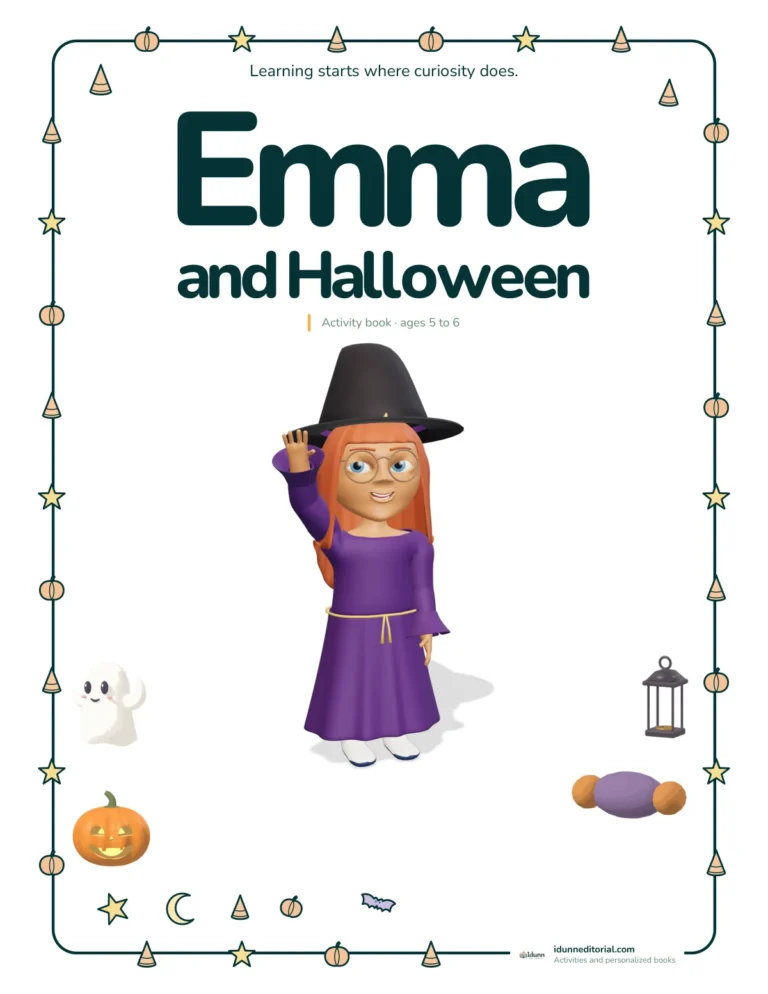
Personalized Halloween activity book
Their character in costume, with their name on the cover
US$5.99
Personalize
Sources
- National Museum of Ireland, Traditions and customs of Halloween / Samhain/Religion-and-Calendar-Customs/Hallowe-en-Samhain). Museum reference for Irish traditions.
- Pliny the Younger, Letters of Pliny, translated by William Melmoth, revised by F. C. T. Bosanquet, letter to Sura (LXXXIII in this selection; VII.27 in the complete collection). Primary text in English.
- Barry Markovsky, Are ghosts real?, University of South Carolina / The Conversation, 2023. A researcher’s explanation of evidence assessment.
- Shane McCorristine, Why ghosts wear clothes or white sheets, Newcastle University / The Conversation, 2024. Specialist historical interpretation.
- Rae Alexandra, Why Ghosts Wear White Sheets, KQED, 2021. Cultural reporting on stage and photographic representations.
- Ruth Edna Kelley, The Book of Hallowe’en, Boston, Lothrop, Lee & Shepard, 1919, Chapter XVII, p. 155. Contemporary testimony about parties.
- Anne Curzan and Rebecca Hector, TWTS: The cow goes … boo?, Michigan Public, 2023. Linguistic explanation drawing on the OED.
- Oscar Wilde, The Canterville Ghost, illustrated by Wallace Goldsmith, John W. Luce and Company, 1906, Chapters II and V; first published in 1887, as recorded in Methuen’s publication history. Primary literary text.
- Charles Dickens, A Christmas Carol, 1843, illustrated by John Leech. Primary literary text, especially Stave One for Marley.
- Mexico’s SEP, “La leyenda como tradición oral”, 2025; Santiago Tourism, Buscando a Santa Compaña. Institutional descriptions of local traditions.
- OCU, Halloween makeup and costume recommendations, 2025, in Spanish. Consumer guidance, including the under-three precaution.
- FDA, Halloween safety tips and Novelty Makeup. Official health-regulator guidance.
- American Academy of Pediatrics, Halloween safety tips. Pediatric guidance on costumes and outings.
- Veracruz Health Secretariat, Cofepris cosmetics guidance, 2026, in Spanish. Mexican public-health recommendations.
- Francis Mershman, All Souls’ Day, The Catholic Encyclopedia, 1907. Historical Catholic reference for the calendar.
Leave a Reply