

A black shirt, a sheet of construction paper and the kitchen broom are waiting on the table. Put them together and a witch starts to appear. The hat is still flat, but your child already knows who they’ll be in the classroom costume parade. How did so few things become so easy to recognize?
The Halloween witch brings together images from different centuries: broomstick flight appears in a fifteenth-century manuscript, the pointy hat has a disputed origin, and a 1939 movie popularized green skin. Postcards and movies gathered those features into a familiar costume. The timeline follows how the pieces came together.
Jump to: the hat · the broom · the black cat · are witches real? · costume and makeup.
Where do Halloween witches come from?
They come from a mixture of European witchcraft imagery, fairy tales and entertainment. The witch hanging in an October window collected her accessories over time. One medieval picture already shows broomstick flight, though the women wear the ordinary clothes of their day.
The Museum of Witchcraft and Magic describes that illustration in a manuscript of Le Champion des Dames, made around 1451. Several centuries stand between those figures and a green construction-paper witch:
| Date | What happened |
|---|---|
| Around 1451 | Two women fly, one on a broom and one on a stick, in Martin Le Franc’s manuscript. |
| 1486–1487 | The Malleus Maleficarum appears: a treatise against witchcraft that helped spread persecutory ideas. 2 |
| 1565 | A print after Pieter Bruegel shows a witch riding a broom up a chimney. 3 |
| 1692 | The Salem trials turn accusations of witchcraft into sentences against real people. 11 |
| 1900 | Baum publishes The Wonderful Wizard of Oz, with witches who help and witches who harm. |
| Around 1900–1910 | Julius Bien & Co.’s postcard The witch combines a witch with a Halloween greeting. The NYPL holds this example of the character becoming a festive decoration. 4 |
| 1939 | MGM’s The Wizard of Oz brings a green-skinned Wicked Witch of the West to movie audiences. 8 |
The holiday has its own story, told in where Halloween came from. The witch joined the classic Halloween monsters alongside characters from other books and movies.
Why do witches wear pointy hats?
The hat has several proposed origins. Tall hats and cone-shaped headdresses existed in real clothing before the black pointy hat became a witch’s calling card. The open question is how those earlier clothes became the costume we know.
Historian Laura Kounine, interviewed by BBC Mundo about the pointy hat, challenges a popular account: that medieval women who brewed beer supplied the witch’s hat, cauldron and broom. Those things belonged to other people’s everyday lives, too.
| People say… | What we know |
|---|---|
| The hat comes straight from old-fashioned clothing. | Tall and conical headwear existed; the specific route to the witch’s hat remains debated. |
| The Inquisition invented it with the capirote or coroza. | Headwear imposed on punished people belongs to that history of public humiliation. The resemblance is a possible connection, rather than a settled single origin. |
| Alewives wore it so customers could spot them at the market. | Kounine questions making this story the explanation for the whole witch image. 6 |
For a costume, the point and wide brim do most of the work. A paper star or purple ribbon can make the hat your child’s own.
Why do witches ride brooms?
Broomstick flight has been part of European witch imagery for centuries. The manuscript from around 1451 gives the association a concrete date, and later prints repeat it. 1 3
Writer Mari Ellis Dunning offers one interpretation: an object associated with women’s housework becomes a way to leave the house and fly. That reading connects the symbol to the domestic roles women were expected to fill. 7
You can explain the playful part to your child: something made for sweeping the floor ends up traveling through the sky. Stories transform familiar things. They also turn a figure from a field into the scarecrow we see at Halloween.
Why are witches green?
The familiar green comes from the movies. MGM’s The Wizard of Oz, released in 1939, popularized the green-skinned Wicked Witch of the West, played by Margaret Hamilton. The Salem Witch Museum explains how the movie differs from the 1900 book: W. W. Denslow’s illustrations gave her a different appearance.
Witches in other stories can have any skin color. Green is an option for dressing up. A hat and a broom already carry the character, with your child’s face just as it is.
Why do witches have black cats?
Cats became associated with witchcraft as supposed familiars: animals believed to help a witch. Historical accusations also named dogs, toads and other creatures. Halloween’s black cat draws on that association and on superstitions about black fur. 7
Is a black cat crossing your path bad luck? That belief changes from place to place. Cats Protection describes traditions in the United Kingdom and Japan that associate black cats with good luck. The same animal can mean opposite things depending on who tells the story. 9
If your child worries about a neighbor’s cat, you can keep the answer simple: the cat is black, and that’s all; the luck part is just a saying. It deserves the same love as any other cat. A stuffed animal makes a good costume companion.
Are witches real?
The storybook kind, with flying brooms and spells, lives in fiction: nobody has ever shown those powers to be real. But people who call themselves witches, or practice traditions with that name, are real. So were the thousands of people accused and punished for witchcraft.
The persecution had real victims. The University of Edinburgh’s research team cited an estimate of about 60,000 executions for witchcraft in Europe in its 2003 FAQ. That approximate number covers different countries and several centuries. Women and men were caught in the persecutions. 10
In Salem in 1692, nineteen people were hanged. Giles Corey died after being pressed with stones, and others died in prison. The Peabody Essex Museum tells the story of those trials through documents and the lives of the accused. At home, you can explain that people were punished over claims of powers nobody had proved.
Salem today also has a living community of people who identify as witches, as the museum explains. Their practices and beliefs belong to the present. Wearing a Halloween costume and following a spiritual tradition are different activities; a pointy hat tells you very little about someone’s beliefs. 11
In Scotland, the Witchcraft Act of 1563 remained in force until 1736. The University of Edinburgh’s Survey of Scottish Witchcraft records 3,837 accusation cases for that period, including entries for unnamed people or groups. These are accusations, not executions, and the surviving records are incomplete. It gives a sense of how widely suspicion could spread through communities. 10
Famous witches in fairy tales
Storybook witches can threaten, set a challenge or help someone along. These three reading choices show how much the character can change:
- Baba Yaga. In Russian fairy tales, she lives in a hut on chicken legs and can also help a hero find the way forward. That extraordinary house makes her recognizable before she says a word. 16
- **The witch in Hansel and Gretel.** The Brothers Grimm place her in an edible house that draws two hungry children inside. Gretel finds a way to free her brother. The danger and ending are intense, so choose a reading moment that fits the kinds of stories your child enjoys. 17
- The witches of Oz. L. Frank Baum’s 1900 novel includes the Witch of the West, the kind Witch of the North and Glinda. The familiar green skin belongs to the later movie image. Reading the book gives you other ways to picture the people of Oz. 5 8
After reading, ask what gave the witch away: her house, her hat or the way she spoke? The costume starts to have a story behind it.
Make it at home: a witch costume and makeup for kids
Start with dark clothes, a paper hat and a paper broom. Allow roughly 45–60 minutes, plus the drying time on your adhesive’s label. Your child chooses colors and decorates; an adult cuts, fastens and checks the fit.
Before you start: skin, movement and visibility
Use cosmetic face paint labeled for your child’s age and intended use. Acrylic craft paint and markers stay off skin. Following FDA guidance, test a small amount on the forearm two days ahead; skip any product that causes a reaction. Keep paint away from eyes, lips and mucous membranes, especially with younger children. Spain’s consumer organization OCU recommends avoiding makeup for children under three. 18 19
The hat should leave your child able to see and breathe freely. Keep hems short enough for walking, avoid ties around the neck, and keep small pieces away from children under three. Skip long or pointed props. Have your child walk and sit in the costume before heading out. Use battery lights, keep paper and fabric away from flames, and add reflective material for nighttime trick-or-treating. 18 20
Materials: black cardstock or craft foam, tape, glue suitable for your materials, scissors, a pencil, light black fabric or tulle, comfortable clothes and tissue-paper strips. Use a short cardboard tube for the broom; save a smooth wooden handle for a stationary decoration with adult supervision.
Hat, cape and broom
- Make the cone. An adult rolls a large sheet of cardstock into a cone and checks the opening against the child’s head. Adjust for a comfortable fit, mark the overlap and glue. Your child can decorate the paper before you close it.
- Add the brim. Mark a level base around the cone. Leave a strip about an inch below it, cut that strip into tabs and fold them outward. Trace the cone’s opening on another sheet, draw a wider circle around it and cut out the ring. Glue the tabs onto the brim, cover the inside edges with tape and check the fit again.
- Choose a cape or skirt. Attach a light piece of fabric to the clothing at the shoulders with hook-and-loop fasteners, away from the neck. For a skirt, tie tulle strips around an elastic waistband. An adult secures the waistband and checks the hem.
- Build the broom. Tape soft paper strips around one end of the short tube and cover the join with a cardstock band. Carry this lightweight version for walking. A broom made with branches and a wooden handle can stay by the door as decoration.
Print the hat template and decorate it before assembling:
The Halloween printables can bring more drawing to your costume-making afternoon.
Easy witch makeup in five steps
- Get ready. Wash your hands and use a clean sponge or brush on clean, dry skin. Keep the label and the recommended remover nearby.
- Add a little green. If your child wants it, dab a small patch on each cheek, away from the eyes. The rest of the face can stay bare.
- Paint a web. On one cheek, draw three short lines from a single point and connect them with little curves. Use black cosmetic face paint and a fine brush.
- Add color. A few purple dots beside the web are enough. Skip loose glitter and glued-on decorations that could come off.
- Check and remove. Ask whether everything feels comfortable. Remove the makeup if itching or redness appears. Take it off as the label directs when the activity ends, before bedtime. 19
To read aloud (ages 4–8)
We recognize a witch by her hat and broom. Stories and movies brought those things together over a long time. In a story, a witch can fly; our broom is for sweeping or playing. And a black cat is a cat: it needs food, rest and kindness, just like other cats.
For the classroom
Set out a paper hat, a broom and a stuffed cat. Which one helps you recognize a witch, and what would you change to make a different costume? Children can answer by pointing, drawing or talking.
Frequently asked questions
Can boys dress up as witches?
Yes. Any child can choose the character they want to play. The hat, broom and colors can follow their ideas.
What fabric works for a witch cape?
Choose light, soft black fabric that you can wash. Check the hem with shoes on, follow the manufacturer’s fire-safety information and keep all fabric away from flames.
Does witch makeup have to cover the whole face?
A small cheek design works, and the costume also works without makeup. The hat already helps people recognize the character.
For another character with a story tucked into the costume, follow where vampires came from.
Halloween activity books and printables
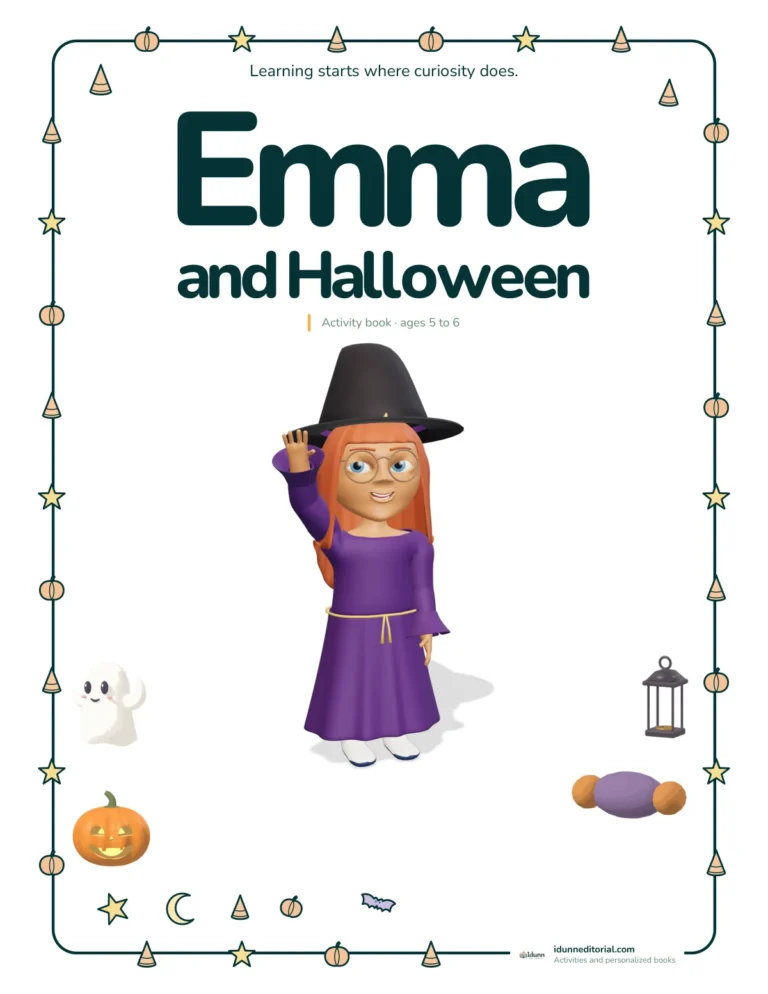
Personalized Halloween activity book
Their character in costume, with their name on the cover
US$5.99
Personalize
Sources
- Museum of Witchcraft and Magic, Le Champion des Dames. Catalog description of a manuscript reproduction, around 1451.
- Christopher S. Mackay, Malleus Maleficarum, vol. II, Cambridge University Press, 2006. Front matter to a scholarly translation.
- British Museum, “Prints of darkness”, 2018. Museum commentary on the 1565 print.
- NYPL, The witch, Julius Bien & Co., around 1900–1910. Historical postcard catalog.
- L. Frank Baum, The Wonderful Wizard of Oz, illustrated by W. W. Denslow, George M. Hill, 1900. Primary literary text.
- Scarlett Harris, article on the origins of the witch’s pointy hat, BBC Mundo, November 22, 2025, in Spanish. Reporting with specialist interviews.
- Mari Ellis Dunning, “Black hats, cauldrons and broomsticks”, Aberystwyth University / The Conversation, October 14, 2025. Interpretation of witch imagery.
- Salem Witch Museum, The Wonderful Wizard of Oz First Edition, May 2019. Museum release comparing book and film.
- Cats Protection, “If a black cat crosses your path…”. Cultural-superstition overview from a cat-welfare charity.
- Julian Goodare and colleagues, Survey of Scottish Witchcraft, FAQ, University of Edinburgh, 2003. Academic history project, with estimates and record limitations.
- Peabody Essex Museum, The Salem Witch Trials of 1692. Museum history grounded in trial documents.
- W. R. S. Ralston, Russian Fairy Tales, Hurst & Co., undated, pp. 135 and 147. Primary English collection drawing on Afanasyev and other collectors. Parallel example: A. N. Afanasyev, Cuentos populares rusos, Calpe, 1922, pp. 23–24.
- Jacob and Wilhelm Grimm, “Hansel and Gretel,” Grimms’ Fairy Tales, translations by Edgar Taylor and Marian Edwardes. Primary tale in English, Project Gutenberg.
- OCU, Halloween costume and makeup recommendations, October 28, 2025, in Spanish. Consumer guidance, including the under-three precaution.
- FDA, Novelty Makeup. U.S. health regulator’s guidance.
- American Academy of Pediatrics, Halloween Fun & Safety Tips for Kids of All Ages, September 29, 2026. Pediatric safety recommendations.
Leave a Reply