

The costume parade is moving around the classroom, except for one child taking wonderfully slow steps. A minute ago, getting those shoes on was urgent. Now each foot needs a whole conversation before it moves. Your child is trying out a zombie walk. Where did that strange shuffle come from?
Zombies come from Haitian traditions with African roots and a history tied to slavery and Haitian Vodou. Movies later turned them into the walking dead who chase people. Those creatures belong to fiction; for a Halloween costume, old clothes and a little optional face paint are enough to play the part.
Jump to: Origins in Haiti · Are they real? · The walk and the brains · Green skin · DIY costume · Easy makeup.
Where did zombies come from?
The familiar zombie took shape in Haiti, in beliefs about death, the soul and losing one’s freedom. It reached movie screens much later and joined the Halloween monsters and characters your child recognizes. Following its story means traveling from the Caribbean to the movies.
The Zombis exhibition at the musée du quai Branly–Jacques Chirac traced that history through African, Caribbean and Catholic traditions during the trafficking of enslaved people. Its curators included Haitian ethnologist Lilas Desquiron and Erol Josué, a Vodou priest and director of Haiti’s Bureau national d’ethnologie.
In stories about zombies controlled by a master, a person loses the ability to choose and is forced to work. That image carries the painful history of slavery: someone could imagine being denied freedom even after death. Film critic Kelli Weston explores that connection in an essay for Museum of the Moving Image. 2
What is Haitian Vodou? It is a living religion that brings together traditions of African origin and elements of Catholicism. Songs, ceremonies and relationships with spirits called lwa are part of its practice. Religion scholar Terry Rey describes that community life in Zombie Apocalypse. A horror movie transforms a small part of a much larger religious world. 3
Who invented zombies?
The figure grew out of shared beliefs, and writers and filmmakers changed what audiences pictured when they heard its name. William Seabrook helped spread Haitian zombie stories among U.S. readers in The Magic Island (1929). Zora Neale Hurston researched Haitian traditions and wrote about them in Tell My Horse (1938). 2 4
Hurston was a novelist and anthropologist. Her book includes zombie accounts and her encounter with a woman believed to be one. It records what people told her and what she thought she saw. Someone described as a zombie by people around them remains a person whose life deserves care.
| Year | What changed |
|---|---|
| 1929 | Seabrook published The Magic Island, bringing Haitian stories to a wide U.S. readership. 2 |
| 1932 | Victor Halperin’s White Zombie, starring Bela Lugosi, portrayed workers controlled by a master. 5 |
| 1938 | Hurston published Tell My Horse, drawing on her research in Jamaica and Haiti. 4 |
| 1968 | George A. Romero’s Night of the Living Dead helped establish the modern zombie that attacks the living. 6 |
| 1985 | Dan O’Bannon’s The Return of the Living Dead put brains on its zombies’ menu. 5 |
These horror films explain pieces of the costume; their stories are for older audiences. You can talk with a young child about the dates and what changed without showing the movies. The holiday has a separate history, told in where Halloween came from.
Are zombies real?
The walking dead who get up and chase people belong to movies. Haitian zombie beliefs and stories are real cultural traditions, and real people have been called zombies. Researchers have tried to understand what happened to people given that name. 4 7
In 1983, ethnobotanist Wade Davis proposed that certain poisons might explain cases of apparent death followed by a person’s subjugation. His hypothesis included tetrodotoxin, a toxic substance found in some fish. It sparked an academic controversy examined by David Inglis in 2010. The explanation remains disputed; calling someone a zombie does not establish that they returned from death. 7 8
If your child asks whether zombies live in your neighborhood, you can answer plainly: “The ones in movies are made-up characters. People tell other stories about them, and we can learn where those stories come from.” If a video has become upsetting, you can close it and return to the costume game at hand.
Stories that travel without a source
| People say… | What we know |
|---|---|
| A poison proved that dead people can come back. | Davis proposed an explanation involving apparent death; that hypothesis drew criticism. 7 8 |
| The Haitian zombie always ate brains. | The enslaved figure and the brain-seeking movie monster belong to different stories. 2 5 |
| Romero also invented the appetite for brains. | O’Bannon’s The Return of the Living Dead is known for that particular craving. 5 |
Why do zombies walk slowly and eat brains?
The slow walk and the appetite for brains come from different movies. Romero made the slowly approaching walking dead widely recognizable; brains became a calling card of The Return of the Living Dead, released in 1985. 5 6
The shuffle had earlier screen appearances. Writing for the BFI, film historian Jon Towlson points to the slowly moving figures in Zombies of Mora-Tau (1957) and the zombie shuffle in Invisible Invaders (1959). Romero gave earlier ideas a new force in Night of the Living Dead. 6
A slow character gives us time to watch it approach. At home, that same device can be funny: your child takes three elaborate steps to reach a shoe right beside them. For the costume game, feet can lift clear of the floor and arms can stay loose. The character still comes across.
Brains took a different route. The British Film Institute describes O’Bannon’s zombies as creatures that can talk, run and reason, as well as seek brains. Even within the movies, the rules change. A zombie can shuffle or sprint, speak or groan, depending on who tells the story.
The vampires in books and movies change between stories, too. Your child can choose a walk or a voice for their own character without copying a scene that feels too frightening.
Why are zombies green?
Green is a makeup choice that gives the character a fantastical appearance. Face-paint maker Snazaroo, for example, starts one zombie design with a green base. Other zombie images use pale skin, gray or different colors. 9
For a child’s costume, choose soft green or gray and leave much of the face bare. A little color on the cheeks, ragged clothing and tousled hair give your child plenty to work with. Try both color combinations on a drawing first and let them choose.
Color alone could suggest another monster. Clothing and movement finish the zombie: a ragged T-shirt gives a different impression from a stiff jacket and cardboard neck bolts.
How can you make a DIY zombie costume with old clothes?
An old T-shirt you can cut, comfortable pants and tousled hair make a simple zombie costume. For a classroom costume parade or a night of trick-or-treating, get the clothes ready first and leave face paint until last, if your child wants it.
Before you start: skin, eyes and movement
Use cosmetic face paint labeled for your child’s age, following its directions. Keep acrylic craft paint and markers on paper. The FDA recommends testing makeup on the arm 24–48 hours ahead. Skip anything that causes irritation. Spain’s consumer organization OCU advises avoiding makeup for children under three. 10
Keep all paint well away from young children’s eyes. For older children, a shadowed-eye effect requires a cosmetic specifically labeled for that area: follow the label and leave eyelids and lash lines bare. Keep lips, nostrils and the mouth clear. This costume uses gentle shading and color, without wounds or blood.
Check that your child can see and breathe freely. Choose well-fitting clothes, hems clear of the feet and comfortable shoes; avoid long hanging strips, cords and small loose pieces. Keep everything away from candles and flames, and add reflective material for nighttime outings. Leave your child’s eyes as they are: decorative contact lenses require professional eye care. 10 11 13
Materials: a clean old T-shirt, comfortable pants, a piece of cardboard to slip inside the shirt, adult-use scissors and optional gray or brown fabric paint. Have a comb ready for the hair. Allow roughly 20–30 minutes, plus any drying time specified on the paint label.
Make the clothes, step by step
- Your child picks the shirt. Make sure it is something you can alter. Try it on with the pants and shoes before cutting.
- You cut a few ragged edges. Take the shirt off first. Cut small uneven sections from the hem and sleeve ends, keeping the neckline and seams intact. Avoid long fringe that could catch on things.
- Your child chooses where the smudges go. Lay the shirt flat and slide cardboard inside to protect the back. Sponge a few patches of fabric paint onto it, following the product’s age guidance and directions. Paint the shirt while it is off the body.
- You let it dry and check it. Follow the label’s drying and setting instructions. You can also leave out the smudges; ragged edges already suggest the character.
- Your child tests the costume. Walk, sit, raise both arms and bend down to pick something up. Adjust anything that catches or gets in the way, then tousle the hair with a comb.
The pants can stay whole. A long-sleeved shirt underneath adds a layer for chilly weather. After the parade, the Halloween printables offer a quieter way to keep playing with colors on paper.
How can you do easy green or gray zombie makeup?
Simple zombie makeup uses a little green or gray on the cheeks and soft shading on the cheekbones. Allow about ten minutes, in addition to the skin test 24–48 hours beforehand. Two small patches can be the finished design if your child would rather get back to playing.
Materials: soft green or gray, white and purple face cosmetics; a clean sponge and brush, water if the label calls for it and the recommended remover. Follow the skin and eye precautions before opening the paints.
- You get ready. Wash your hands and start with clean, dry skin. Your child chooses a color and sees where the patches will go.
- You dab on the base. Sponge green or gray lightly onto the cheeks and, if wanted, the middle of the forehead. Keep clear of eyes, nostrils and mouth.
- You add shadows. Blend a little purple along the outer cheekbones. For younger children, keep all shading there, well away from the eyes.
- You decide together about shadowed eyes. For older children only, use a product labeled for that area to add a faint shadow along the bone beneath the eye. Leave a generous gap from the lash line. Skip this step if your child moves around or rubs their face.
- Your child checks the result. Add a small white highlight to each cheekbone if wanted, or stop there. Remove the paint if itching or redness appears.
- You take it off when the fun is over. Follow the label, use a gentle touch and remove it before bedtime. The FDA notes that leaving makeup on too long can irritate skin. 12
For a smaller design, keep only the green cheek patches. The clothes and the walk can carry the rest. On a day when your child wants a clean face, the makeup can stay on the drawing.
To read aloud (ages 4–8)
Zombie stories come from Haiti, a country in the Caribbean. In some stories, someone took people’s freedom away and forced them to work. Later, movies invented zombies that walked slowly and others that asked for brains. Movie zombies are fictional characters. With an old T-shirt, you can try moving like one, then stop whenever you want.
For the classroom
A question can explore how a gesture changes a character: What could someone wearing the same T-shirt do to look like a zombie, a scarecrow or a person who just woke up? Children can answer with a pose, drawing or words, without chasing or frightening anyone.
If you discuss Haiti, explain slavery in a concrete sentence: people were denied their freedom and forced to work. Then return to how movies changed the character. Keep the costume activity focused on clothing and movement.
Frequently asked questions
Are zombies and mummies the same thing?
They have different histories. Real mummies are preserved human remains; some movie stories imagine them waking up. 15 Zombies have Haitian roots and a long history of changes on screen. Bandages usually signal a mummy costume, while ragged clothes and a slow walk suggest a zombie.
How can you make a zombie costume without cutting clothes?
Wear an old T-shirt untucked, with the hem a little crooked, and tousle the hair. Add small green cheek patches if your child wants makeup and is old enough to use it. For a doll-sized costume, draw ragged edges on a paper shirt instead.
Why is it sometimes spelled “zombi”?
Zombi is the adapted Spanish spelling, with zombis as its plural. English generally uses zombie and zombies. A child reading in both languages may meet both spellings while learning about the same character. 14
If your child has another costume question ready, explore Halloween ghosts and their white sheets together.
Halloween activity books and printables
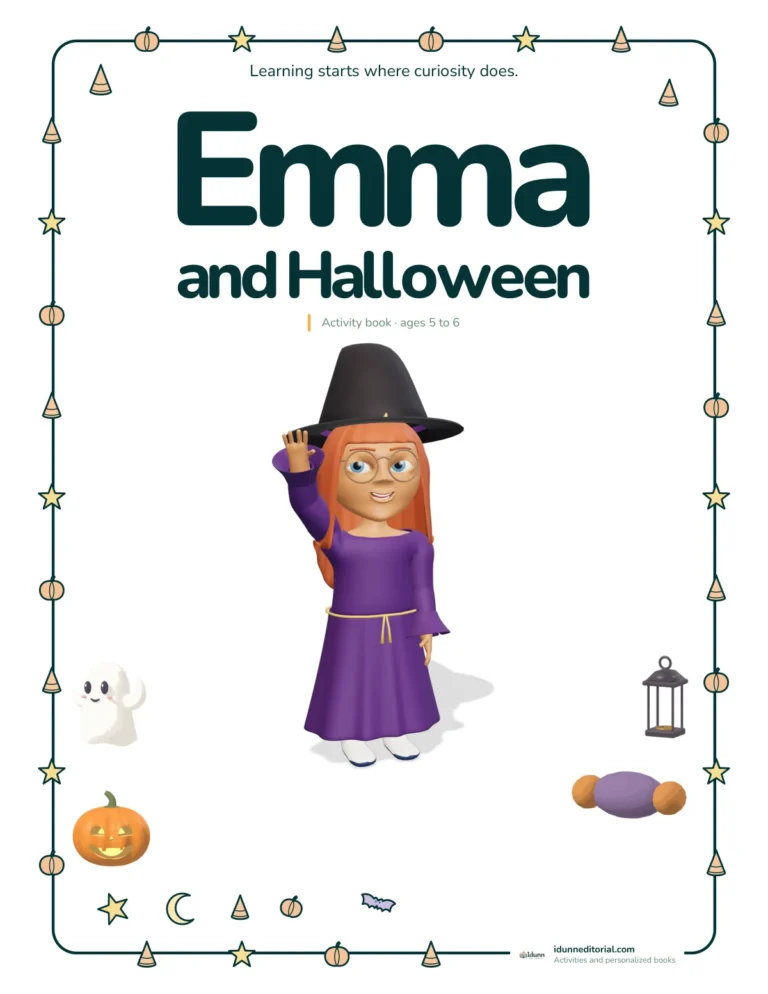
Personalized Halloween activity book
Their character in costume, with their name on the cover
US$5.99
Personalize

Sources
- **Musée du quai Branly–Jacques Chirac, Zombis. La mort n’est pas une fin ?, 2024–2025.** Museum exhibition involving Haitian specialists; cultural context, in French.
- Kelli Weston, “Grave Legacies: The Racialized Origins of the Zombie Myth”, Museum of the Moving Image, 2022. Film criticism addressing slavery, racism and representation.
- **Terry Rey, “What is Vodou?”, Chapter 6 of Zombie Apocalypse: Holy Land, Haiti, Hollywood, North Broad Press, 2024.** Academic account by a scholar of African and African diasporic religions.
- Terry Rey, “How Did Zombies Wind Up in America?”, Chapter 9 of the same book. Scholarly discussion of Zora Neale Hurston’s Tell My Horse (J. B. Lippincott, 1938), particularly Chapter XIII. Her account records beliefs and her own interpretation.
- Anton Bitel, “10 great zombie films”, British Film Institute, 2022. Institutional film history and criticism for White Zombie (1932) and The Return of the Living Dead (1985). The American Film Institute catalog also documents the latter film’s date and appetite for brains.
- Jon Towlson, “Why Night of the Living Dead was a big-bang moment for horror movies”, BFI, 2018. Historical analysis of Romero and earlier movie zombies.
- **E. Wade Davis, “The ethnobiology of the Haitian zombi,” Journal of Ethnopharmacology, 9.1 (1983), pp. 85–104, DOI90029-6).** Library of Congress annotation. A disputed ethnopharmacological hypothesis.
- **David Inglis, “The Zombie from Myth to Reality: Wade Davis, Academic Scandal and the Limits of the Real”, SCRIPTed, 7.2 (2010), DOI.** Scholarly article whose abstract documents the controversy surrounding Davis.
- Snazaroo, “Zombie Face Paint”. Manufacturer’s example of green zombie makeup.
- OCU, Halloween makeup and costume advice, October 28, 2025, in Spanish. Consumer organization’s age and accessory precautions.
- FDA, “Halloween Safety Tips: Costumes, Candy, and Colored Contact Lenses”. U.S. regulator’s guidance on skin testing, clothing and decorative lenses.
- **FDA, Novelty Makeup.** Official guidance on application areas and makeup removal.
- **American Academy of Pediatrics, Halloween Fun & Safety Tips for Kids of All Ages, 2026.** Pediatric recommendations on costume fit, visibility and safety.
- **Real Academia Española and ASALE, “zombi,” Diccionario de la lengua española.** Normative reference for the Spanish form. FundéuRAE explains the adaptation and plural in “zombi, sin e final, plural zombis”, 2016, in Spanish.
- Science Museum Group, “Egyptian mummy, Egypt, 343–69 BCE”. Museum catalog identifying human remains and explaining preservation.
Leave a Reply