In Mexico, on the night of November 1, candles are lit on home altars and a path of marigold petals is laid so the dead can find their way home. That same night in Poland, cemeteries fill with thousands of candles glowing on the graves. In Guatemala, giant kites of colored tissue paper rise over a cemetery. In Bolivia, families set tables with breads and offerings to welcome their dead. And the evening before, across half the world, kids in costume are ringing doorbells for candy.
How do so many places, so far apart, remember their dead on nearly the same day?
Because of a calendar. November 1, All Saints’ Day, was set by the popes in Rome in the eighth century, and November 2, All Souls’ Day, was added by the monks of Cluny, in France, around the year 1000. The Church carried that calendar everywhere it went, and everywhere it mixed with local customs. That’s why these holidays are cousins: they share a grandmother. There are others, in Asia and in ancient Rome, that look a lot alike and fall on other dates, because they were born on their own. Those are lookalikes. This is the story of both families.
Who put the dead in November?
Popes and monks, over four centuries. According to the Catholic Encyclopedia of 1907:
- In 609 or 610, Pope Boniface IV dedicated the Pantheon in Rome to all the martyrs, on May 13.
- Between 731 and 741, Pope Gregory III consecrated a chapel to all the saints and set their feast on November 1.
- Between 827 and 844, Pope Gregory IV extended that date to the whole Church.
- Around the year 1000, Saint Odilo, abbot of the monastery of Cluny, ordered that every year, the day after, all the faithful departed be remembered: November 2. From Cluny the custom spread to other monasteries and then to the whole Church.
That’s how the pair was set: the 1st for the saints, the 2nd for all the dead. And the night before the 1st, the eve, is the one English called All Hallows’ Even: Halloween.
How did that calendar reach Mexico?
With the Spanish conquest, in the sixteenth century. The Mexica (Aztecs) already honored their dead, but at a different time of year: two festivals in their calendar, the “little feast of the dead” and the “great feast of the dead,” fell toward the summer, between August and September, according to the magazine Arqueología Mexicana.
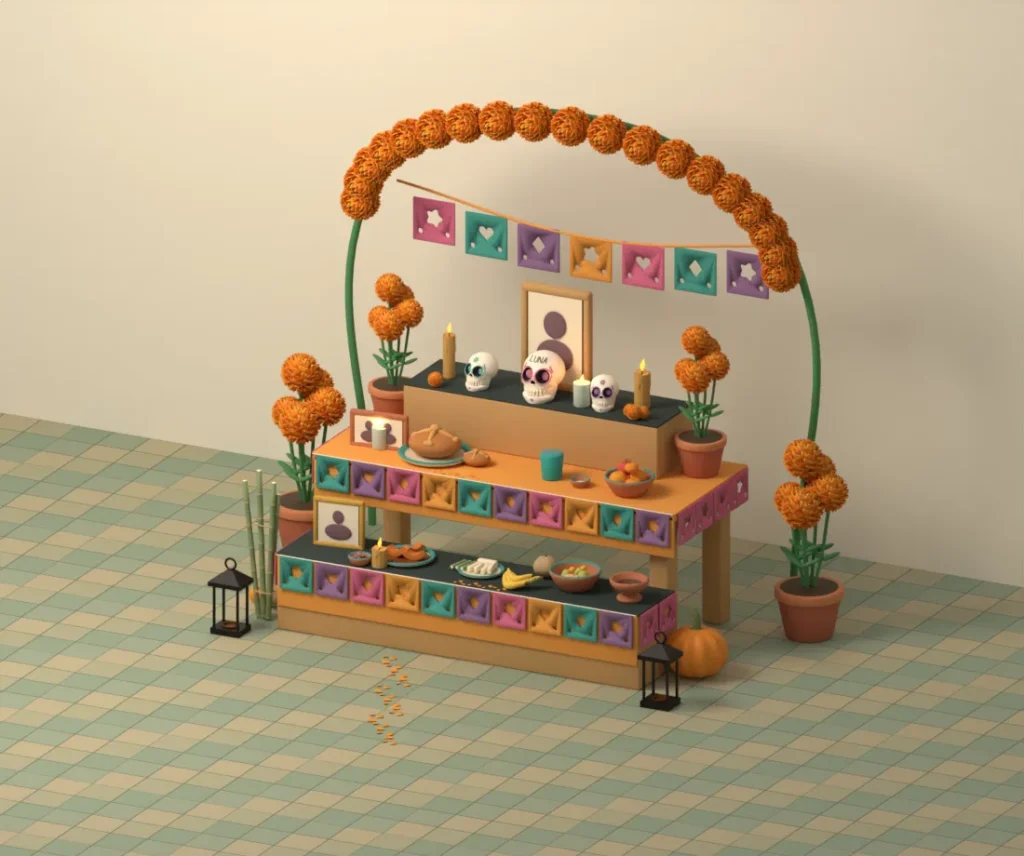
When the Catholic days of All Saints and All Souls arrived in November, the two traditions met. Out of that meeting, over the colonial period, came the Day of the Dead: a holiday that took shape on the Catholic calendar and, region by region, took in Indigenous practices. By the 1760s a friar in Mexico City saw an entire market of sugar figures made for those days, and people were already calling it the “Day of the Dead.”
UNESCO recognized it in 2008 as intangible cultural heritage, under a name worth saying in full: the Indigenous festivity dedicated to the dead.
And from Mexico it kept traveling: since the 1970s it has had a public life in the United States, starting with Chicano artists in Los Angeles and San Francisco. That chapter is in how Halloween came to North America.
Where else are the dead remembered on those days?
In almost every place the Catholic calendar reached. Each one dressed it in its own way:
| Where | When | How |
|---|---|---|
| Mexico | October 31 to November 2 | Ofrendas (home altars), marigolds, candles, visits to the graves |
| Guatemala (Sumpango and Santiago Sacatepéquez) | November 1 | Giant kites of tissue paper, months in the making, raised in the cemetery. UNESCO dates the tradition to the late nineteenth and early twentieth centuries |
| Bolivia and Peru | November 1 and 2 | Andean Todos Santos: tables of offerings to welcome the souls |
| La Paz, Bolivia | November 8 | The Fiesta de las Ñatitas: skulls cared for by families, carried to the cemetery with flowers and candles. It closes the season of the dead |
| Poland | November 1 and 2 | Mass visits to cemeteries, with thousands of candles on the graves |
| Philippines | November 1 and 2 | Undas: families visit and keep vigil over their dead in the cemeteries |
| Brazil | November 2 | Finados: visiting the graves |
| Ireland, Scotland, the United States, Canada and half the world | October 31 | Halloween, the eve, with customs of its own |
They’re all cousins: different on the outside, the same date on the inside.
And the ones on other dates?
Some peoples remember their dead with great tenderness, in festivals that look remarkably similar, at other times of the year. They never had anything to do with Rome or Cluny.
| Festival | Where | When | How |
|---|---|---|---|
| Obon | Japan | Summer (July or August) | Ancestors are welcomed home, people dance bon-odori and light lanterns |
| Ghost Festival | China and Chinese communities worldwide | Seventh month of the lunar calendar (August or September) | Offerings for ancestors and for wandering spirits with no family |
| Chuseok | Korea | Eighth lunar month (September or October) | A table of offerings for the ancestors |
| Pchum Ben | Cambodia | Fifteen days in a lunar month of September or October | Offerings to monks, to help the dead |
| Parentalia and Lemuria | Ancient Rome | February and May | Offerings at the tombs; and, in May, rites to drive spirits out of the house |
These are lookalikes: they resemble each other because nearly everywhere, people want to remember those who have gone, and each people found its own way. Although within this family there are cousins too: Japan’s Obon and China’s Ghost Festival share the same Buddhist root.
Does every culture honor the dead at the end of the harvest?
It’s often said. The idea of one great, universal festival of the dead at harvest’s end became very popular in the late nineteenth century, above all through the Scottish anthropologist James Frazer, who was looking for a single agricultural myth behind many customs.
What people who study it say today: it’s too easy a model. The folklorist Juliette Wood writes that Frazer and his speculations about a universal agrarian myth produced “an emotionally appealing, but far too glib a model” for explaining these customs. And the historian Ronald Hutton traces back to Frazer and John Rhys the idea that Samhain was “the feast of the dead.”
The dates make the point on their own: Obon is in summer, Parentalia in February, Lemuria in May, and Qingming, in China, in spring. What repeats is the wish to remember the dead. Each calendar sets the moment.
Cousins and lookalikes, in one table
| Family | Festivals | Why they’re alike |
|---|---|---|
| Cousins (Catholic calendar) | All Saints and All Souls, Halloween, Day of the Dead, Andean Todos Santos, Ñatitas, Guatemala’s kites, Undas, Finados, Poland’s November 1 | They share dates because they come from the same calendar, which the Church carried everywhere |
| Cousins of each other (Buddhist root) | Obon, Ghost Festival | A shared religious root, on another date |
| Lookalikes (born on their own) | Chuseok, Pchum Ben, Qingming, Parentalia, Lemuria | They look alike because many cultures remember their dead, each on its own |
For home or the classroom
How does your family remember the people who are gone? Ask your grandparents what their families did on these days, wherever they grew up: what went on the altar or the grave, what was cooked, who was remembered. Write it down or draw it. Every family has its own version of the holiday, and in a classroom in the United States or Canada, the answers usually come from several of the places in these tables.
Questions
Is the Day of the Dead the same as Halloween? They’re cousins: both lean on the calendar of All Saints and All Souls, and each took its own road. How they’re alike and how they differ is in Halloween vs. Day of the Dead.
Why is the Day of the Dead on November 1 and 2? Because those are the Catholic days of All Saints and All Souls, which arrived in Mexico with the Spanish conquest.
Which other countries celebrate the Day of the Dead? The Day of the Dead, with its ofrenda and marigolds, is Mexican, and today it’s also celebrated in many communities in the United States. On the same dates, Guatemala, Bolivia, Peru, the Philippines, Brazil and Poland remember their dead, each in its own way.
Sources
- Francis Mershman, “All Saints’ Day” and “All Souls’ Day,” The Catholic Encyclopedia, vol. 1, 1907. All Saints · All Souls.
- Stanley Brandes, “El Día de Muertos, el Halloween y la búsqueda de una identidad nacional mexicana,” Alteridades 10, no. 20, 2000, pp. 7–20. Open access on Redalyc (in Spanish).
- Arqueología Mexicana, “Miccailhuitontli y huey miccaílhuitl” (in Spanish).
- UNESCO, “Indigenous festivity dedicated to the dead”, inscribed 2008.
- UNESCO, “Technique of making the giant kites of Santiago Sacatepéquez and Sumpango, Guatemala,” 2024. Multimedia archive.
- Gerardo Fernández Juárez, “La revuelta de las ‘ñatitas’…,” Revista de Dialectología y Tradiciones Populares 65, no. 1, 2010, pp. 185–214. doi:10.3989/rdtp.2010.006 (open access, in Spanish).
- Óscar Muñoz Morán, “Todos los Santos: tradición y ayllu andino,” Chungara 49, no. 2, 2017. doi:10.4067/S0717-73562017005000013 (open access, in Spanish).
- Sławoj Tanaś, “The profane sphere of All Saints’ Day and the social aspects of cemeteries,” Turyzm/Tourism 30, no. 2, 2020, pp. 91–99. doi:10.18778/0867-5856.30.2.25
- Stephen F. Teiser, The Ghost Festival in Medieval China, Princeton University Press, 1988. doi:10.1515/9780691222172
- Deborah Wong, Louder and Faster, University of California Press, 2019, ch. “Dancing the Body Politic: Obon and Bon-odori.” doi:10.1525/luminos.71.d (open access).
- John C. Holt, “Caring for the Dead Ritually in Cambodia,” Southeast Asian Studies 1, no. 1, 2012, pp. 3–75. doi:10.20495/seas.1.1_3 (open access).
- J. M. C. Toynbee, Death and Burial in the Roman World, Thames & Hudson, 1971.
- Juliette Wood, “‘The Great Scarecrow in Days Long Ago’: Gothic Myths and Family Festivals,” 2007. PDF.
- Ronald Hutton, “The Celtic New Year and Feast of the Dead,” Folklore 135, no. 1, 2024, pp. 69–86. doi:10.1080/0015587X.2023.2282282.
Written by the Idunn Editorial Team, with support from AI tools in the research and drafting.
Leave a Reply